
[Paper Review] Towards Knowledge-driven Autonomous Driving
This paper surveys knowledge-driven autonomous driving, arguing limitations of data-driven systems and outlining a framework with dataset/benchmark, environment, and driver agent, powered by LLMs, world models, and neural rendering to achieve cognition, generalization, and life-long learning.
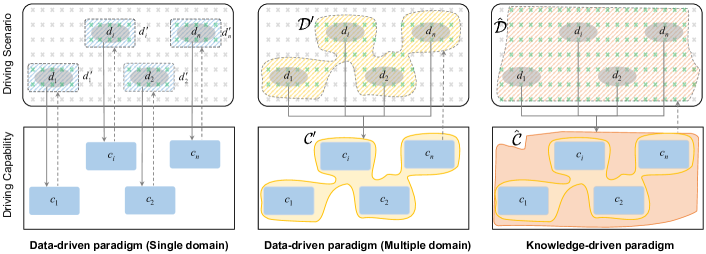
This paper explores the emerging knowledge-driven autonomous driving technologies. Our investigation highlights the limitations of current autonomous driving systems, in particular their sensitivity to data bias, difficulty in handling long-tail scenarios, and lack of interpretability. Conversely, knowledge-driven methods with the abilities of cognition, generalization and life-long learning emerge as a promising way to overcome these challenges. This paper delves into the essence of knowledge-driven autonomous driving and examines its core components: dataset \& benchmark, environment, and driver agent. By leveraging large language models, world models, neural rendering, and other advanced artificial intelligence techniques, these components collectively contribute to a more holistic, adaptive, and intelligent autonomous driving system. The paper systematically organizes and reviews previous research efforts in this area, and provides insights and guidance for future research and practical applications of autonomous driving. We will continually share the latest updates on cutting-edge developments in knowledge-driven autonomous driving along with the relevant valuable open-source resources at: \url{https://github.com/PJLab-ADG/awesome-knowledge-driven-AD}.
Motivation & Objective
- Highlight the limitations of data-driven autonomous driving (data bias, long-tail, lack of interpretability).
- Define the knowledge-driven paradigm and its three core components: dataset & benchmark, environment, and driver agent.
- Review existing research trends and propose knowledge-driven solutions using advanced AI techniques such as LLMs and world models.
- Discuss opportunities, challenges, and practical guidance for future research and applications in knowledge-driven autonomous driving.
Proposed method
- Provide a systematic review of knowledge-driven autonomous driving literature.
- Present a framework with three core components: Dataset & Benchmark, Environment, Driver Agent.
- Discuss enabling technologies including LLMs, world models, and neural rendering.
- Analyze the shift from perception to cognition and the implications for planning and control.
- Highlight the role of open-source resources and community-driven updates (GitHub link).

Experimental results
Research questions
- RQ1What constitutes a knowledge-driven autonomous driving system?
- RQ2How can datasets, environments, and driver agents be designed to enable knowledge-driven learning?
- RQ3What advantages does knowledge-driven driving offer over data-driven methods in generalization and interpretability?
- RQ4What are the main challenges and potential solutions for knowledge-driven autonomous driving?
Key findings
- Knowledge-driven methods aim to generalize across domains by incorporating human knowledge and common sense into driving representations.
- LLMs and world models enable reasoning, scene understanding, and future content prediction for driving scenarios.
- Neural rendering supports realistic, diverse environments and rare corner cases through closed-loop simulations.
- There is a trade-off between end-to-end and modular designs; knowledge-driven approaches seek interpretable, knowledge-grounded outputs.
- The paper points to valuable open-source resources and benchmarks that facilitate progress in knowledge-driven autonomous driving.
Read this paper
Open the full text in the Nubint reader and ask about any passage as you read.
Read this paper on NubintThis review was generated by AI from the original paper. Please check the paper before citing it.