
[Paper Review] Towards Mitigating Hallucination in Large Language Models via Self-Reflection
The paper analyzes hallucination in medical generative QA and proposes an interactive self-reflection loop to generate, evaluate, and refine background knowledge and answers, reducing hallucinations across multiple LLMs and datasets.
Large language models (LLMs) have shown promise for generative and knowledge-intensive tasks including question-answering (QA) tasks. However, the practical deployment still faces challenges, notably the issue of "hallucination", where models generate plausible-sounding but unfaithful or nonsensical information. This issue becomes particularly critical in the medical domain due to the uncommon professional concepts and potential social risks involved. This paper analyses the phenomenon of hallucination in medical generative QA systems using widely adopted LLMs and datasets. Our investigation centers on the identification and comprehension of common problematic answers, with a specific emphasis on hallucination. To tackle this challenge, we present an interactive self-reflection methodology that incorporates knowledge acquisition and answer generation. Through this feedback process, our approach steadily enhances the factuality, consistency, and entailment of the generated answers. Consequently, we harness the interactivity and multitasking ability of LLMs and produce progressively more precise and accurate answers. Experimental results on both automatic and human evaluation demonstrate the superiority of our approach in hallucination reduction compared to baselines.
Motivation & Objective
- Examine the prevalence and nature of hallucination in medical generative QA systems using multiple LLMs and medical QA datasets.
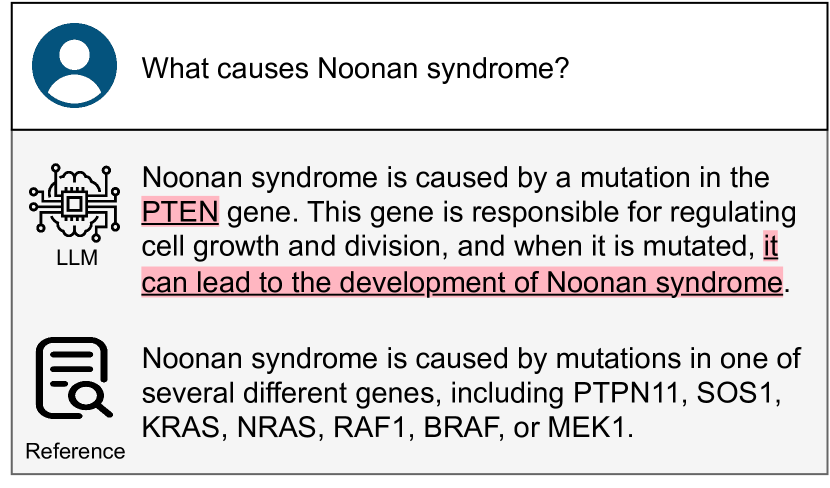
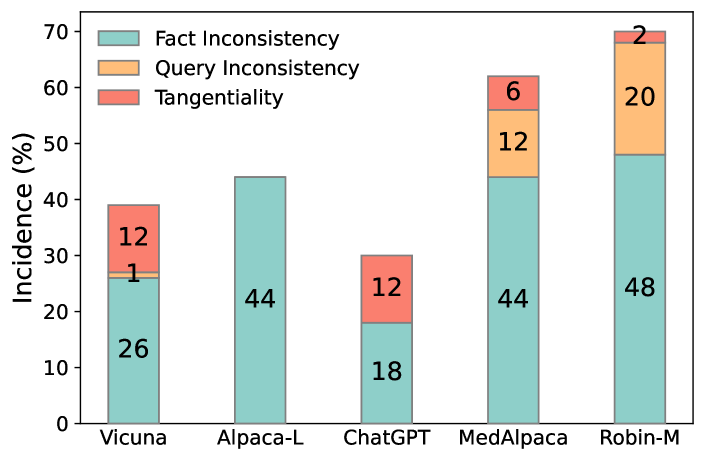
- Investigate causes of hallucination such as fact inconsistency, query inconsistency, and tangentiality in medical answers.
- Propose and evaluate a self-reflection workflow that iteratively generates, scores, and refines knowledge and answers to improve factual reliability.
- Assess generalizability and scalability of the approach across models with varying parameter counts (7B and 175B).
Proposed method
- Propose an iterative self-reflection pipeline with three loops: Factual Knowledge Acquiring, Knowledge-Consistent Answering, and Question-Entailment Answering.
- Use a generate-score-refine cycle where a factuality scorer assesses generated background knowledge and prompts refinement until factuality meets a threshold.
- Generate answers conditioned on refined knowledge, then assess consistency with background knowledge using CTRLEval, prompting refinement if needed.
- Incorporate an entailment evaluation between the answer and the question using sentence-level checks to ensure answerability.
- Evaluate both automatic metrics (MedNLI, CtrlEval, F1, ROUGE-L, etc.) and human judgments (query consistency, tangentiality, and fact consistency).
Experimental results
Research questions
- RQ1What is the incidence and nature of hallucination in medical GQA across general and medical-domain LLMs?
- RQ2Can an interactive self-reflection loop reduce hallucinations and improve factuality, consistency, and entailment in medical QA?
- RQ3How does the proposed method perform across models with different parameter counts and across multiple medical QA datasets?
- RQ4What are the contributions of refinement, aspect description, and explicit scoring to the effectiveness of the loop?
Key findings
- The self-reflection loop reduces query inconsistency, tangentiality, and fact inconsistency in generated medical QA replies compared with baselines.
- The approach improves MedNLI and related entailment and consistency metrics across multiple models and five medical datasets.
- Human evaluation shows reduced hallucinations and higher consistency with the provided knowledge when using the loop.
- Ablation studies indicate that refinement steps, explicit aspect descriptions, and scoring signals contribute to better factuality and alignment.
- The method demonstrates generalizability and scalability across 7B and 175B models in diverse medical QA tasks.
Read this paper
Open the full text in the Nubint reader and ask about any passage as you read.
Read this paper on NubintThis review was generated by AI from the original paper. Please check the paper before citing it.