
[Paper Review] Towards Open-Vocabulary Video Instance Segmentation
This paper introduces Open-Vocabulary Video Instance Segmentation (OV-VIS), a new task enabling end-to-end segmentation, tracking, and classification of objects from open-set categories, including novel ones. It proposes OV2Seg, a Memory-Induced Transformer model that uses class-independent queries and memory-augmented feature aggregation for robust, real-time inference, achieving strong zero-shot generalization on novel categories without fine-tuning.
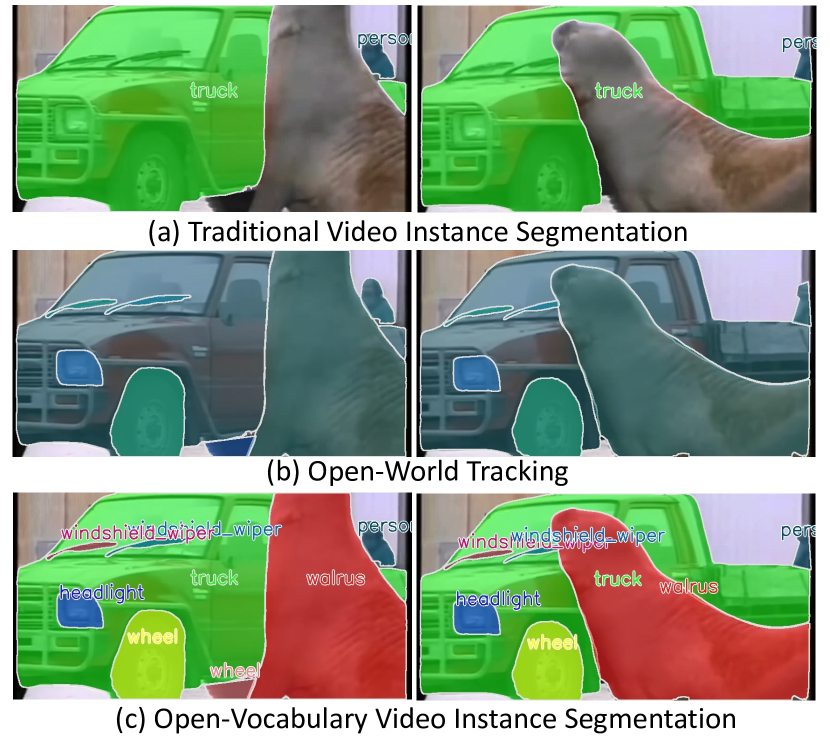
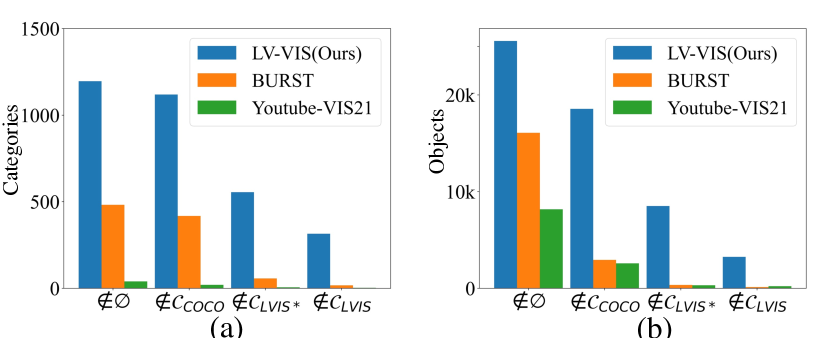
Video Instance Segmentation (VIS) aims at segmenting and categorizing objects in videos from a closed set of training categories, lacking the generalization ability to handle novel categories in real-world videos. To address this limitation, we make the following three contributions. First, we introduce the novel task of Open-Vocabulary Video Instance Segmentation, which aims to simultaneously segment, track, and classify objects in videos from open-set categories, including novel categories unseen during training. Second, to benchmark Open-Vocabulary VIS, we collect a Large-Vocabulary Video Instance Segmentation dataset (LV-VIS), that contains well-annotated objects from 1,196 diverse categories, significantly surpassing the category size of existing datasets by more than one order of magnitude. Third, we propose an efficient Memory-Induced Transformer architecture, OV2Seg, to first achieve Open-Vocabulary VIS in an end-to-end manner with near real-time inference speed. Extensive experiments on LV-VIS and four existing VIS datasets demonstrate the strong zero-shot generalization ability of OV2Seg on novel categories. The dataset and code are released here https://github.com/haochenheheda/LVVIS.
Motivation & Objective
- To address the limitation of traditional Video Instance Segmentation (VIS) in generalizing to novel object categories unseen during training.
- To propose a new benchmark task, Open-Vocabulary Video Instance Segmentation, enabling simultaneous segmentation, tracking, and classification of open-set categories.
- To collect and release LV-VIS, a large-scale video instance segmentation dataset with 1,196 diverse categories, significantly expanding existing datasets in category diversity and scale.
- To develop an end-to-end model, OV2Seg, capable of zero-shot generalization to novel categories with near real-time inference speed.
- To demonstrate strong zero-shot performance on novel categories across multiple benchmark datasets without fine-tuning.
Proposed method
- Proposes a novel task: Open-Vocabulary Video Instance Segmentation (OV-VIS), which unifies segmentation, tracking, and classification for both seen and novel categories.
- Introduces LV-VIS, a new dataset with 4,828 videos, 544k instance masks, and 1,196 diverse categories, surpassing existing datasets in category count and diversity.
- Designs OV2Seg, an end-to-end architecture using a Universal Object Proposal module for initial detection and segmentation.
- Employs Memory Queries to incrementally encode and track object features across frames, enabling long-term temporal awareness and robustness to occlusion.
- Uses a language transformer encoder to classify objects based on memory-augmented features, accepting arbitrary category names as input for zero-shot inference.
- Applies a memory update mechanism with learnable factors α and object confidence scores to stabilize feature aggregation and improve tracking accuracy.
Experimental results
Research questions
- RQ1Can video instance segmentation models generalize to novel object categories not seen during training?
- RQ2How can a unified framework simultaneously achieve segmentation, tracking, and classification in videos for open-set categories?
- RQ3What is the impact of memory-augmented feature aggregation on long-term tracking and zero-shot classification in videos?
- RQ4How does the proposed end-to-end architecture compare to pipeline-based methods in terms of accuracy and inference speed?
- RQ5To what extent can a model trained on a closed-set image dataset achieve strong zero-shot performance on diverse video instance segmentation benchmarks?
Key findings
- OV2Seg achieves 11.1 mAP n on Youtube-VIS2019 and 7.3 mAP n on Youtube-VIS2021 novel categories without any fine-tuning, outperforming Detic-OWTB by 6.6 and 1.5 mAP n respectively.
- On the OVIS dataset with severe occlusions, OV2Seg achieves 11.2 mAP, comparable to fully-supervised models like MaskTrack and FEELVOS.
- OV2Seg with class-independent queries achieves comparable accuracy to class-dependent queries but is two orders of magnitude faster, especially critical for large open-vocabulary settings.
- The memory update mechanism with α = 0.7 and object confidence scores yields the best performance, achieving 27.2 mAP on Youtube-VIS2019 and 14.2 mAP on LV-VIS validation.
- Memory Queries outperform simple averaging of per-frame classification scores by better handling motion blur and occlusion through confidence-weighted feature aggregation.
- OV2Seg successfully re-tracks objects after complete occlusion, as demonstrated in visualizations on the LV-VIS dataset.
Read this paper
Open the full text in the Nubint reader and ask about any passage as you read.
Read this paper on NubintThis review was generated by AI from the original paper. Please check the paper before citing it.