
[Paper Review] Towards Personalized Federated Learning via Heterogeneous Model Reassembly
This paper introduces pFedHR, a framework that enables personalized federated learning with heterogeneous client models by reassembling candidate models on the server and matching them to clients without leaking private data. It automatically generates diverse personalized candidates and mitigates public-data distribution issues through layer stitching and similarity-based selection.
This paper focuses on addressing the practical yet challenging problem of model heterogeneity in federated learning, where clients possess models with different network structures. To track this problem, we propose a novel framework called pFedHR, which leverages heterogeneous model reassembly to achieve personalized federated learning. In particular, we approach the problem of heterogeneous model personalization as a model-matching optimization task on the server side. Moreover, pFedHR automatically and dynamically generates informative and diverse personalized candidates with minimal human intervention. Furthermore, our proposed heterogeneous model reassembly technique mitigates the adverse impact introduced by using public data with different distributions from the client data to a certain extent. Experimental results demonstrate that pFedHR outperforms baselines on three datasets under both IID and Non-IID settings. Additionally, pFedHR effectively reduces the adverse impact of using different public data and dynamically generates diverse personalized models in an automated manner.
Motivation & Objective
- Address model heterogeneity in federated learning where clients have different network structures.
- Develop a server-side mechanism to generate and select personalized models without sharing private data.
- Reduce reliance on public data distributions and enhance personalization through heterogeneous model reassembly.
- Demonstrate superior performance over baselines under IID and Non-IID settings across multiple datasets.
Proposed method
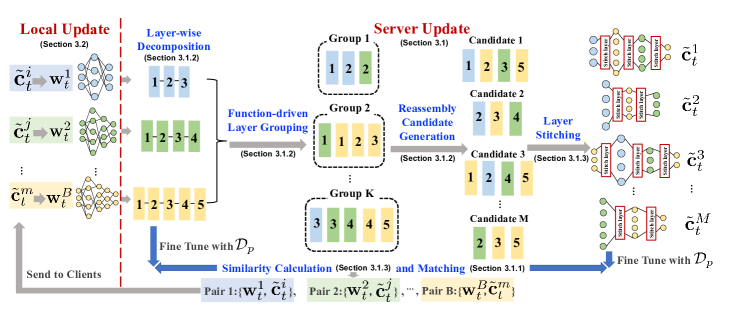
- Decompose each client model into layers and group layers by function using a CKA-based similarity metric.
- Generate M heterogeneous model candidates via a layer-wise decomposition, function-driven grouping, and reassembly with layer stitching.
- Compute similarity between each client model and stitched candidates using publicly available data and a cosine similarity of logits after finetuning.
- Select the best-matched candidate per client as the personalized model for that round, to be used as guidance in client-side learning via knowledge distillation.
- Fine-tune stitched candidates with a small number of epochs using public data to limit adverse effects; use labeled or unlabeled public data for guidance but avoid heavy parameter sharing.
- Client update uses knowledge distillation to integrate the personalized model into local training, preserving client data privacy.

Experimental results
Research questions
- RQ1Can heterogeneous client models be effectively personalized via server-side model reassembly without revealing private data?
- RQ2How can informative and diverse personalized model candidates be automatically generated and matched to clients in FL with heterogeneous architectures?
Key findings
- pFedHR achieves state-of-the-art performance on MNIST, SVHN, and CIFAR-10 under both IID and Non-IID settings in heterogeneous-model experiments.
- With labeled public data, pFedHR consistently outperforms baselines across all datasets and settings. For MNIST: 93.08% vs 93.27% (FedGH) and 94.55% (pFedHR); for SVHN: 81.55% (FedMD) vs 83.68% (pFedHR); for CIFAR-10: 68.22% (FedMD) vs 73.88% (pFedHR).
- With unlabeled public data, pFedHR remains competitive and often superior to baselines, e.g., MNIST 93.89% IID vs 93.01% (FedKEMF); SVHN 83.15% IID vs 82.03% (FCCL); CIFAR-10 69.38% IID vs 68.77% (FCCL).
- The framework maintains performance when the public data distribution differs from client data, showing robustness to public data sensitivity.
- Increasing the number of clusters K improves performance but requires balancing with the number of generated candidates M.
Read this paper
Open the full text in the Nubint reader and ask about any passage as you read.
Read this paper on NubintThis review was generated by AI from the original paper. Please check the paper before citing it.