
[论文解读] Towards physically consistent data-driven weather forecasting: Integrating data assimilation with equivariance-preserving deep spatial transformers
该论文通过整合三个组件,提出了一种物理一致的数据驱动天气预报框架:保持旋转和缩放对称性的等变性保留深度空间变换器,用于维持时空数据中的对称性;基于sigma点集合卡尔曼滤波器(SPEnKF)的数据同化方法,用于处理带噪声的观测数据;以及利用虚拟观测的多时间步算法。该框架将预报准确率提升了最高达45%,并实现了稳定的大规模集合生成(O(1000)),从而实现鲁棒的数据同化。
There is growing interest in data-driven weather prediction (DDWP), for example using convolutional neural networks such as U-NETs that are trained on data from models or reanalysis. Here, we propose 3 components to integrate with commonly used DDWP models in order to improve their physical consistency and forecast accuracy. These components are 1) a deep spatial transformer added to the latent space of the U-NETs to preserve a property called equivariance, which is related to correctly capturing rotations and scalings of features in spatio-temporal data, 2) a data-assimilation (DA) algorithm to ingest noisy observations and improve the initial conditions for next forecasts, and 3) a multi-time-step algorithm, which combines forecasts from DDWP models with different time steps through DA, improving the accuracy of forecasts at short intervals. To show the benefit/feasibility of each component, we use geopotential height at 500~hPa (Z500) from ERA5 reanalysis and examine the short-term forecast accuracy of specific setups of the DDWP framework. Results show that the equivariance-preserving networks (U-STNs) clearly outperform the U-NETs, for example improving the forecast skill by $45\%$. Using a sigma-point ensemble Kalman (SPEnKF) algorithm for DA and U-STN as the forward model, we show that stable, accurate DA cycles are achieved even with high observation noise. The DDWP+DA framework substantially benefits from large ($O(1000)$) ensembles that are inexpensively generated with the data-driven forward model in each DA cycle. The multi-time-step DDWP+DA framework also shows promises, e.g., it reduces the average error by factors of 2-3.
研究动机与目标
- 提升数据驱动天气预测(DDWP)模型的物理一致性和预报准确率。
- 解决物理无关神经网络在捕捉大气流中旋转和缩放等对称性方面的局限性。
- 通过从DDWP模型中廉价生成的大集合,实现稳定且准确的数据同化,以应对带噪声的观测。
- 通过使用虚拟观测的多时间步框架,提升短期预报的准确率。
- 开发一种灵活、模块化的框架,可扩展至其他地球系统组分,如海洋和陆面。
提出的方法
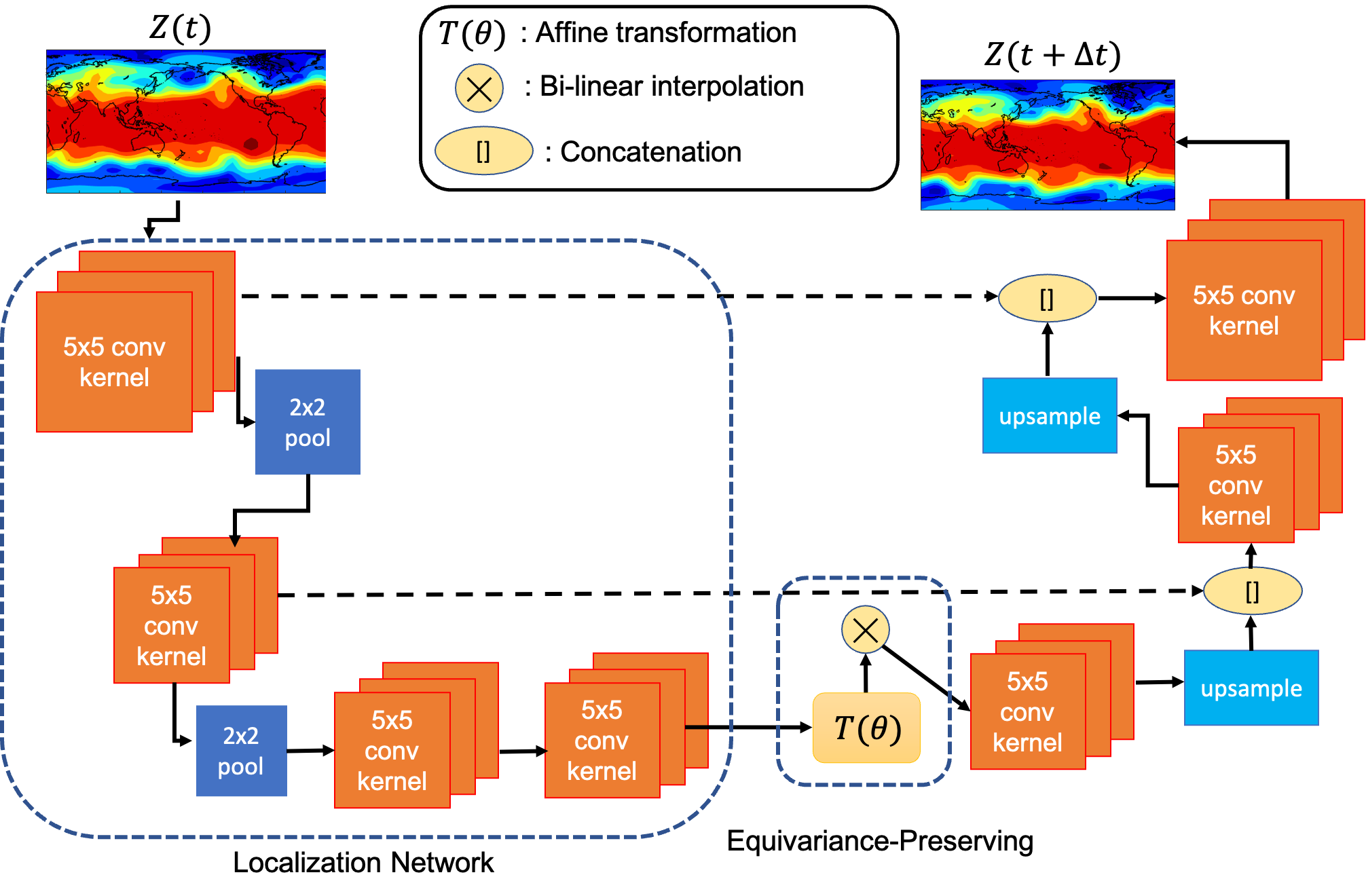
- 在U-NET的潜在空间中引入深度空间变换器(U-STN),以在旋转和缩放变换下保持等变性,从而在时空特征中保留物理对称性。
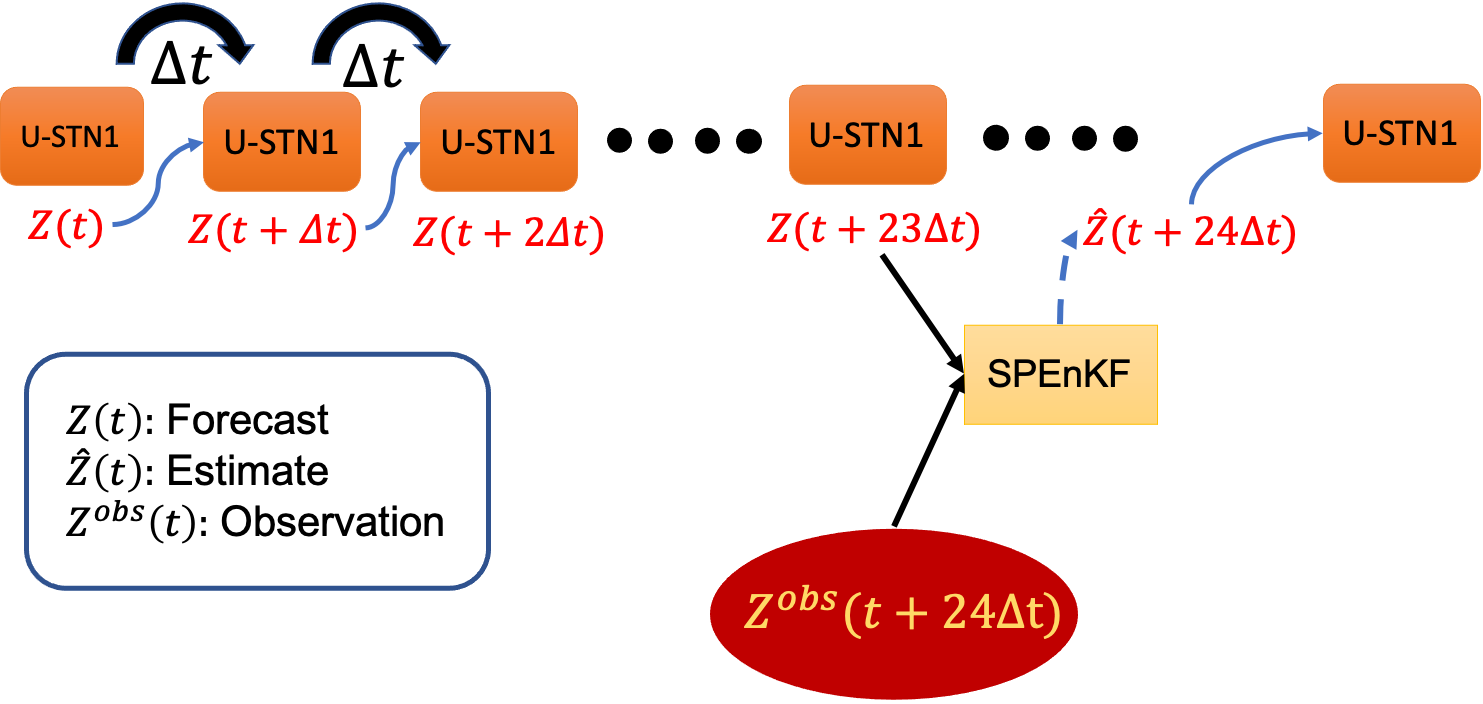
- 采用sigma点集合卡尔曼滤波器(SPEnKF)作为数据同化(DA)算法,以处理带噪声的观测并改善初始条件。
- 利用DDWP模型作为快速前向模型,在每次DA周期中廉价地生成O(1000)个集合成员,从而提升稳定性与准确率。
- 提出一种多时间步算法,通过将中间预报作为虚拟观测,融合不同时间步长模型(如U-STN1和U-STN12)的预报结果。
- 将该框架应用于ERA5再分析数据中的500 hPa位势高度(Z500)以评估短期预报性能。
- 利用自动微分支持未来的变分数据同化,扩展对基于集合方法之外的兼容性。
实验结果
研究问题
- RQ1在深度学习架构中强制实施等变性,是否能提升数据驱动天气模型的物理一致性和预报准确率?
- RQ2能否有效且稳定地将带噪声观测的数据同化与数据驱动的前向模型相结合,特别是在能够廉价生成大规模集合的情况下?
- RQ3通过将多个时间步长模型的预报结果结合虚拟观测,是否能提升短期预报准确率?
- RQ4与标准U-NET基线相比,等变性、数据同化与多时间步预报的集成在技能与稳定性方面表现如何?
- RQ5该模块化框架在多大程度上可扩展至其他地球系统组分,如海洋和陆面?
主要发现
- 保持等变性的U-STN模型在Z500数据上相比标准U-NET将预报技能提升了45%,证明了其优越的物理一致性。
- 基于SPEnKF的DDWP+DA框架即使在高噪声观测条件下,也能实现稳定且准确的数据同化周期,得益于廉价生成的大规模集合。
- 每次DA周期使用O(1000)个集合成员显著提升了数据同化的稳定性和准确率,减少了误差累积并改善了初始条件估计。
- 多时间步DDWP+DA框架通过将中间预报作为虚拟观测,将平均预报误差降低了2至3倍。
- 该框架具有模块化和灵活性,可与各种U-NET架构、数据同化频率,以及基于集合或变分的数据同化算法相结合。
- 该方法可迁移至其他地球系统组分,如海洋和陆面,这些领域正面临数据增长和预报需求的迅速提升。
更好的研究,从现在开始
从阅读论文到最终审阅,大幅缩短您的研究时间。
无需绑定信用卡
本解读由 AI 生成,并经人工编辑审核。