
[Paper Review] Towards Predicting Equilibrium Distributions for Molecular Systems with Deep Learning
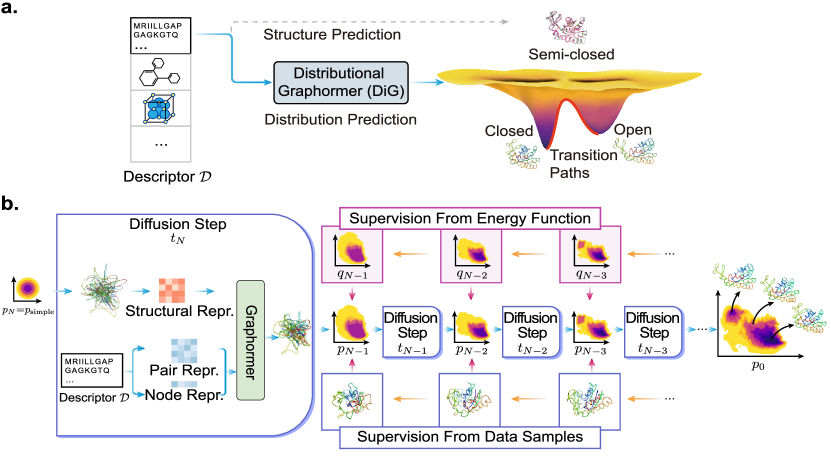
DiG predicts equilibrium distributions of molecular systems by a diffusion-based Graphormer framework conditioned on molecular descriptors, enabling efficient sampling of diverse conformations.
Advances in deep learning have greatly improved structure prediction of molecules. However, many macroscopic observations that are important for real-world applications are not functions of a single molecular structure, but rather determined from the equilibrium distribution of structures. Traditional methods for obtaining these distributions, such as molecular dynamics simulation, are computationally expensive and often intractable. In this paper, we introduce a novel deep learning framework, called Distributional Graphormer (DiG), in an attempt to predict the equilibrium distribution of molecular systems. Inspired by the annealing process in thermodynamics, DiG employs deep neural networks to transform a simple distribution towards the equilibrium distribution, conditioned on a descriptor of a molecular system, such as a chemical graph or a protein sequence. This framework enables efficient generation of diverse conformations and provides estimations of state densities. We demonstrate the performance of DiG on several molecular tasks, including protein conformation sampling, ligand structure sampling, catalyst-adsorbate sampling, and property-guided structure generation. DiG presents a significant advancement in methodology for statistically understanding molecular systems, opening up new research opportunities in molecular science.
Motivation & Objective
- Motivate the need to predict equilibrium distributions rather than a single structure for molecular systems.
- Propose a deep learning framework that can approximate equilibrium distributions and sample diverse, chemically plausible structures.
- Enable estimations of state densities and support inverse design via property-guided generation.
Proposed method
- Introduce Distributional Graphormer (DiG) that performs diffusion-based generation to transform a simple distribution into the target equilibrium distribution conditioned on a molecular descriptor.
- Use a forward Langevin diffusion to move from the target distribution toward a simple Gaussian, and learn a reverse diffusion process with a score model s^θ_D,t(R) based on Graphormer.
- Train the score model with stepwise, independent supervision using either data-based scores or physics-informed diffusion pre-training (PIDP) that leverages energy functions E_D.
- Ground the diffusion process in score matching and diffusion theory to obtain samples R_0 from the equilibrium distribution via discretized reverse steps.
- Estimate densities along the diffusion path by tracking the process, enabling thermodynamic quantity computation such as free energy and entropy.
- Support inverse design by conditioning the score on target properties c, transforming the conditional distribution q_D,t(R|c) through Bayes-rule-based adjustment.
Experimental results
Research questions
- RQ1Can a diffusion-based generative model approximate the equilibrium distribution of molecular systems from descriptors?
- RQ2How well does DiG sample diverse, functionally relevant conformations compared with MD simulations and experimental structures?
- RQ3Can DiG perform ligand binding pose sampling and catalyst-adsorbate adsorption distributions with accuracy comparable to or better than existing approaches?
- RQ4How can physics-informed pre-training (PIDP) augment learning when equilibrium data are scarce?
- RQ5Can DiG support property-guided (inverse) design by conditioning on target properties?
Key findings
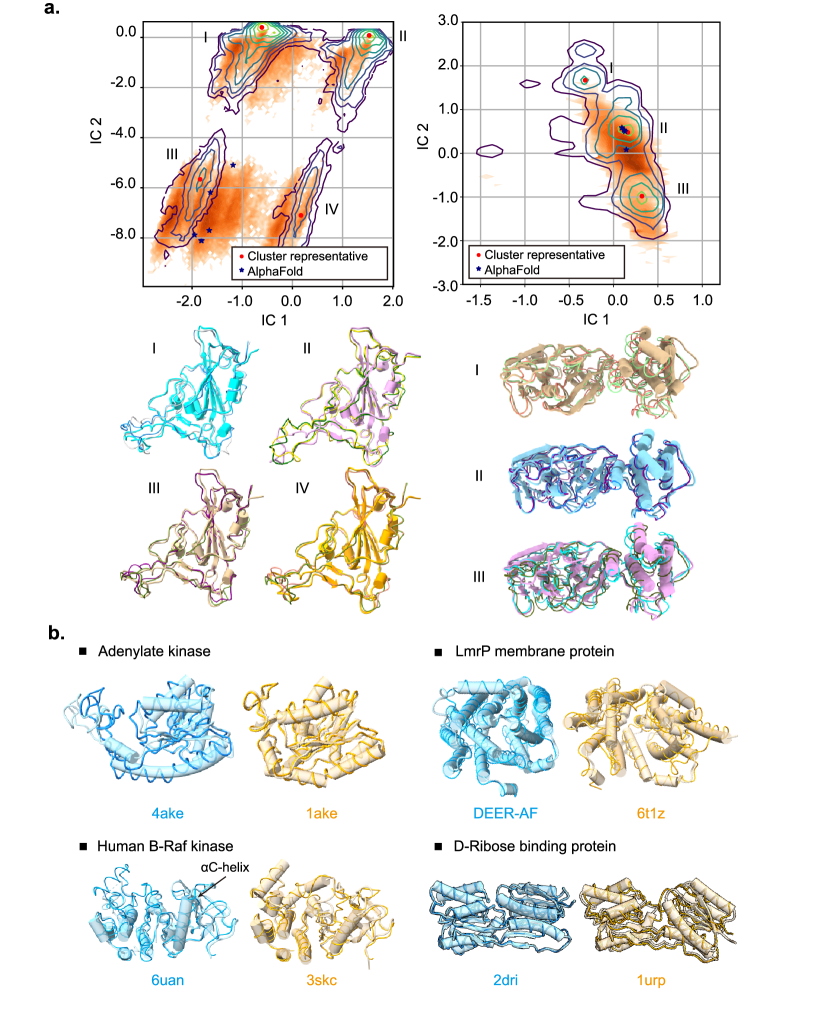
- DiG can generate diverse protein conformations that resemble distributions observed in millisecond MD simulations and align with known functional states.
- DiG produces ligand structures in pockets with RMSD distributions indicating high similarity to crystal structures, achieving best matches within ~2.0 Å for many cases.
- DiG can sample catalyst-adsorbate adsorption configurations that closely match DFT-derived baselines across adsorption sites.
- The Physics-Informed Diffusion Pre-training (PIDP) enables score learning when equilibrium data are scarce by leveraging energy functions during pre-training.
- DiG supports conditional generation for property-guided structure generation, enabling inverse design without requiring large conditional datasets.
Read this paper
Open the full text in the Nubint reader and ask about any passage as you read.
Read this paper on NubintThis review was generated by AI from the original paper. Please check the paper before citing it.