
[Paper Review] Towards Reliable Evaluation of Neural Program Repair with Natural Robustness Testing
This paper investigates the naturalness of semantic-preserving code transformations used to evaluate Neural Program Repair (NPR) systems, revealing that 19.3% of transformations are unnatural and introduce a 25.2% false alarm rate in robustness evaluation. It proposes a naturalness metric based on Cross-Entropy to automate assessment, achieving an AUC of 0.7, and shows NPR performance drops by up to 23.6% when evaluated on natural transformations, highlighting the need for naturalness-aware robustness testing.
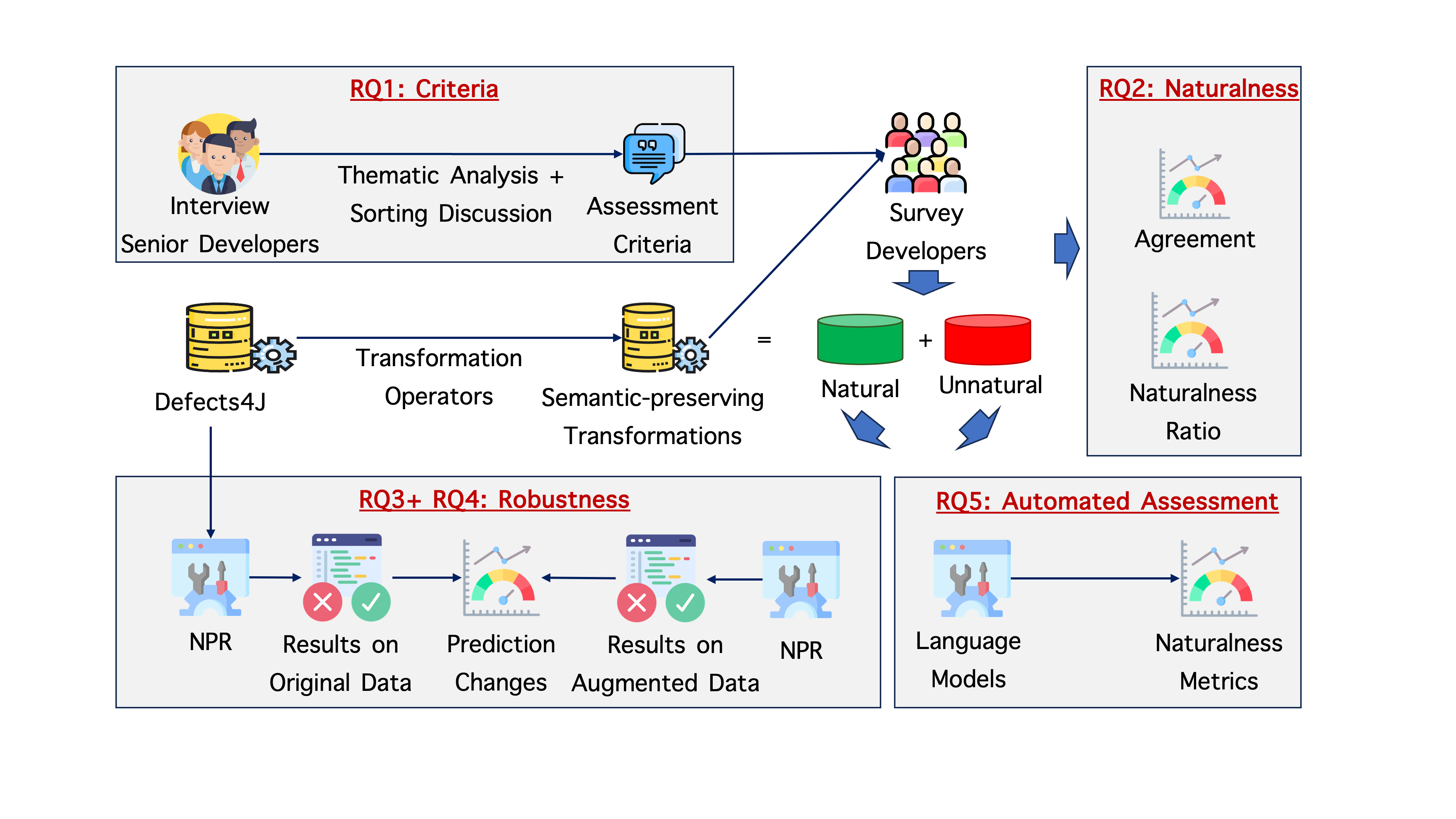
In this paper, we propose shifting the focus of robustness evaluation for Neural Program Repair (NPR) techniques toward naturally-occurring data transformations. To accomplish this, we first examine the naturalness of semantic-preserving transformations through a two-stage human study. This study includes (1) interviews with senior software developers to establish concrete criteria for evaluating the naturalness of these transformations, and (2) a survey involving 10 developers to assess the naturalness of 1,178 transformations, i.e., pairs of original and transformed programs, applied to 225 real-world bugs. Our findings show that only 60% of these transformations are deemed natural, while 20% are considered unnatural, with strong agreement among annotators. Moreover, the unnaturalness of these transformations significantly impacts both their applicability to benchmarks and the conclusions drawn from robustness testing. Next, we conduct natural robustness testing on NPR techniques to assess their true effectiveness against real-world data variations. Our experimental results reveal a substantial number of prediction changes in NPR techniques, leading to significant reductions in both plausible and correct patch rates when comparing performance on the original and transformed datasets. Additionally, we observe notable differences in performance improvements between NPR techniques, suggesting potential biases on NPR evaluation introduced by limited datasets. Finally, we propose an LLM-based metric to automate the assessment of transformation naturalness, ensuring the scalability of natural robustness testing.
Motivation & Objective
- To investigate the naturalness of semantic-preserving code transformations used in evaluating Neural Program Repair (NPR) systems.
- To assess the impact of unnatural transformations on the robustness evaluation of NPR systems, which may lead to false alarms.
- To establish concrete criteria for code transformation naturalness through expert developer input.
- To develop and validate an automated naturalness metric for code transformations to support reliable NPR evaluation.
- To re-evaluate NPR system robustness using only natural transformations, revealing underappreciated performance drops.
Proposed method
- Conducted a two-stage human study: first, interviews with senior developers to define naturalness criteria; second, a survey with 10 developers to rate the naturalness of 1178 code transformation pairs.
- Used thematic analysis and open card-sorting to derive structured naturalness criteria from developer feedback.
- Proposed a novel naturalness metric called Relative Naturalness Changes (RNC), which computes the relative difference in Cross-Entropy (CE) values between original and transformed code.
- Validated the RNC metric using human-annotated naturalness scores, achieving an AUC of 0.7 in classifying natural vs. unnatural transformations.
- Re-evaluated five well-known NPR systems using only natural transformations to measure real-world robustness.
- Applied statistical tests (e.g., Mann-Whitney-Wilcoxon, Spearman’s rho) to assess significance and inter-rater agreement (Cohen’s Kappa).
Experimental results
Research questions
- RQ1How natural are the semantic-preserving code transformations commonly used in NPR evaluation?
- RQ2To what extent do unnatural transformations lead to false alarms in robustness evaluation of NPR systems?
- RQ3How does the performance of NPR systems degrade when evaluated on natural transformations versus all transformations?
- RQ4Can a machine-learnable naturalness metric be effectively derived from code representation differences, such as Cross-Entropy?
- RQ5What is the impact of naturalness-aware evaluation on the perceived robustness of existing NPR tools?
Key findings
- Nearly 60% of semantic-preserving transformations are deemed natural by developers, with substantial inter-rater agreement, while 20% are considered unnatural.
- Unnatural transformations introduce a 25.2% false alarm rate in robustness evaluation across five well-known NPR systems.
- When evaluated only on natural transformations, NPR systems show a performance drop of up to 22.9% in correct patches and 23.6% in plausible patches.
- The proposed Relative Naturalness Changes (RNC) metric, based on Cross-Entropy differences, achieves an AUC of 0.7 in classifying transformation naturalness.
- The study reveals that current robustness evaluation methods may overestimate NPR robustness due to reliance on unnatural transformations.
- The findings suggest that naturalness-aware evaluation is essential for accurately assessing the real-world effectiveness of NPR systems.
Read this paper
Open the full text in the Nubint reader and ask about any passage as you read.
Read this paper on NubintThis review was generated by AI from the original paper. Please check the paper before citing it.