
[Paper Review] Towards Self-Interpretable Graph-Level Anomaly Detection
SIGNET jointly detects graph-level anomalies and provides explanations by learning cross-view bottleneck subgraphs from a graph and its dual hypergraph, without supervision.
Graph-level anomaly detection (GLAD) aims to identify graphs that exhibit notable dissimilarity compared to the majority in a collection. However, current works primarily focus on evaluating graph-level abnormality while failing to provide meaningful explanations for the predictions, which largely limits their reliability and application scope. In this paper, we investigate a new challenging problem, explainable GLAD, where the learning objective is to predict the abnormality of each graph sample with corresponding explanations, i.e., the vital subgraph that leads to the predictions. To address this challenging problem, we propose a Self-Interpretable Graph aNomaly dETection model (SIGNET for short) that detects anomalous graphs as well as generates informative explanations simultaneously. Specifically, we first introduce the multi-view subgraph information bottleneck (MSIB) framework, serving as the design basis of our self-interpretable GLAD approach. This way SIGNET is able to not only measure the abnormality of each graph based on cross-view mutual information but also provide informative graph rationales by extracting bottleneck subgraphs from the input graph and its dual hypergraph in a self-supervised way. Extensive experiments on 16 datasets demonstrate the anomaly detection capability and self-interpretability of SIGNET.
Motivation & Objective
- Define explainable graph-level anomaly detection (Explainable GLAD) where the model outputs an anomaly score and a rationale subgraph.
- Develop a self-interpretable GLAD model that learns explanations without ground-truth anomaly labels.
- Propose a multi-view subgraph information bottleneck (MSIB) framework to extract informative bottleneck subgraphs.
- Leverage a dual hypergraph transformation to create distinct views and enable self-supervised learning.
- Demonstrate that SIGNET achieves strong anomaly detection performance and provides meaningful explanations.
Proposed method
- Introduce MSIB as the design basis for self-interpretable GLAD.
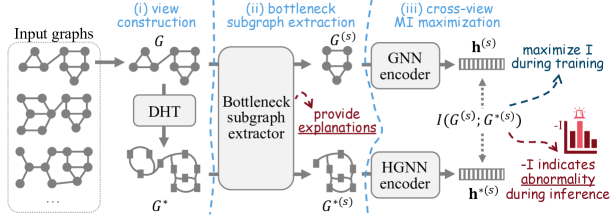
- Construct two views for each graph: the original graph G and its dual hypergraph G*, via Dual Hypergraph Transformation (DHT).
- Use a bottleneck subgraph extractor to produce probabilistic node/edge selections that define G^(s) and G^(s)*.
- Maximize cross-view mutual information I(h_{G^(s)}; h_{G^(s)*}) with an Info-NCE objective to learn representations and explanations.
- During inference, compute anomaly score as -I(h_{G^(s)}; h_{G^(s)*}) and provide explanations via top-k nodes/edges in the bottleneck subgraphs.
- Optionally, lift node probabilities to edge probabilities to align subgraphs across views, and use a single extractor to simplify architecture.

Experimental results
Research questions
- RQ1Can SIGNET provide informative explanations for GLAD predictions (explanations via bottleneck subgraphs)?
- RQ2How effective is SIGNET at identifying anomalous graphs across diverse datasets?
- RQ3What are the contributions of the core design choices in SIGNET to performance and interpretability?
Key findings
- SIGNET achieves state-of-the-art explanation performance on six explainable GLAD datasets, with average NX-AUC gains of 27.89% and EX-AUC gains of 8.99% over baselines.
- SIGNET outperforms baselines in anomaly detection across 10 of 16 datasets and is competitive on the rest.
- The dual hypergraph transformation provides distinct, stable views and enables edge-focused explanations.
- Using a single extractor to generate bottleneck subgraphs for both views improves consistency and reduces model complexity.
- Quantitative and qualitative results show that SIGNET assigns higher probabilities to discriminative motifs, producing meaningful explanations.
Better researchstarts right now
From paper design to paper writing, dramatically reduce your research time.
No credit card · Free plan available
This review was created by AI and reviewed by human editors.