
[Paper Review] Towards the Development of a Real-Time Deepfake Audio Detection System in Communication Platforms
This paper evaluates the feasibility of deploying pre-trained static deepfake audio detection models—based on ResNet and LCNN architectures—within real-time communication platforms like Microsoft Teams. Despite achieving strong benchmark performance on the ASVspoof 2019 dataset, these models show degraded performance (F-score: 0.45 for LA, 0.40 for PA) in live audio streams, highlighting the need for enhanced data diversity and platform-specific adaptation strategies to enable robust real-time detection.
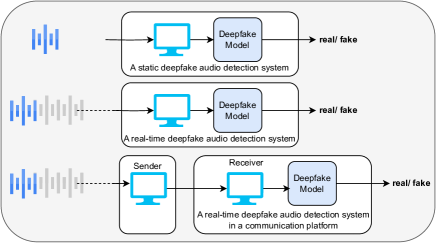
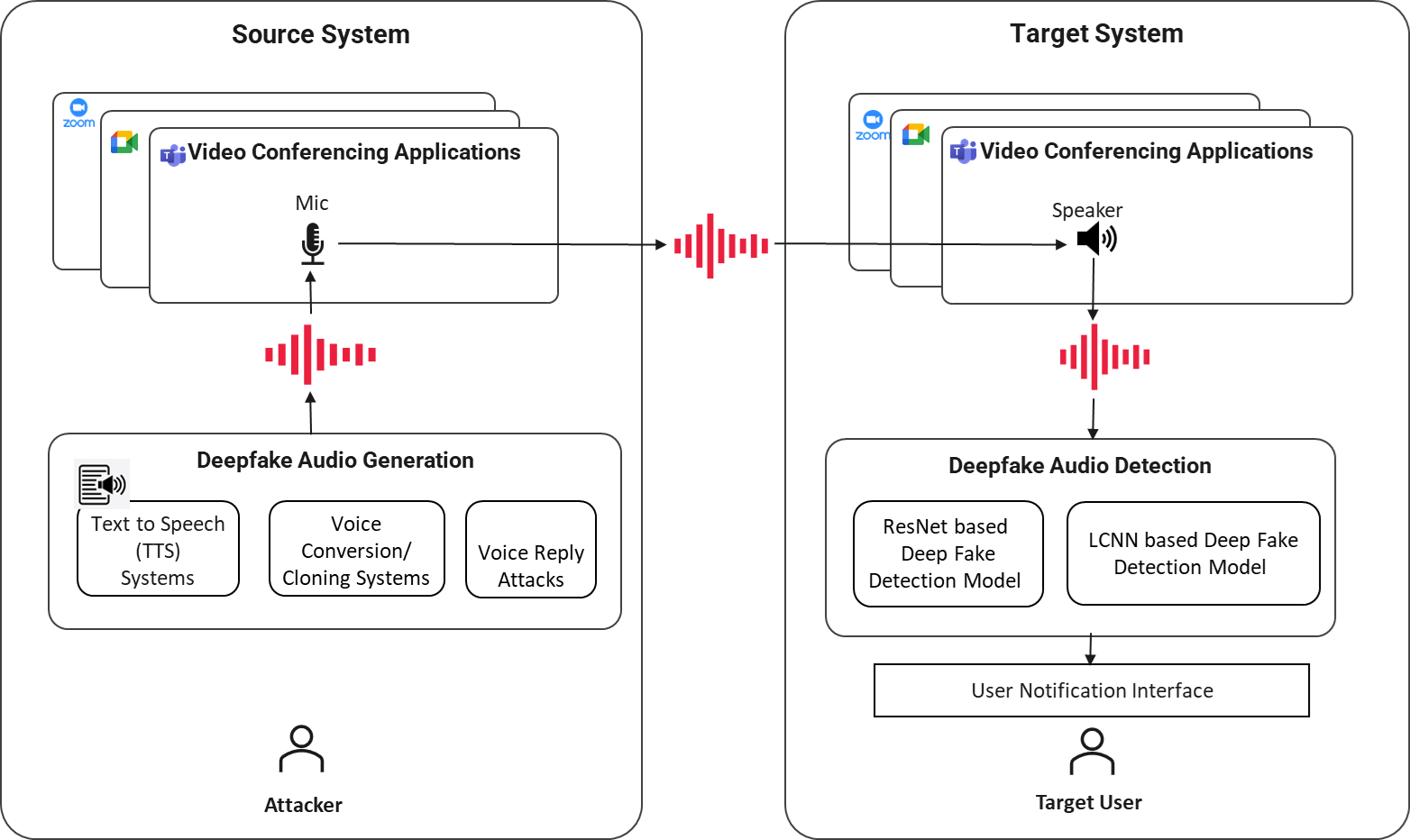
Deepfake audio poses a rising threat in communication platforms, necessitating real-time detection for audio stream integrity. Unlike traditional non-real-time approaches, this study assesses the viability of employing static deepfake audio detection models in real-time communication platforms. An executable software is developed for cross-platform compatibility, enabling real-time execution. Two deepfake audio detection models based on Resnet and LCNN architectures are implemented using the ASVspoof 2019 dataset, achieving benchmark performances compared to ASVspoof 2019 challenge baselines. The study proposes strategies and frameworks for enhancing these models, paving the way for real-time deepfake audio detection in communication platforms. This work contributes to the advancement of audio stream security, ensuring robust detection capabilities in dynamic, real-time communication scenarios.
Motivation & Objective
- To assess the viability of static deepfake audio detection models in real-time communication platforms such as Microsoft Teams.
- To identify performance degradation in real-time streaming scenarios compared to static benchmark datasets.
- To develop a cross-platform executable software for real-time deployment and evaluation of deepfake detection models.
- To propose strategies for improving model robustness in dynamic, real-time audio environments.
- To bridge the gap between static dataset performance and real-world deployment in voice-centric communication platforms.
Proposed method
- Implementation of two deepfake detection models using ResNet and LCNN architectures trained on the ASVspoof 2019 dataset.
- Benchmarking against official ASVspoof 2019 challenge baselines using EER and t-DCF metrics.
- Development of a cross-platform executable software application to enable real-time inference on audio streams.
- Real-time evaluation during live Microsoft Teams group meetings using custom-curated audio stream data.
- Application of standard classification metrics—precision, recall, and F-score—on streaming audio to assess model performance.
- Proposed strategies include data augmentation with conversational and noisy speech, platform-specific artifact simulation, and generative model-based data synthesis.
Experimental results
Research questions
- RQ1Can static deepfake audio detection models trained on isolated, short-duration recordings generalize effectively to real-time, continuous audio streams in communication platforms?
- RQ2What performance degradation occurs when deploying static models in live communication environments like Microsoft Teams?
- RQ3How do model metrics such as precision, recall, and F-score change when transitioning from static datasets to real-time streaming data?
- RQ4What data augmentation and model adaptation strategies can improve robustness in real-time communication scenarios?
- RQ5Can generative models enhance training data diversity to improve detection in dynamic, noisy, and compressed audio streams?
Key findings
- The LA model achieved a higher precision (0.48) than the PA model (0.39) in real-time Teams sessions, indicating better positive prediction accuracy.
- The LA model recorded a higher F-score (0.45) compared to the PA model (0.40), suggesting better overall balance between precision and recall in real-time detection.
- Both models exhibited significantly degraded performance in real-time streaming compared to their benchmark scores on the ASVspoof 2019 dataset, indicating poor generalization to dynamic audio conditions.
- The performance drop is attributed to the static nature of training data, limited variability in speaker count, background noise, and recording conditions.
- The study identifies that training data variability, platform-specific artifacts, and generative data augmentation are critical areas for future improvement.
- The authors recommend augmenting training data with conversational, noisy, and fragmented speech from datasets like VoxCeleb2, LRPD, and WaveFake to improve real-time robustness.
Read this paper
Open the full text in the Nubint reader and ask about any passage as you read.
Read this paper on NubintThis review was generated by AI from the original paper. Please check the paper before citing it.