
[Paper Review] Towards Verifiable Generation: A Benchmark for Knowledge-aware Language Model Attribution
The paper defines KaLMA, builds BioKaLMA with 1,085 questions over BioKGs, introduces Conscious Incompetence, and presents a retrieval-grounded, fully automatic evaluation framework showing room for improvement in knowledge-grounded attribution.
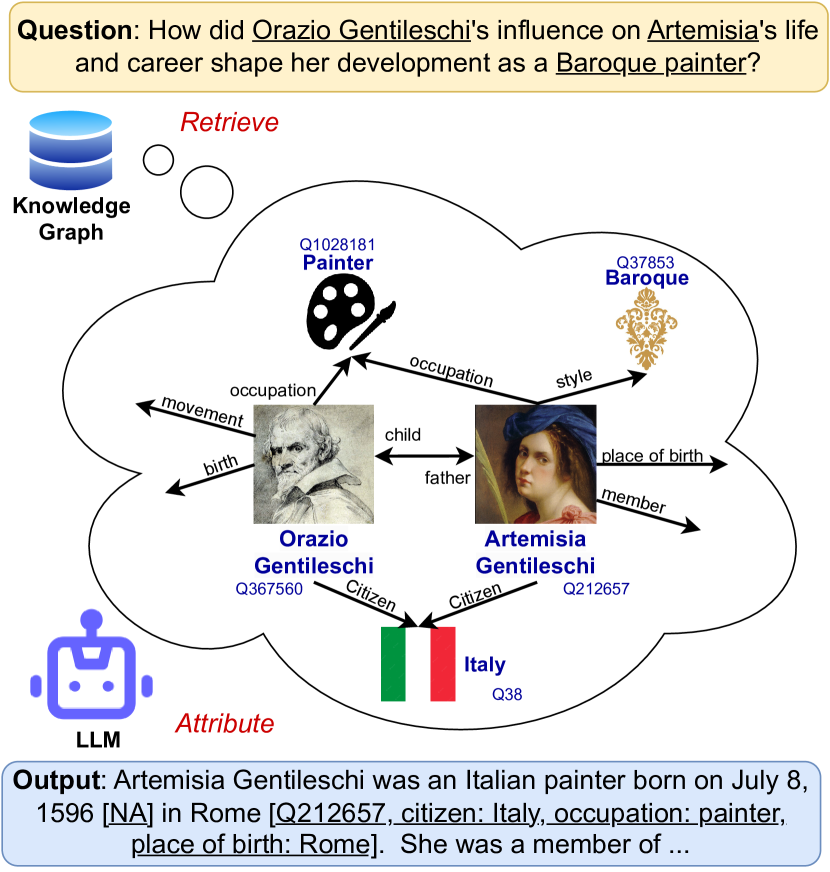
Although achieving great success, Large Language Models (LLMs) usually suffer from unreliable hallucinations. Although language attribution can be a potential solution, there are no suitable benchmarks and evaluation metrics to attribute LLMs to structured knowledge. In this paper, we define a new task of Knowledge-aware Language Model Attribution (KaLMA) that improves upon three core concerns with conventional attributed LMs. First, we extend attribution source from unstructured texts to Knowledge Graph (KG), whose rich structures benefit both the attribution performance and working scenarios. Second, we propose a new ``Conscious Incompetence" setting considering the incomplete knowledge repository, where the model identifies the need for supporting knowledge beyond the provided KG. Third, we propose a comprehensive automatic evaluation metric encompassing text quality, citation quality, and text citation alignment. To implement the above innovations, we build a dataset in biography domain BioKaLMA via evolutionary question generation strategy, to control the question complexity and necessary knowledge to the answer. For evaluation, we develop a baseline solution and demonstrate the room for improvement in LLMs' citation generation, emphasizing the importance of incorporating the "Conscious Incompetence" setting, and the critical role of retrieval accuracy.
Motivation & Objective
- Extend attribution sources from unstructured texts to knowledge graphs to leverage structured knowledge.
- Address coverage gaps by enabling models to recognize knowledge gaps and cite absent knowledge as [NA].
- Propose a comprehensive automatic evaluation framework for text quality, citation quality, and text-citation alignment without ground-truth references.
- Construct BioKaLMA to facilitate controlled, automatic evaluation in the biography domain.
Proposed method
- Ground the generation in a knowledge graph by retrieving one-hop sub-graphs around identified entities from WikiData.
- Implement a retrieval and re-ranking pipeline to disambiguate entities using exact-match neighborhood structures.
- Train the generation model with a prompt that includes the retrieved KG and the question, using one-shot in-context learning with a demonstration.
- Incorporate Conscious Incompetence by allowing sentences to map to [NA] when knowledge is missing from the KG.
- Evaluate text quality with a reference-free NLG evaluator (GPTScore) across coherence, consistency, fluency, and relevance.
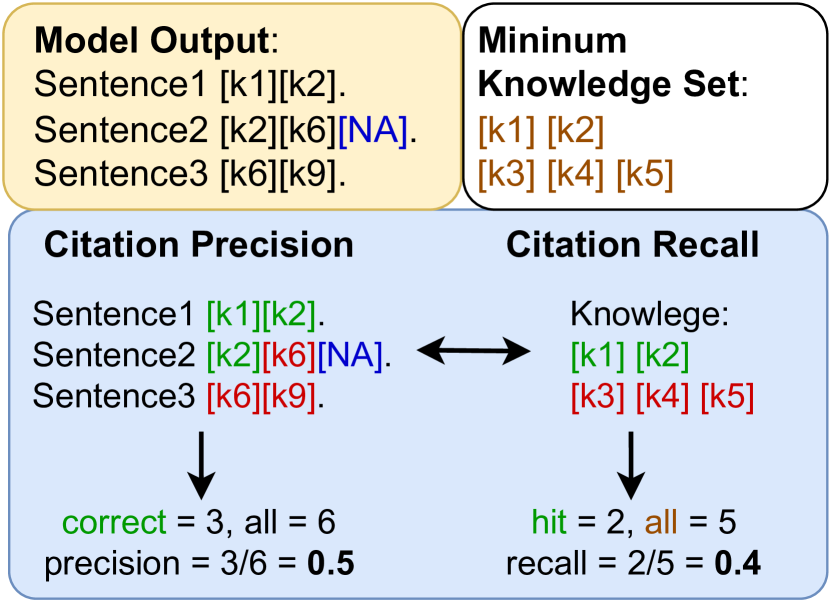
- Evaluate citations on correctness, precision, recall, and F1 against the minimum knowledge set, and assess text-citation alignment with an NLI-based entailment check.
Experimental results
Research questions
- RQ1How can attribution sources be extended from unstructured documents to knowledge graphs in KaLMA?
- RQ2Can models identify and indicate knowledge gaps not present in the provided KG via a Conscious Incompetence setting?
- RQ3How do retrieval accuracy and KG coverage impact the quality of generated text and citations?
- RQ4How can we automatically evaluate text quality, citation quality, and text-citation alignment without gold references?
- RQ5What is the effectiveness of BioKaLMA as a benchmark for knowledge-aware language model attribution in the biography domain?
Key findings
- GPT-4 achieves the best overall citation quality across most metrics, with higher alignment and relatively high coherence and consistency.
- All models show room for improvement in citation precision and recall, highlighting the challenge of grounding with KG-based attribution.
- Retrieval accuracy strongly affects citation quality, with recall being more sensitive to retrieval errors than precision.
- Conscious Incompetence helps reveal knowledge gaps and improves trustworthiness when coverage is limited.
- Text-citation alignment correlates with model size, showing larger models yield higher alignment.
- Automatic evaluation metrics for alignment and citation quality correlate with human judgments for at least some baselines.
Read this paper
Open the full text in the Nubint reader and ask about any passage as you read.
Read this paper on NubintThis review was generated by AI from the original paper. Please check the paper before citing it.