
[Paper Review] TrackFormer: Multi-Object Tracking with Transformers
TrackFormer introduces a novel tracking-by-attention paradigm for multi-object tracking using an end-to-end Transformer-based encoder-decoder architecture. It jointly performs detection and data association via autoregressive track queries that evolve through video sequences, achieving state-of-the-art performance on MOT17, MOT20, and MOTS20 benchmarks without relying on graph optimization or explicit motion/appearance modeling.
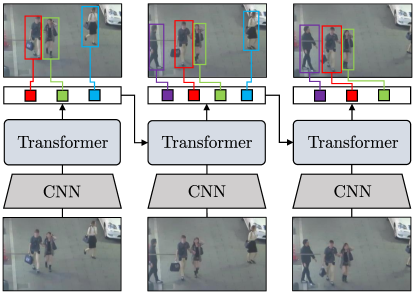
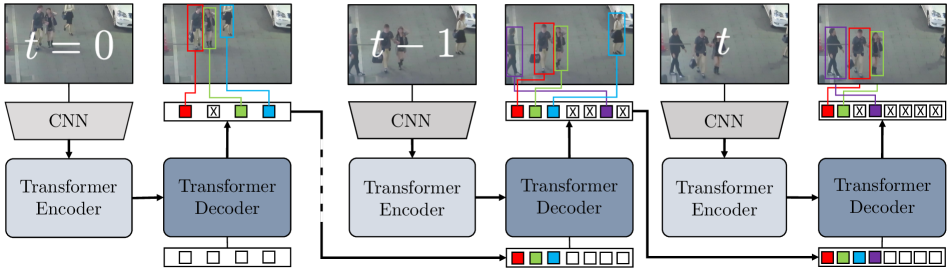
The challenging task of multi-object tracking (MOT) requires simultaneous reasoning about track initialization, identity, and spatio-temporal trajectories. We formulate this task as a frame-to-frame set prediction problem and introduce TrackFormer, an end-to-end trainable MOT approach based on an encoder-decoder Transformer architecture. Our model achieves data association between frames via attention by evolving a set of track predictions through a video sequence. The Transformer decoder initializes new tracks from static object queries and autoregressively follows existing tracks in space and time with the conceptually new and identity preserving track queries. Both query types benefit from self- and encoder-decoder attention on global frame-level features, thereby omitting any additional graph optimization or modeling of motion and/or appearance. TrackFormer introduces a new tracking-by-attention paradigm and while simple in its design is able to achieve state-of-the-art performance on the task of multi-object tracking (MOT17 and MOT20) and segmentation (MOTS20). The code is available at https://github.com/timmeinhardt/trackformer .
Motivation & Objective
- To address the challenge of joint detection and data association in multi-object tracking (MOT) by replacing traditional two-stage tracking-by-detection with an end-to-end attention-based approach.
- To eliminate the need for separate data association modules, graph optimization, or explicit motion/appearance modeling by leveraging self- and cross-attention in a Transformer decoder.
- To introduce a new paradigm—tracking-by-attention—where identity-preserving track queries are autoregressively updated across frames to form spatio-temporal trajectories.
- To achieve state-of-the-art performance on standard MOT benchmarks (MOT17, MOT20) and extend to instance segmentation (MOTS20) with a mask prediction head.
Proposed method
- Formulates MOT as a frame-to-frame set prediction problem using an encoder-decoder Transformer architecture.
- Employs static object queries for initial detection and autoregressive track queries for identity-preserving tracking across frames.
- Uses self-attention within track queries and cross-attention between queries and global frame-level features for spatio-temporal reasoning.
- Performs joint detection and data association via attention mechanisms, eliminating the need for post-hoc matching or graph optimization.
- Introduces identity-preserving track queries that evolve over time, maintaining object identity through attention-driven refinement.
- Extends the model with a mask prediction head for instance segmentation, enabling performance on the MOTS20 benchmark.
Experimental results
Research questions
- RQ1Can a pure attention-based Transformer architecture achieve end-to-end multi-object tracking without relying on external data association modules?
- RQ2How effective is the use of autoregressive track queries in maintaining object identity and trajectory consistency across frames?
- RQ3Can the tracking-by-attention paradigm outperform traditional tracking-by-detection and tracking-by-regression methods on standard benchmarks?
- RQ4To what extent can a single Transformer-based architecture jointly perform detection, tracking, and segmentation in a unified framework?
Key findings
- TrackFormer achieves state-of-the-art performance on the MOT17 benchmark with a MOTA of 62.3% and IDF1 of 57.6% using public detections.
- On the MOT20 benchmark, TrackFormer achieves a MOTA of 68.6% and IDF1 of 65.7% with private detections, setting a new SOTA.
- For the MOTS20 instance segmentation benchmark, TrackFormer achieves a sMOTSA of 54.9%, IDF1 of 63.6%, and MOTSA of 69.9%, demonstrating strong generalization to segmentation.
- The model outperforms prior methods on all sequences in MOT17 and MOT20, including those with high object counts and complex motion.
- The ablation study confirms that the autoregressive track query mechanism is critical for identity preservation and trajectory consistency.
- The absence of explicit motion or appearance modeling, yet strong performance, validates the effectiveness of global attention in spatio-temporal reasoning.
Read this paper
Open the full text in the Nubint reader and ask about any passage as you read.
Read this paper on NubintThis review was generated by AI from the original paper. Please check the paper before citing it.