
[Paper Review] Training Deep Boltzmann Networks with Sparse Ising Machines
This paper proposes a hybrid hardware-software framework that uses sparse, asynchronous Ising machines implemented on FPGAs to train deep Boltzmann machines (DBMs) with orders-of-magnitude speedup. By leveraging probabilistic bit (p-bit) architectures for fast Markov Chain Monte Carlo sampling, the system achieves 90% MNIST classification accuracy using only 4,264 p-bits—comparable to a 3.25 million-parameter software RBM—while also generating new samples, a capability the software model lacks.
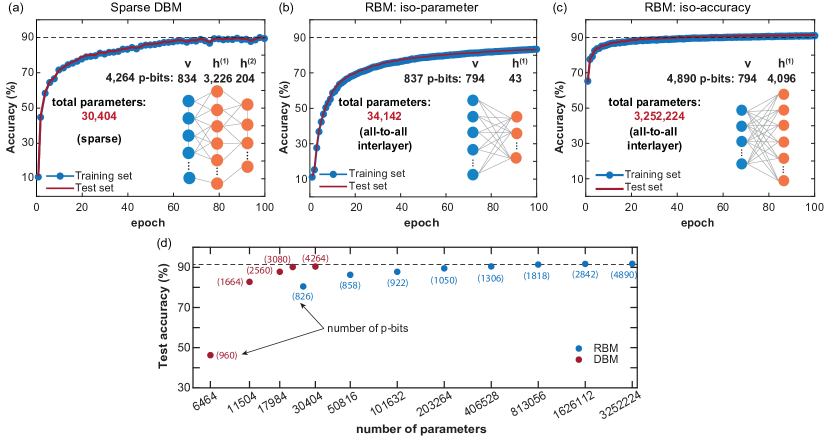
The slowing down of Moore's law has driven the development of unconventional computing paradigms, such as specialized Ising machines tailored to solve combinatorial optimization problems. In this paper, we show a new application domain for probabilistic bit (p-bit) based Ising machines by training deep generative AI models with them. Using sparse, asynchronous, and massively parallel Ising machines we train deep Boltzmann networks in a hybrid probabilistic-classical computing setup. We use the full MNIST and Fashion MNIST (FMNIST) dataset without any downsampling and a reduced version of CIFAR-10 dataset in hardware-aware network topologies implemented in moderately sized Field Programmable Gate Arrays (FPGA). For MNIST, our machine using only 4,264 nodes (p-bits) and about 30,000 parameters achieves the same classification accuracy (90%) as an optimized software-based restricted Boltzmann Machine (RBM) with approximately 3.25 million parameters. Similar results follow for FMNIST and CIFAR-10. Additionally, the sparse deep Boltzmann network can generate new handwritten digits and fashion products, a task the 3.25 million parameter RBM fails at despite achieving the same accuracy. Our hybrid computer takes a measured 50 to 64 billion probabilistic flips per second, which is at least an order of magnitude faster than superficially similar Graphics and Tensor Processing Unit (GPU/TPU) based implementations. The massively parallel architecture can comfortably perform the contrastive divergence algorithm (CD-n) with up to n = 10 million sweeps per update, beyond the capabilities of existing software implementations. These results demonstrate the potential of using Ising machines for traditionally hard-to-train deep generative Boltzmann networks, with further possible improvement in nanodevice-based realizations.
Motivation & Objective
- To demonstrate that probabilistic Ising machines can efficiently train deep generative models like deep Boltzmann machines, overcoming limitations of traditional software-based training.
- To address the computational intractability of training deep Boltzmann networks on conventional hardware by exploiting the massively parallel, low-latency sampling of p-bit-based Ising machines.
- To show that sparse, hardware-aware DBM topologies can achieve high performance with minimal hardware resources, enabling energy-efficient training of deep generative models.
- To validate the scalability and efficiency of this hybrid approach by comparing it to software-based RBM implementations on standard datasets like MNIST, FMNIST, and CIFAR-10.
- To explore the feasibility of extending this framework to nanodevice-based p-computers for future energy-efficient AI hardware.
Proposed method
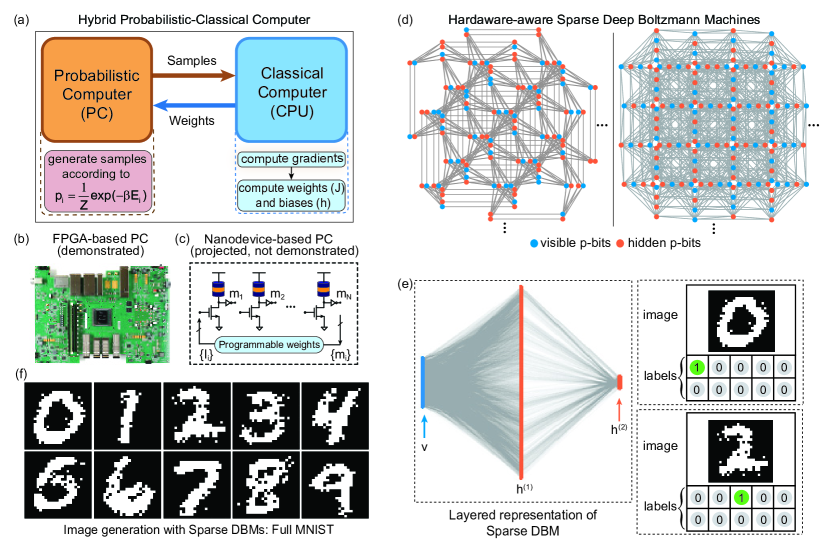
- The system uses a hybrid architecture where a p-bit-based Ising machine implemented on an FPGA performs fast probabilistic sampling from the Boltzmann-Gibbs distribution, while a CPU handles gradient computation and weight updates.
- The Ising machine is built using digital CMOS logic on FPGAs, with each p-bit consisting of a pseudorandom number generator, a tanh activation lookup table, and a thresholding unit for binary output.
- The network topology is sparse and asynchronous, with p-bits dynamically updating in parallel without a global clock, enabling high-throughput sampling across multiple color blocks.
- The system employs a hardware-aware sparse DBM structure using Pegasus and Zephyr graph topologies to map connections efficiently on the FPGA’s physical interconnects.
- A PCIe interface enables bidirectional communication between the FPGA and CPU, allowing for periodic weight and bias updates, with p-bit states saved to block RAM (BRAM) before data transfer.
- Sampling speed is measured via programmable counters in the FPGA, comparing p-bit flip counts to a reference clock to compute flips per nanosecond in real time.
Experimental results
Research questions
- RQ1Can sparse, asynchronous Ising machines implemented on FPGAs effectively train deep Boltzmann networks with performance comparable to software-based RBMs?
- RQ2Does the hybrid p-computer architecture enable significant speedup in probabilistic sampling compared to GPU/TPU-based implementations for contrastive divergence training?
- RQ3Can the same hardware-efficient setup generate new samples (e.g., handwritten digits) while maintaining high classification accuracy, a capability that software RBMs fail to achieve despite matching accuracy?
- RQ4To what extent does the sparsity and hardware-aware topology of the DBM reduce parameter count and resource usage without sacrificing model performance?
- RQ5How does the sampling rate of the p-computer (in flips per second) compare to conventional hardware, and can it sustain high-n contrastive divergence (e.g., CD-10^7) training?
Key findings
- The FPGA-based p-computer achieves a measured sampling rate of 50 to 64 billion probabilistic flips per second, exceeding the performance of GPU/TPU-based implementations by at least an order of magnitude.
- The system trains a sparse DBM with only 4,264 p-bits and ~30,000 parameters to achieve 90% classification accuracy on the full MNIST dataset—matching the performance of a software-based RBM with 3.25 million parameters.
- Despite achieving identical accuracy, the 3.25 million-parameter software RBM fails to generate new handwritten digits, whereas the sparse DBM trained on the p-computer successfully generates realistic samples.
- The hybrid training pipeline completes 100 epochs on full MNIST in approximately 20 hours using CD-10^5, while the equivalent CPU-based RBM with CD-10^4 would require ~24 days to complete 100 epochs.
- The system supports contrastive divergence with up to n = 10 million sweeps per update, a scale beyond the reach of typical software implementations.
- The results are scalable to other datasets: similar performance is observed on Fashion-MNIST and a reduced CIFAR-10 dataset, confirming the method’s generalizability.
Read this paper
Open the full text in the Nubint reader and ask about any passage as you read.
Read this paper on NubintThis review was generated by AI from the original paper. Please check the paper before citing it.