
[Paper Review] Training Diverse High-Dimensional Controllers by Scaling Covariance Matrix Adaptation MAP-Annealing
This paper proposes scalable variants of Covariance Matrix Adaptation MAP-Annealing (CMA-MAE) that enable efficient training of diverse, high-dimensional neural network controllers for robotic locomotion. By replacing the quadratic-complexity CMA-ES with sparse, efficient approximations, the method achieves state-of-the-art quality diversity performance on locomotion tasks while maintaining low hyperparameter sensitivity and significantly reducing training time compared to deep reinforcement learning baselines.
Pre-training a diverse set of neural network controllers in simulation has enabled robots to adapt online to damage in robot locomotion tasks. However, finding diverse, high-performing controllers requires expensive network training and extensive tuning of a large number of hyperparameters. On the other hand, Covariance Matrix Adaptation MAP-Annealing (CMA-MAE), an evolution strategies (ES)-based quality diversity algorithm, does not have these limitations and has achieved state-of-the-art performance on standard QD benchmarks. However, CMA-MAE cannot scale to modern neural network controllers due to its quadratic complexity. We leverage efficient approximation methods in ES to propose three new CMA-MAE variants that scale to high dimensions. Our experiments show that the variants outperform ES-based baselines in benchmark robotic locomotion tasks, while being comparable with or exceeding state-of-the-art deep reinforcement learning-based quality diversity algorithms.
Motivation & Objective
- To address the challenge of training diverse, high-performing neural network controllers for robotic locomotion under limited compute budgets.
- To overcome the quadratic time complexity of CMA-MAE, which limits its scalability to high-dimensional controllers with thousands to millions of parameters.
- To develop efficient, low-hyperparameter alternatives to deep reinforcement learning-based quality diversity algorithms for robotic control.
- To enable practical deployment of quality diversity algorithms in real-world robotics by reducing training time and computational overhead.
- To demonstrate that evolution strategy-based methods can match or exceed state-of-the-art deep RL-based QD algorithms in performance while being more efficient and easier to tune.
Proposed method
- Proposes three new CMA-MAE variants that replace the full-rank covariance matrix in CMA-ES with sparse, low-rank approximations to reduce time complexity from O(n²) to O(n) per sample.
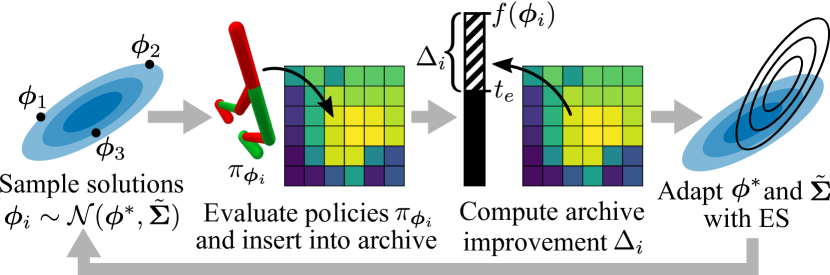
- Maintains the core CMA-MAE framework: a Gaussian search distribution with mean φ* and approximate covariance matrix Σ̃, updated via evolution strategy feedback.
- Incorporates a soft archive with cell-specific thresholds and improvement feedback Δi to balance exploration in measure space and objective optimization.
- Uses a single hyperparameter α ∈ [0,1] to control the trade-off between exploration and exploitation, similar to original CMA-MAE.
- Employs efficient estimation of natural gradient updates using only function evaluations, avoiding backpropagation and network training.
- Applies the method to robotic locomotion tasks using simulated environments, with performance evaluated via QD score and controller diversity metrics.
Experimental results
Research questions
- RQ1Can CMA-MAE be scaled to high-dimensional neural network controllers used in modern robotic locomotion tasks?
- RQ2Do sparse covariance approximations in CMA-MAE variants maintain or improve performance while reducing computational complexity?
- RQ3How does the performance of the proposed CMA-MAE variants compare to state-of-the-art deep reinforcement learning-based quality diversity algorithms like PGA-ME and CMA-MEGA (TD3, ES)?
- RQ4To what extent do the proposed variants inherit the low hyperparameter sensitivity of CMA-ES while achieving high-quality diversity?
- RQ5Does the soft archive mechanism with adaptive learning rate α effectively balance exploration and exploitation in high-dimensional controller search?
Key findings
- The proposed CMA-MAE variants outperform all ES-based baselines on standard robotic locomotion benchmarks, achieving higher QD scores across QD Ant, Half-Cheetah, Hopper, and Walker tasks.
- On three out of four tasks (QD Ant, Half-Cheetah, Hopper), the variants match or exceed the performance of the state-of-the-art deep RL-based PGA-ME algorithm, with QD scores up to 2.939×10⁶ on Half-Cheetah.
- The variants are significantly faster than PGA-ME and CMA-MEGA (TD3, ES), with runtime reductions exceeding 2x, primarily due to avoiding deep RL training loops.
- The ablation study confirms that intermediate α values (e.g., α=0.001) yield optimal performance, while extreme values (α=0 or α=1) degrade performance by focusing solely on exploration or exploitation.
- Memory usage is dominated by the archive in all methods, but the CMA-MAE variants require less memory than TD3-based methods due to absence of replay buffers.
- The variants maintain low hyperparameter sensitivity, requiring only five parameters (ψ, λ, σ, α, min_f), in contrast to 15–18 parameters in deep RL-based methods.
Read this paper
Open the full text in the Nubint reader and ask about any passage as you read.
Read this paper on NubintThis review was generated by AI from the original paper. Please check the paper before citing it.