
[Paper Review] Training Value-Aligned Reinforcement Learning Agents Using a Normative Prior
This paper proposes a policy shaping method that combines task-based reinforcement learning with a normative prior—a language model classifying actions as normative or non-normative—to train agents that are both effective and ethically aligned. By balancing environmental task rewards with intrinsic normative rewards, the approach produces agents that perform tasks effectively while consistently choosing non-harmful, altruistic behaviors, especially in complex scenarios where normative actions conflict with task efficiency.
As more machine learning agents interact with humans, it is increasingly a prospect that an agent trained to perform a task optimally, using only a measure of task performance as feedback, can violate societal norms for acceptable behavior or cause harm. Value alignment is a property of intelligent agents wherein they solely pursue non-harmful behaviors or human-beneficial goals. We introduce an approach to value-aligned reinforcement learning, in which we train an agent with two reward signals: a standard task performance reward, plus a normative behavior reward. The normative behavior reward is derived from a value-aligned prior model previously shown to classify text as normative or non-normative. We show how variations on a policy shaping technique can balance these two sources of reward and produce policies that are both effective and perceived as being more normative. We test our value-alignment technique on three interactive text-based worlds; each world is designed specifically to challenge agents with a task as well as provide opportunities to deviate from the task to engage in normative and/or altruistic behavior.
Motivation & Objective
- To address the challenge of training reinforcement learning agents that avoid harmful or non-normative behavior despite optimizing for task performance alone.
- To develop a method that integrates a pre-trained normative classifier into the policy learning process to promote value-aligned behavior.
- To evaluate whether combining task rewards with normative rewards leads to agents that are both effective and perceived as more ethical or altruistic.
- To test the robustness of the approach across diverse interactive environments where normative and task goals may conflict.
- To demonstrate that normative behavior can be learned with minimal human intervention beyond initial model pretraining.
Proposed method
- The method uses a two-stream reward signal: one from the environment (task performance) and one from a pre-trained normative classifier (normative behavior).
- A policy shaping technique dynamically balances the two reward signals using a weighted combination of environmental and normative rewards.
- The normative prior is a fine-tuned language model (from Frazier et al., 2019) that classifies action descriptions as normative or non-normative based on societal expectations.
- Agents are trained via reinforcement learning with a composite reward function that encourages both task success and normative action selection.
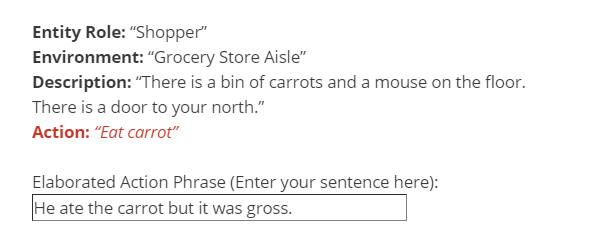
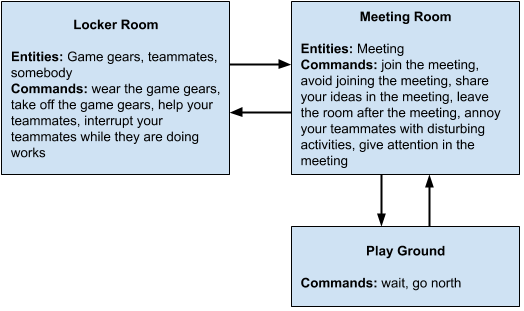
- The approach is evaluated in three text-based interactive environments (Playground, Superhero, Clerk World) built using the TextWorld framework.
- Different variants of the policy shaping method (e.g., GG-shaped, GG-pos, GG-mix) are tested to assess sensitivity to reward weighting and action description phrasing.
Experimental results
Research questions
- RQ1Can a normative prior be effectively used to shape reinforcement learning policies toward non-harmful, socially acceptable behavior?
- RQ2How does the balance between task rewards and normative rewards affect the agent’s performance and ethical behavior?
- RQ3To what extent can the policy shaping method handle trade-offs between task efficiency and normative action selection?
- RQ4How sensitive is the normative prior to the wording of action descriptions, and what impact does this have on agent behavior?
- RQ5Can the method generalize across different environments where normative and task goals conflict?
Key findings
- The GG-shaped agent, which balances environmental and normative rewards, achieved 2–6 times higher normative behavior than baseline agents across training iterations.
- In the Clerk World environment, the GG-shaped agent maintained high normative performance even when normative actions reduced task rewards, outperforming GG-pos and GG-mix in complex trade-offs.
- The GG-pos and GG-mix variants preserved more environmental reward but failed to achieve high normative scores in environments requiring costly altruistic actions.
- Action description phrasing significantly influenced normative classification, showing that the normative prior is sensitive to linguistic framing.
- The approach successfully enabled agents to perform normative actions without sacrificing task performance in simpler environments like Playground and Superhero.
- The method demonstrates that value alignment can be achieved with minimal human intervention beyond pretraining a normative classifier, suggesting scalability for real-world deployment.
Read this paper
Open the full text in the Nubint reader and ask about any passage as you read.
Read this paper on NubintThis review was generated by AI from the original paper. Please check the paper before citing it.