
[Paper Review] Traj-LIO: A Resilient Multi-LiDAR Multi-IMU State Estimator Through Sparse Gaussian Process
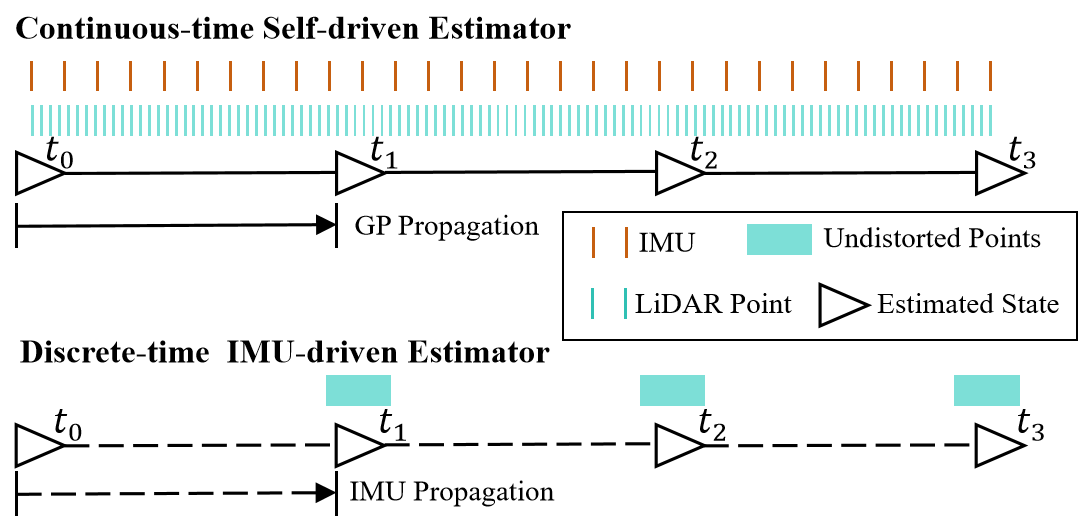
Traj-LIO presents a continuous-time, GP-based multi-LiDAR and multi-IMU state estimator that is self-driven (IMU-independent) and resilient to sensor failures by decoupling rotation and translation in SO(3) and vector space.
Nowadays, sensor suits have been equipped with redundant LiDARs and IMUs to mitigate the risks associated with sensor failure. It is challenging for the previous discrete-time and IMU-driven kinematic systems to incorporate multiple asynchronized sensors, which are susceptible to abnormal IMU data. To address these limitations, we introduce a multi-LiDAR multi-IMU state estimator by taking advantage of Gaussian Process (GP) that predicts a non-parametric continuous-time trajectory to capture sensors' spatial-temporal movement with limited control states. Since the kinematic model driven by three types of linear time-invariant stochastic differential equations are independent of external sensor measurements, our proposed approach is capable of handling different sensor configurations and resilient to sensor failures. Moreover, we replace the conventional $\mathrm{SE}(3)$ state representation with the combination of $\mathrm{SO}(3)$ and vector space, which enables GP-based LiDAR-inertial system to fulfill the real-time requirement. Extensive experiments on the public datasets demonstrate the versatility and resilience of our proposed multi-LiDAR multi-IMU state estimator. To contribute to the community, we will make our source code publicly available.
Motivation & Objective
- Motivate robust state estimation when using redundant, asynchronous LiDARs and IMUs amid potential sensor failures.
- Develop a continuous-time, GP-based framework to fuse multiple sensors without relying on a fixed discrete-time pipeline.
- Decouple rotation and translation to enable analytic Jacobians and real-time performance in LiDAR-inertial odometry.
- Provide a self-driven kinematic model driven by GP priors, independent of IMU data, to enhance resilience.
Proposed method
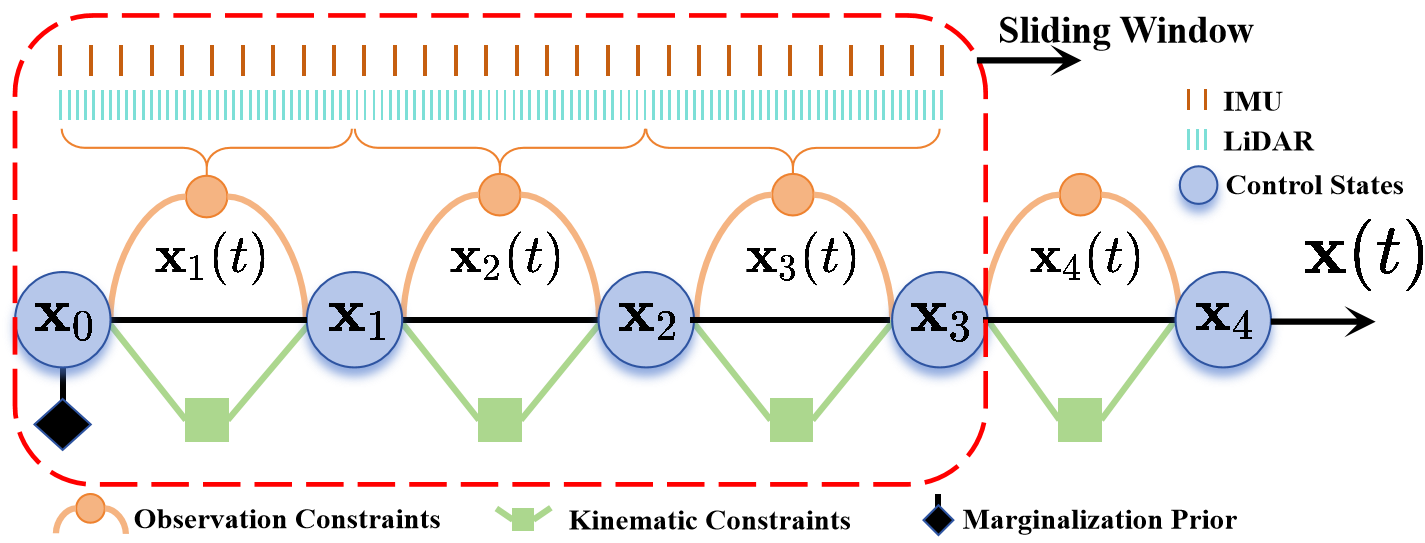
- Represent the continuous-time state x(t) with a Gaussian Process over a time window, enabling querying at any timestamp via interpolation.
- Use three GP priors on vector space (Random Walk, Constant Velocity, Constant Acceleration) and a manifold-aware GP on SO(3) to model rotation.
- Decouple rotation (SO(3)) from translation (vector space) to simplify Jacobians and integrate IMU measurements.
- Adopt a self-driven kinematic model driven by sparse GP priors that does not rely on IMU input for propagation.
- Formulate state estimation as a sparse GP regression with a piecewise LTISDE and analytic Jacobians for real-time performance.
- Employ a continuous-time sliding-window optimization that marginalizes old states while interpolating sensor measurements at their timestamps.
Experimental results
Research questions
- RQ1How can a multi-LiDAR multi-IMU system be fused in a continuous-time framework without requiring synchronous sensor measurements?
- RQ2Can a GP-based, self-driven kinematic model maintain accuracy and resilience when some IMUs or LiDARs fail or provide degraded data?
- RQ3Does decoupling rotation and translation improve computational efficiency and enable real-time GP-based LiDAR-inertial odometry?
- RQ4To what extent can the proposed method handle various sensor configurations and still achieve competitive accuracy on public datasets?
Key findings
- The approach achieves resilience to sensor failures by treating all sensor inputs as measurements within a GP-based, self-driven kinematic model.
- Decoupling rotation (SO(3)) from translation enables analytic Jacobians and supports real-time performance in GP-based estimation.
- The method supports flexible sensor configurations, including multiple LiDARs and multiple IMUs, with a continuous-time trajectory representation.
- Interpolation within GP priors allows querying states at arbitrary timestamps, reducing the need for dense discrete states.
- The framework demonstrates competitive accuracy across handheld to aggressive UAV datasets, illustrating versatility.
Read this paper
Open the full text in the Nubint reader and ask about any passage as you read.
Read this paper on NubintThis review was generated by AI from the original paper. Please check the paper before citing it.