
[Paper Review] Trajectory Design for Energy Minimization in UAV-enabled Wireless Communications with Latency Constraints
This paper proposes a two-stage trajectory design for UAV-enabled wireless communications to minimize energy consumption while satisfying user latency constraints. It uses dynamic programming (DP) to find near-optimal paths based on the time-windowed traveling salesman problem (TSPTW), then jointly optimizes UAV velocity across hops; DP achieves near-exhaustive performance with significantly lower complexity, outperforming benchmarks in energy efficiency and outage performance.
This paper studies energy-efficient unmanned aerial vehicle (UAV)-enabled wireless communications, where the UAV acts as a flying base station (BS) to serve the ground users (GUs) within some predetermined latency constraints, e.g., requested timeout (RT). Our goal is to design the UAV trajectory to minimize the total energy consumption while satisfying the RT requirement and energy budget, which is accomplished via jointly optimizing the trajectory and UAV's velocities along subsequent hops. The corresponding optimization problem is difficult to solve due to its non-convexity and combinatorial nature. To overcome this difficulty, we solve the original problem via two consecutive steps. Firstly, we propose two algorithms, namely heuristic search, and dynamic programming (DP) to obtain a feasible set of trajectories without violating the GU's RT requirements based on the traveling salesman problem with time window (TSPTW). Then, they are compared with exhaustive search and traveling salesman problem (TSP) used as reference methods. While the exhaustive algorithm achieves the best performance at a high computation cost, the heuristic algorithm exhibits poorer performance with low complexity. As a result, the DP is proposed as a practical trade-off between the exhaustive and heuristic algorithms. Specifically, the DP algorithm results in near-optimal performance at a much lower complexity. Secondly, for given feasible trajectories, we propose an energy minimization problem via a joint optimization of the UAV's velocities along subsequent hops. Finally, numerical results are presented to demonstrate the effectiveness of our proposed algorithms. ...
Motivation & Objective
- Address the challenge of minimizing UAV energy consumption in wireless networks while meeting strict user latency requirements.
- Overcome the non-convex and combinatorial nature of the joint trajectory and velocity optimization problem.
- Design a feasible trajectory that satisfies ground users’ requested timeout (RT) constraints and energy budget.
- Balance performance and computational complexity by proposing a practical trade-off between exhaustive search and heuristic methods.
- Enable energy-efficient UAV operation in dynamic or sparse network environments where traditional infrastructure is impractical.
Proposed method
- Formulate the trajectory design problem as a time-windowed traveling salesman problem (TSPTW) to incorporate user latency constraints.
- Propose two algorithms—heuristic search and dynamic programming (DP)—to generate feasible UAV paths without violating RT requirements.
- Use dynamic programming as a practical alternative to exhaustive search, achieving near-optimal performance with reduced computational complexity.
- For each feasible path, jointly optimize UAV velocity across hops to minimize total energy consumption using energy models from Eq. (11).
- Integrate the best-performing path from the DP algorithm into a two-stage optimization: first path selection, then velocity optimization.
- Apply block coordinate descent with successive convex approximation (SCA) as a potential extension for fine-tuning trajectories to waypoints.
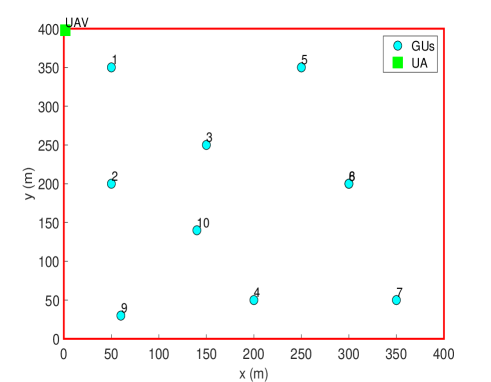
Experimental results
Research questions
- RQ1How can UAV trajectory and velocity be jointly optimized to minimize energy consumption under strict latency constraints?
- RQ2What is the trade-off between computational complexity and performance in finding feasible UAV paths that satisfy user RT requirements?
- RQ3Can dynamic programming provide a near-optimal solution with significantly lower complexity than exhaustive search in UAV trajectory planning?
- RQ4How does the proposed method compare to baseline approaches like TSP and heuristic search in terms of energy efficiency and outage performance?
- RQ5To what extent can variable-speed trajectory design improve UAV energy efficiency compared to fixed-velocity schemes?
Key findings
- The dynamic programming (DP) algorithm achieves near-exhaustive performance in energy consumption while reducing computational complexity significantly.
- The DP-based trajectory design reduces average energy consumption to within close range of the exhaustive search, with a much lower running time.
- The heuristic algorithm shows poorer performance than both DP and exhaustive search, with a growing energy gap as network size increases.
- Energy consumption increases with network size due to longer travel distances and higher velocity requirements, especially when $V_{ ext{max}}$ is constrained.
- The running time of the exhaustive search increases exponentially with the number of ground users, making it impractical for large-scale deployments.
- The proposed DP-based method outperforms the TSP-based reference scheme in both energy consumption and outage probability, demonstrating superior robustness and efficiency.
Read this paper
Open the full text in the Nubint reader and ask about any passage as you read.
Read this paper on NubintThis review was generated by AI from the original paper. Please check the paper before citing it.