
[Paper Review] Transferability of datasets between Machine-Learning Interaction Potentials
This study investigates the transferability of machine learning training datasets between differentiable machine learning interaction potentials (MLIPs), demonstrating that data optimized for one model—especially MACE—can effectively fine-tune other architectures. Key results show that human-designed data improve performance across models, while active-learned data from one algorithm rarely benefit others, with MACE showing superior generalization even on minimal datasets.
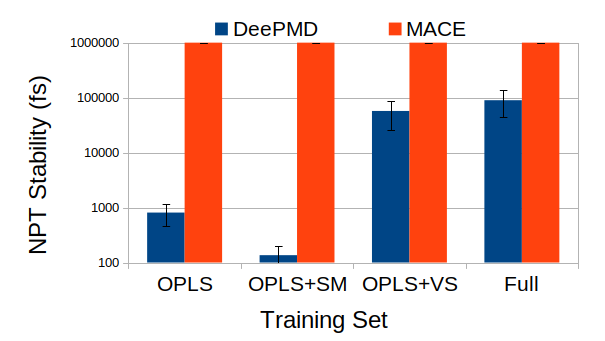
With the emergence of Foundational Machine Learning Interatomic Potential (FMLIP) models trained on extensive datasets, transferring data between different ML architectures has become increasingly important. In this work, we examine the extent to which training data optimised for one machine-learning forcefield algorithm may be re-used to train different models, aiming to accelerate FMLIP fine-tuning and to reduce the need for costly iterative training. As a test case, we train models of an organic liquid mixture that is commonly used as a solvent in rechargeable battery electrolytes, making it an important target for reactive MLIP development. We assess model performance by analysing the properties of molecular dynamics trajectories, showing that this is a more stringent test than comparing prediction errors for fixed datasets. We consider several types of training data, and several popular MLIPs - notably the recent MACE architecture, a message-passing neural network designed for high efficiency and smoothness. We demonstrate that simple training sets constructed without any ab initio dynamics are sufficient to produce stable models of molecular liquids. For simple neural-network architectures, further iterative training is required to capture thermodynamic and kinetic properties correctly, but MACE performs well with extremely limited datsets. We find that configurations designed by human intuition to correct systematic model deficiencies transfer effectively between algorithms, but active-learned data that are generated by one MLIP do not typically benefit a different algorithm. Finally, we show that any training data which improve model performance also improve its ability to generalise to similar unseen molecules. This suggests that trajectory failure modes are connected with chemical structure rather than being entirely system-specific.
Motivation & Objective
- To assess how effectively training data from one MLIP architecture can be reused to train different models, reducing iterative training costs.
- To evaluate whether data generated via active learning in one model can benefit a different MLIP architecture.
- To determine the impact of dataset size and composition on model generalization to unseen molecular systems.
- To compare the performance of diverse MLIP architectures—especially MACE—on a complex organic liquid mixture relevant to battery electrolytes.
- To identify practical principles for accelerating fine-tuning of foundational MLIPs using transferable training data.
Proposed method
- Trained multiple MLIP architectures—including MACE, traditional message-passing networks, and GAP/DeePMD—on a common dataset of configurations from a battery-relevant organic liquid mixture.
- Generated training data using both human-informed selection (targeting model deficiencies) and active learning (using prediction error to select new configurations).
- Assessed model performance via long molecular dynamics trajectories, focusing on thermodynamic and kinetic stability rather than just local prediction error.
- Validated predictions against reference DFT data by sampling configurations from NVT trajectories and comparing energy and force errors.
- Used a 1:1 comparison of MACE and DeePMD models trained on the same dataset to evaluate error evolution and accuracy in diffusion coefficient estimation.
- Analyzed the correlation between prediction errors and reference DFT values to assess model reliability in exploring high-energy regions of the potential energy surface.
Experimental results
Research questions
- RQ1To what extent can training data optimized for one MLIP architecture be successfully transferred to improve performance in another architecture?
- RQ2How does the performance of MACE compare to traditional neural networks when trained on the same transferred datasets, particularly with limited data?
- RQ3Can active-learned data from one MLIP model effectively improve the performance of a different MLIP architecture?
- RQ4Does the size and composition of a transferred dataset influence the ability of a model to generalize to unseen molecular configurations?
- RQ5Are failure modes in molecular dynamics trajectories primarily due to chemical structure or system-specific configuration space deficiencies?
Key findings
- Human-designed training data that correct systematic model deficiencies are effectively transferable across different MLIP architectures, improving stability and accuracy in molecular dynamics.
- Active-learned data generated by one MLIP model (e.g., DeePMD) show limited transferability to other architectures, indicating algorithm-specific learning patterns.
- MACE achieves high accuracy and stability with minimal training data, outperforming traditional message-passing networks even when trained on the same small datasets.
- Prediction errors in DeePMD models increase significantly over time in MD trajectories, indicating drift from well-trained regions, while MACE maintains low and stable errors (~4 meV/atom for energy, ~25 meV/Å for forces).
- Configurations with high DFT energy and large prediction errors are more frequently sampled by DeePMD than by MACE, suggesting MACE explores more reliable regions of the potential energy surface.
- Any training data that improve performance on the base molecule also enhance stability for related, unseen molecules, indicating that trajectory failure modes are linked to chemical structure rather than system-specific artifacts.

Read this paper
Open the full text in the Nubint reader and ask about any passage as you read.
Read this paper on NubintThis review was generated by AI from the original paper. Please check the paper before citing it.