
[Paper Review] Transformers and Large Language Models for Efficient Intrusion Detection Systems: A Comprehensive Survey
This survey analyzes how Transformers and large language models are applied to intrusion detection systems, covering architectures, datasets, metrics, and open challenges.
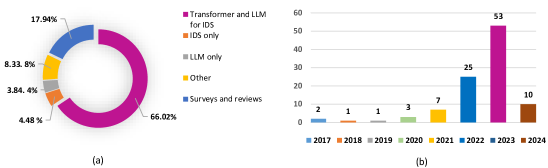
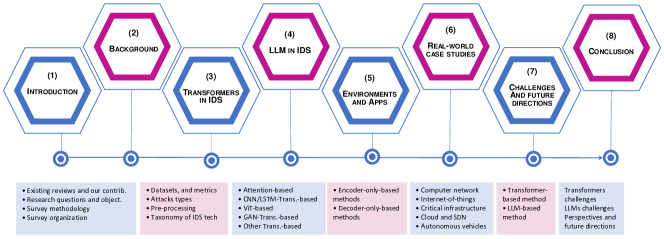
With significant advancements in Transformers LLMs, NLP has extended its reach into many research fields due to its enhanced capabilities in text generation and user interaction. One field benefiting greatly from these advancements is cybersecurity. In cybersecurity, many parameters that need to be protected and exchanged between senders and receivers are in the form of text and tabular data, making NLP a valuable tool in enhancing the security measures of communication protocols. This survey paper provides a comprehensive analysis of the utilization of Transformers and LLMs in cyber-threat detection systems. The methodology of paper selection and bibliometric analysis is outlined to establish a rigorous framework for evaluating existing research. The fundamentals of Transformers are discussed, including background information on various cyber-attacks and datasets commonly used in this field. The survey explores the application of Transformers in IDSs, focusing on different architectures such as Attention-based models, LLMs like BERT and GPT, CNN/LSTM-Transformer hybrids, emerging approaches like ViTs, among others. Furthermore, it explores the diverse environments and applications where Transformers and LLMs-based IDS have been implemented, including computer networks, IoT devices, critical infrastructure protection, cloud computing, SDN, as well as in autonomous vehicles. The paper also addresses research challenges and future directions in this area, identifying key issues such as interpretability, scalability, and adaptability to evolving threats, and more. Finally, the conclusion summarizes the findings and highlights the significance of Transformers and LLMs in enhancing cyber-threat detection capabilities, while also outlining potential avenues for further research and development.
Motivation & Objective
- Explain the motivation for applying Transformers and LLMs to IDS and compare with traditional ML/DL models.
- Survey Transformer-based architectures and LLM variants used in IDS across environments.
- Catalog datasets, metrics, and evaluation approaches for Transformer/LLM-based IDS.
- Identify challenges, gaps, and future directions for Transformer and LLM-based IDS.
Proposed method
- Perform a structured literature review of Transformers and LLM-based IDS from 2017 to 2024 using Scopus and other sources.
- Provide taxonomy of IDS types (HIDS/NIDS) and attack categories, and map them to Transformer/LLM techniques.
- Analyze Transformer architectures (Attention-based models, CNN/LSTM-Transformer, ViT, GAN-Transformer, GPT, BERT) and their IDS applications.
- Review datasets, evaluation metrics, and data preprocessing steps used in Transformer/LLM-based IDS studies.
- Highlight applications across networks, IoT/IIoT, critical infrastructure, cloud/SDN, and autonomous vehicles, and discuss challenges and future directions.
Experimental results
Research questions
- RQ1RQ1: What drives the use of Transformers and LLMs in IDS and what benefits do they provide over traditional ML/DL models?
- RQ2RQ2: What are the current Transformer/LLM-based IDS methodologies for various attack types and how successful are they?
- RQ3RQ3: How do Transformer/LLM-based IDS methods compare with traditional methods in accuracy and efficiency?
- RQ4RQ4: How can interpretability of Transformer/LLM-based IDS be improved and what are the current trends and challenges?
- RQ5RQ5: What are the primary applications of Transformer/LLM-based IDS in diverse network settings?
- RQ6RQ6: What future research areas are critical for Transformer and LLM-based IDS?
Key findings
- Transformers and LLMs are proposed to address limitations of traditional IDS, including handling sequential and temporal patterns in network data.
- The survey catalogues architectures such as attention-based models, CNN/LSTM-Transformer hybrids, ViT, GAN-Transformer, GPT, and BERT variants used in IDS.
- A diverse set of datasets and evaluation metrics are used to assess IDS performance, with MCC and FPR highlighted among specialized metrics.
- The paper discusses applications across computer networks, IoT/IIoT, critical infrastructure, cloud, SDN, and autonomous vehicles.
- Open challenges include interpretability, scalability, and adaptability to evolving threats, with recommendations for future research directions.
Read this paper
Open the full text in the Nubint reader and ask about any passage as you read.
Read this paper on NubintThis review was generated by AI from the original paper. Please check the paper before citing it.