
[Paper Review] Transformers in Single Object Tracking: An Experimental Survey
This paper presents a comprehensive survey and experimental evaluation of Transformer-based single-object tracking methods, categorizing them into CNN-Transformer, two-stream two-stage, and one-stream one-stage fully-Transformer trackers. It demonstrates that one-stream one-stage fully-Transformer trackers achieve state-of-the-art performance in tracking robustness, while identifying key challenges in handling small targets, occlusions, and low-resolution scenarios.
Single-object tracking is a well-known and challenging research topic in computer vision. Over the last two decades, numerous researchers have proposed various algorithms to solve this problem and achieved promising results. Recently, Transformer-based tracking approaches have ushered in a new era in single-object tracking by introducing new perspectives and achieving superior tracking robustness. In this paper, we conduct an in-depth literature analysis of Transformer tracking approaches by categorizing them into CNN-Transformer based trackers, Two-stream Two-stage fully-Transformer based trackers, and One-stream One-stage fully-Transformer based trackers. In addition, we conduct experimental evaluations to assess their tracking robustness and computational efficiency using publicly available benchmark datasets. Furthermore, we measure their performances on different tracking scenarios to identify their strengths and weaknesses in particular situations. Our survey provides insights into the underlying principles of Transformer tracking approaches, the challenges they encounter, and the future directions they may take.
Motivation & Objective
- To systematically categorize and analyze recent Transformer-based tracking approaches in single-object tracking.
- To evaluate the tracking robustness and computational efficiency of Transformer trackers using standard benchmark datasets.
- To identify performance gaps in challenging scenarios such as occlusion, fast motion, and low resolution.
- To provide insights into the limitations of fully-Transformer trackers, especially regarding small target tracking and local feature learning.
- To propose future research directions for improving Transformer-based tracking through architectural enhancements and attention mechanisms.
Proposed method
- Categorize Transformer-based trackers into three types: CNN-Transformer, two-stream two-stage fully-Transformer, and one-stream one-stage fully-Transformer architectures.
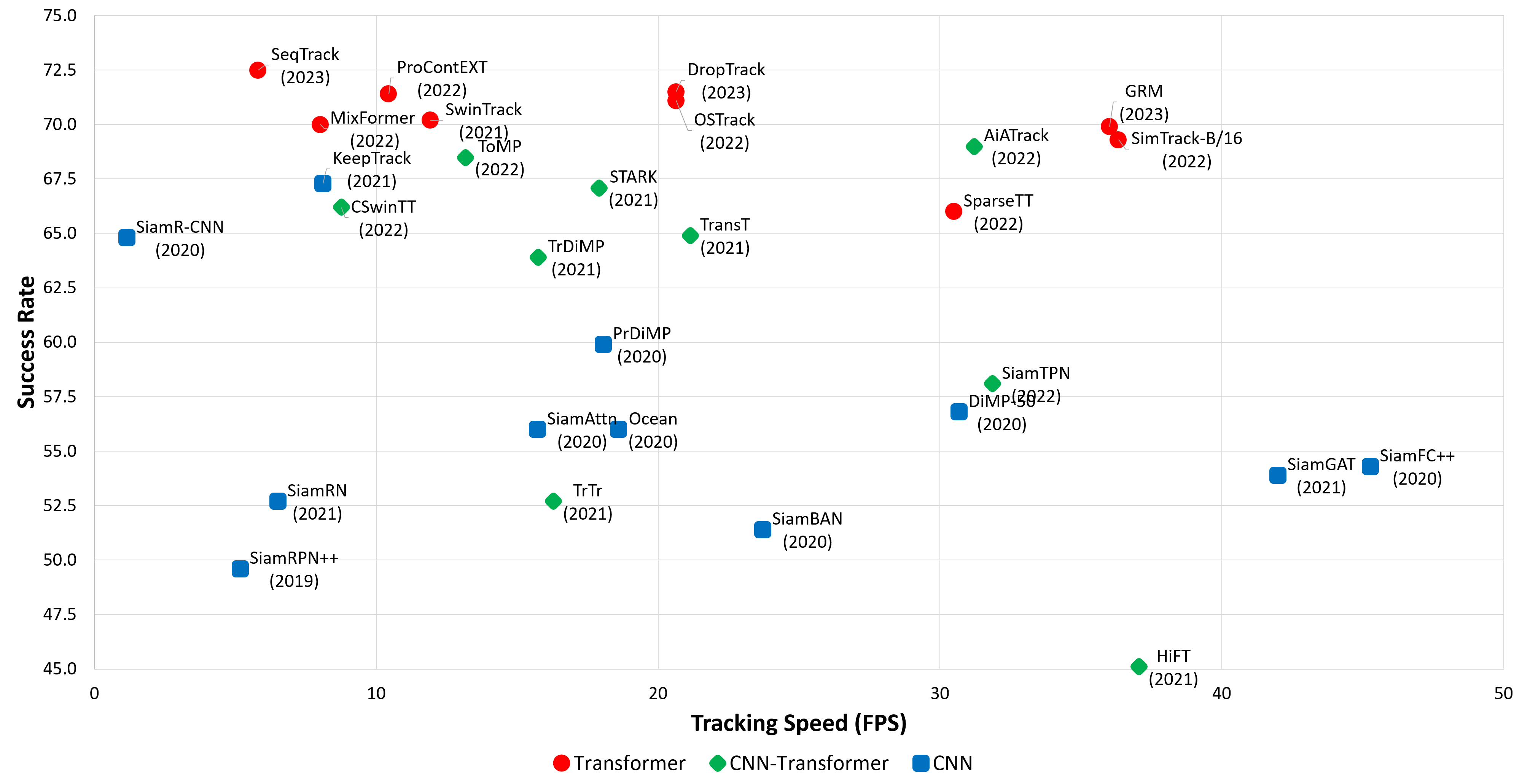
- Conduct experimental evaluations on public benchmark datasets, including LaSOT, to compare tracking performance and inference speed.
- Measure performance across diverse tracking scenarios—full occlusion, fast motion, low resolution, and background clutter—using standard metrics like success and precision scores.
- Analyze attention mechanisms and token processing strategies, particularly focusing on patch-level attention and its limitations in capturing local features.
- Investigate the impact of architectural components such as hierarchical design, target-specific patch merging, and distractor-aware token selection on tracking accuracy.
- Propose improvements such as target size-aware attention and temporal-aware token selection to enhance robustness and efficiency.
Experimental results
Research questions
- RQ1How do different Transformer-based tracking architectures (CNN-Transformer, two-stream, one-stream) compare in terms of tracking accuracy and computational efficiency?
- RQ2What are the key performance limitations of fully-Transformer trackers in challenging scenarios like occlusion, fast motion, and low resolution?
- RQ3Why do fully-Transformer trackers underperform on small target objects, and what architectural modifications can improve their performance?
- RQ4How does the patch-level attention mechanism affect local feature learning, and what techniques can enhance local representation in Transformers?
- RQ5What role does token selection play in mitigating background interference, and how can it be improved using temporal context?
Key findings
- One-stream one-stage fully-Transformer based trackers achieve state-of-the-art performance in tracking robustness across benchmark datasets.
- Fully-Transformer trackers achieve success scores of only 60.1%, 64.5%, and 65.6% on LaSOT for fast motion, full occlusion, and low-resolution scenarios, respectively, indicating significant performance gaps.
- CNN-Transformer based trackers maintain a favorable balance between tracking robustness and computational efficiency, outperforming pure Transformer models in speed-sensitive applications.
- The patch-level attention mechanism in standard Vision Transformers fails to capture sufficient appearance cues for small targets, leading to poor performance in small-object tracking.
- Incorporating target-specific patch merging techniques, such as those in T2T-ViT, can enhance local feature learning and improve tracking accuracy.
- Token selection mechanisms that exclude background and distractor tokens—especially when informed by temporal context—can significantly improve both accuracy and efficiency of Transformer trackers.
Read this paper
Open the full text in the Nubint reader and ask about any passage as you read.
Read this paper on NubintThis review was generated by AI from the original paper. Please check the paper before citing it.