
[Paper Review] Transforming Unstructured Text into Data with Context Rule Assisted Machine Learning (CRAML)
This paper introduces Context Rule Assisted Machine Learning (CRAML), a no-code, hybrid methodology enabling domain experts to transform unstructured text into structured, labeled datasets using expert-written context rules, which are then used to train interpretable, reproducible machine learning models. CRAML enables scalable, transparent, and traceable text classification, demonstrated through three applications: analyzing management literature, classifying proprietary job ads for labor market insights, and detecting thousands of previously overlooked 'no poach' clauses in franchise disclosure documents.
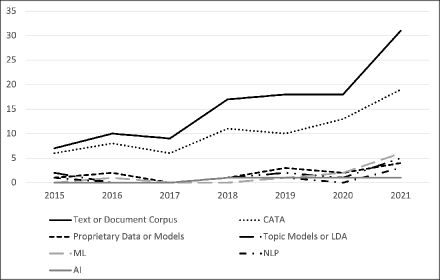
We describe a method and new no-code software tools enabling domain experts to build custom structured, labeled datasets from the unstructured text of documents and build niche machine learning text classification models traceable to expert-written rules. The Context Rule Assisted Machine Learning (CRAML) method allows accurate and reproducible labeling of massive volumes of unstructured text. CRAML enables domain experts to access uncommon constructs buried within a document corpus, and avoids limitations of current computational approaches that often lack context, transparency, and interpetability. In this research methods paper, we present three use cases for CRAML: we analyze recent management literature that draws from text data, describe and release new machine learning models from an analysis of proprietary job advertisement text, and present findings of social and economic interest from a public corpus of franchise documents. CRAML produces document-level coded tabular datasets that can be used for quantitative academic research, and allows qualitative researchers to scale niche classification schemes over massive text data. CRAML is a low-resource, flexible, and scalable methodology for building training data for supervised ML. We make available as open-source resources: the software, job advertisement text classifiers, a novel corpus of franchise documents, and a fully replicable start-to-finish trained example in the context of no poach clauses.
Motivation & Objective
- To address the challenge of transforming unstructured text into structured, labeled data for quantitative and qualitative research.
- To empower domain experts to build custom, interpretable machine learning models without requiring programming or ML expertise.
- To overcome limitations of current NLP and ML methods in handling context, transparency, and interpretability in text classification.
- To create a scalable, low-resource framework for generating training data from large text corpora using human-in-the-loop rule development.
- To establish new standards for transparency and replicability in text-to-data machine learning, especially with proprietary or sensitive data.
Proposed method
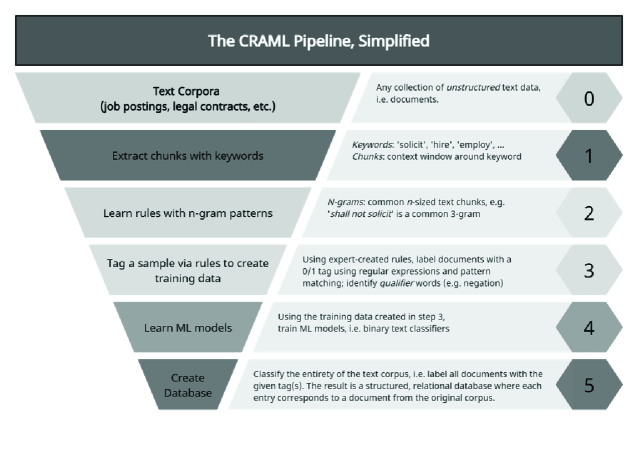
- CRAML uses a hybrid workflow combining expert-written context rules with machine learning to transform unstructured text into structured, tabular datasets.
- The method begins with qualitative coding by domain experts who define context-sensitive rules to identify specific constructs within text.
- These rules are applied iteratively to large text corpora to generate labeled training data, which is then used to train supervised machine learning classifiers.
- The framework supports incremental refinement of rules and model performance through user feedback and evaluation.
- CRAML is implemented via open-source software tools that allow users to build, test, and deploy custom text classification models on desktop systems.
- The approach enables full replication of the entire pipeline, from rule creation to model training, using publicly released datasets and code.
Experimental results
Research questions
- RQ1How can domain experts systematically extract niche, context-dependent constructs from large volumes of unstructured text?
- RQ2To what extent can expert-written context rules improve the accuracy and interpretability of machine learning models for text classification compared to purely data-driven approaches?
- RQ3Can a no-code, rule-assisted machine learning framework scale qualitative coding schemes across massive text corpora while maintaining transparency and reproducibility?
- RQ4What is the impact of CRAML in uncovering previously undetected patterns in sensitive or proprietary text data, such as no poach clauses in franchise documents?
- RQ5How can CRAML support researchers in accessing and analyzing confidential or restricted text data without compromising privacy or data ownership?
Key findings
- CRAML successfully identified thousands more suspected 'no poach' clauses in franchise disclosure documents than previously documented, suggesting widespread potential antitrust violations.
- The method enabled the creation of a fully replicable, rectangular dataset of suspected no poach clauses from a newly published, large corpus of franchise disclosure documents.
- The CRAML framework produced machine learning classifiers for job advertisement text that are transparent, interpretable, and publicly available, setting a new standard for research in labor market analysis.
- The approach allowed researchers to analyze proprietary job ad data without accessing the full confidential text, by extracting and classifying only relevant keyword-identified segments.
- CRAML demonstrated high scalability and accuracy in transforming qualitative coding schemes into quantitative datasets, even for complex, context-sensitive constructs.
- The open-source release of software, models, rules, and datasets enables full replication and extension of all three case studies by other researchers.
Read this paper
Open the full text in the Nubint reader and ask about any passage as you read.
Read this paper on NubintThis review was generated by AI from the original paper. Please check the paper before citing it.