
[Paper Review] Transmit Design for Joint MIMO Radar and Multiuser Communications with Transmit Covariance Constraint
This paper proposes a joint MIMO radar and multiuser communication system where the transmit covariance is fixed to ensure optimal radar performance, while optimizing downlink communication via transmit beamforming and dirty paper coding (DPC). By leveraging Lagrange duality and downlink-uplink duality, the non-convex SINR balancing and sum rate maximization problems are reformulated as convex optimizations, enabling efficient gradient-based solutions. DPC significantly improves user SINRs compared to beamforming, but performance is limited by the rank of the fixed covariance matrix.
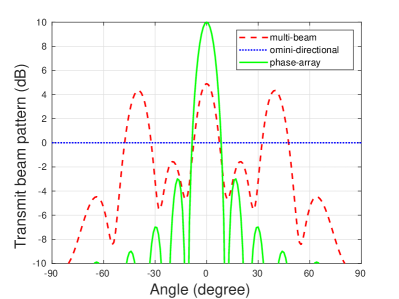
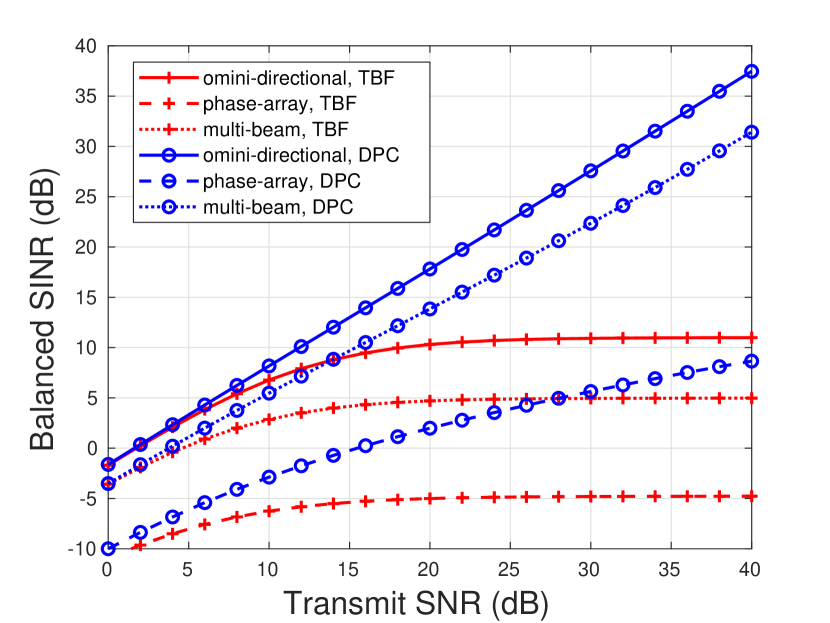
In this paper, we consider the design of a multiple-input multiple-output (MIMO) transmitter which simultaneously functions as a MIMO radar and a base station for downlink multiuser communications. In addition to a power constraint, we require the covariance of the transmit waveform be equal to a given optimal covariance for MIMO radar, to guarantee the radar performance. With this constraint, we formulate and solve the signal-to-interference-plus-noise ratio (SINR) balancing problem for multiuser transmit beamforming via convex optimization. Considering that the interference cannot be completely eliminated with this constraint, we introduce dirty paper coding (DPC) to further cancel the interference, and formulate the SINR balancing and sum rate maximization problem in the DPC regime. Although both of the two problems are non-convex, we show that they can be reformulated to convex optimizations via the Lagrange and downlink-uplink duality. In addition, we propose gradient projection based algorithms to solve the equivalent dual problem of SINR balancing, in both transmit beamforming and DPC regimes. The simulation results demonstrate significant performance improvement of DPC over transmit beamforming, and also indicate that the degrees of freedom for the communication transmitter is restricted by the rank of the covariance.
Motivation & Objective
- To design a MIMO transmitter that simultaneously supports MIMO radar and downlink multiuser communications with guaranteed radar performance.
- To maintain optimal radar performance by constraining the transmit waveform's covariance to a pre-defined optimal value, independent of communication signals.
- To optimize multiuser communication performance under this strict radar constraint, focusing on SINR balancing and sum rate maximization.
- To develop low-complexity, convergent algorithms for solving the resulting non-convex optimization problems via duality.
- To quantify the performance limits of communication in the presence of a fixed radar covariance, particularly the impact of its rank on degrees of freedom.
Proposed method
- Formulates the communication optimization under a fixed transmit covariance constraint derived from optimal radar waveform design.
- Reformulates the SINR balancing problem for transmit beamforming as a linear conic optimization via Lagrange duality, enabling efficient solution via gradient projection.
- Applies dirty paper coding (DPC) to cancel inter-user interference under the same covariance constraint, enabling higher spectral efficiency.
- Uses downlink-uplink duality to transform the non-convex sum rate maximization problem into a convex-concave saddle point problem, solvable via linear conic optimization.
- Proposes gradient projection algorithms to solve the dual problems in both beamforming and DPC regimes, ensuring fast convergence and low complexity.
- Derives analytical expressions for gradients and projections using matrix calculus and eigen-decomposition, enabling numerical implementation.
Experimental results
Research questions
- RQ1Can multiuser communication performance be maximized under a strict transmit covariance constraint that preserves optimal MIMO radar performance?
- RQ2How does the fixed radar covariance limit the degrees of freedom available for communication beamforming and interference cancellation?
- RQ3To what extent does dirty paper coding (DPC) improve SINR performance compared to linear transmit beamforming under the same radar constraint?
- RQ4Can the non-convex optimization problems for SINR balancing and sum rate maximization be reformulated into convex forms using duality?
- RQ5What is the impact of the covariance matrix rank on the achievable communication sum rate and SINR in the joint radar-communications system?
Key findings
- DPC significantly improves user SINRs compared to linear transmit beamforming under the same transmit covariance constraint, demonstrating the effectiveness of interference cancellation.
- The SINR balancing problem in the beamforming regime is reformulated as a convex linear conic optimization via Lagrange duality, enabling low-complexity gradient-based solution.
- The sum rate maximization problem in the DPC regime is transformed into a convex-concave saddle point problem using downlink-uplink duality, which is further solved via equivalent linear conic optimization.
- The performance of the communication system is fundamentally limited by the rank of the fixed transmit covariance matrix, which restricts the number of independent spatial streams.
- Simulation results confirm that the proposed gradient projection algorithms converge quickly and achieve high performance, especially in the DPC regime.
- The derived dual problems are strictly convex, ensuring global optimality and enabling reliable numerical solutions for practical system design.
Read this paper
Open the full text in the Nubint reader and ask about any passage as you read.
Read this paper on NubintThis review was generated by AI from the original paper. Please check the paper before citing it.