
[Paper Review] TranssionADD: A multi-frame reinforcement based sequence tagging model for audio deepfake detection
TranssionADD proposes a novel multi-frame reinforcement-based sequence tagging model for audio deepfake detection, framing the task as frame-level labeling to localize manipulated regions. By integrating RCNN-BLSTM feature extraction, multi-frame detection, data augmentation, and an isolated-frame penalty loss, the system achieved 2nd place in the ADD 2023 Manipulation Region Location Track, demonstrating superior robustness and outlier handling.
Thanks to recent advancements in end-to-end speech modeling technology, it has become increasingly feasible to imitate and clone a user`s voice. This leads to a significant challenge in differentiating between authentic and fabricated audio segments. To address the issue of user voice abuse and misuse, the second Audio Deepfake Detection Challenge (ADD 2023) aims to detect and analyze deepfake speech utterances. Specifically, Track 2, named the Manipulation Region Location (RL), aims to pinpoint the location of manipulated regions in audio, which can be present in both real and generated audio segments. We propose our novel TranssionADD system as a solution to the challenging problem of model robustness and audio segment outliers in the trace competition. Our system provides three unique contributions: 1) we adapt sequence tagging task for audio deepfake detection; 2) we improve model generalization by various data augmentation techniques; 3) we incorporate multi-frame detection (MFD) module to overcome limited representation provided by a single frame and use isolated-frame penalty (IFP) loss to handle outliers in segments. Our best submission achieved 2nd place in Track 2, demonstrating the effectiveness and robustness of our proposed system.
Motivation & Objective
- To address the challenge of detecting and localizing manipulated audio segments in real-world scenarios with noisy and variable data.
- To improve model generalization and robustness against outliers in time-series audio data.
- To develop a sequence tagging framework that enables precise localization of forged regions in audio, moving beyond binary classification.
- To reduce false positives from isolated or fragmented frame predictions through a novel loss function.
Proposed method
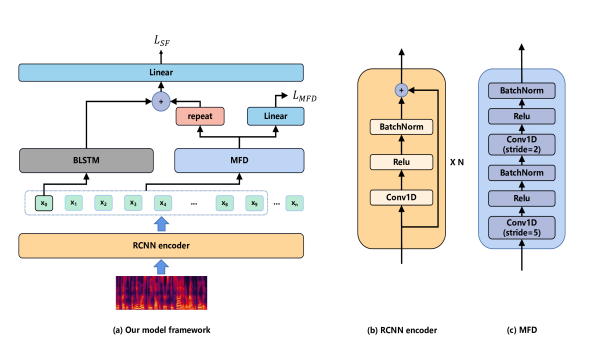
- The model treats audio deepfake detection as a sequence tagging task, predicting labels (real/fake) for each audio frame and merging contiguous frames with the same label to identify manipulated segments.
- It employs an RCNN-BLSTM backbone to extract spatial and temporal features from mel-spectrograms, capturing both spectral and sequential patterns.
- A multi-frame detection (MFD) module aggregates information across multiple adjacent frames to enhance local representation and improve robustness to noise.
- Data augmentation is applied both before and during training, including voice conversion, pitch shifting, and random noise injection (SNR < 15 dB) to improve generalization.
- An isolated-frame penalty (IFP) loss is introduced to penalize predictions where isolated frames (shorter than 6 frames) are labeled as fake, reducing false positives from outliers.
- The final score combines 30% sentence-level accuracy (A_sentence) and 70% segment-level F1-score (F1_segment), with an auxiliary iso-rate metric to evaluate outlier handling.
Experimental results
Research questions
- RQ1Can a sequence tagging approach outperform traditional binary classification in localizing manipulated audio regions?
- RQ2How effective is multi-frame feature aggregation in improving model robustness to noisy or outlier frames?
- RQ3To what extent do combined pre-training and in-training data augmentation techniques enhance model generalization in audio deepfake detection?
- RQ4Can an isolated-frame penalty loss effectively reduce false positives from fragmented or isolated frame predictions?
- RQ5How does the proposed system compare to baseline models in terms of both detection accuracy and outlier resilience?
Key findings
- TranssionADD achieved 2nd place in the ADD 2023 Manipulation Region Location Track, outperforming both the baseline RCNN-BLSTM and a modified RawNet2 model.
- The model achieved a significantly lower iso-rate (0.085) compared to the baseline (0.152), indicating better handling of isolated or fragmented predictions.
- The isolated-frame penalty (IFP) loss reduced the iso-rate by 44% compared to the baseline, demonstrating its effectiveness in suppressing outlier predictions.
- Ablation studies showed that removing the MFD module caused a notable drop in detection score, highlighting its key role in contextual feature learning.
- Combined pre-training and in-training data augmentation (BefAug & InAug) led to the largest performance gain, especially on the augmented development and test sets.
- The system achieved a final weighted score of 0.3*A_sentence + 0.7*F1_segment, with the highest F1_segment and A_sentence scores among all submissions.
Read this paper
Open the full text in the Nubint reader and ask about any passage as you read.
Read this paper on NubintThis review was generated by AI from the original paper. Please check the paper before citing it.