
[Paper Review] Tree of Clarifications: Answering Ambiguous Questions with Retrieval-Augmented Large Language Models
This paper proposes Tree of Clarifications (ToC), a retrieval-augmented framework that uses few-shot prompting and external knowledge to recursively generate a tree of disambiguated questions (DQs) for ambiguous queries in open-domain question answering. By leveraging retrieved passages to guide diverse clarification paths and pruning unhelpful branches, ToC generates comprehensive long-form answers, achieving state-of-the-art performance on the ASQA benchmark—surpassing fully supervised models in Disambig-F1 and Disambig-ROUGE with only 5-shot prompting.
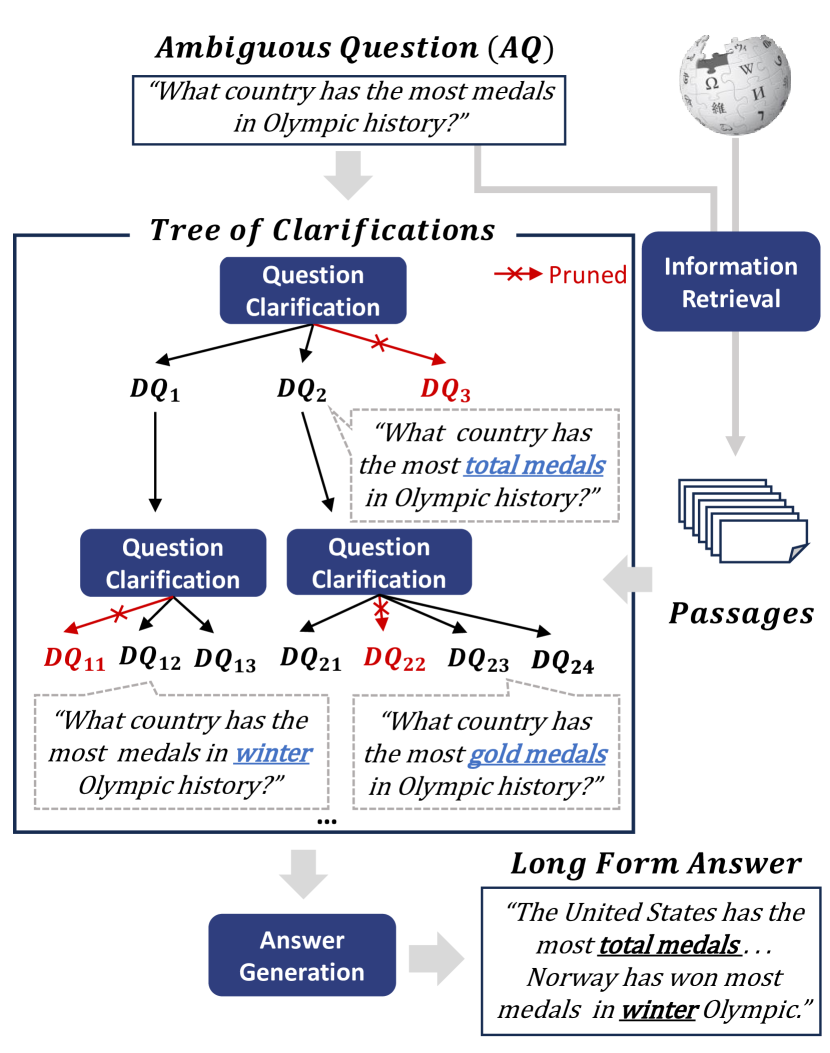
Questions in open-domain question answering are often ambiguous, allowing multiple interpretations. One approach to handling them is to identify all possible interpretations of the ambiguous question (AQ) and to generate a long-form answer addressing them all, as suggested by Stelmakh et al., (2022). While it provides a comprehensive response without bothering the user for clarification, considering multiple dimensions of ambiguity and gathering corresponding knowledge remains a challenge. To cope with the challenge, we propose a novel framework, Tree of Clarifications (ToC): It recursively constructs a tree of disambiguations for the AQ -- via few-shot prompting leveraging external knowledge -- and uses it to generate a long-form answer. ToC outperforms existing baselines on ASQA in a few-shot setup across the metrics, while surpassing fully-supervised baselines trained on the whole training set in terms of Disambig-F1 and Disambig-ROUGE. Code is available at https://github.com/gankim/tree-of-clarifications.
Motivation & Objective
- To address the challenge of answering ambiguous questions (AQs) in open-domain question answering (ODQA) without requiring user clarification.
- To overcome the limitations of LLMs in handling multi-dimensional ambiguity and factual hallucinations by integrating external knowledge through retrieval.
- To develop a structured, recursive method for exploring diverse interpretations of AQs while ensuring factual consistency and completeness.
- To generate long-form answers that comprehensively address all plausible disambiguated interpretations of the original AQ.
Proposed method
- Retrieves relevant Wikipedia passages for the ambiguous question (AQ) using a dense retrieval model.
- Applies few-shot prompting to generate disambiguated questions (DQs) from retrieved passages, exploring multiple dimensions of ambiguity.
- Constructs a tree structure (ToC) where each node represents a DQ, enabling recursive exploration of clarification paths.
- Implements a self-verification mechanism using LLMs to evaluate factual coherence between DQs and retrieved context, discarding inconsistent or unhelpful branches.
- Uses retrieved context and verified DQs as input to generate a long-form answer that integrates all valid interpretations.
- Employs a two-stage process: first, retrieval-augmented clarification (RAC) to generate and prune DQs; second, answer generation using disambiguated questions and context.
Experimental results
Research questions
- RQ1Can a retrieval-augmented LLM framework effectively explore multiple dimensions of ambiguity in open-domain questions without user interaction?
- RQ2How can external knowledge from retrieved passages guide LLMs to generate diverse and factually coherent disambiguated questions?
- RQ3To what extent can few-shot prompting with retrieval enhance the quality of long-form answers to ambiguous questions compared to fully supervised baselines?
- RQ4Can a tree-structured approach to clarification improve the comprehensiveness and factual consistency of answers compared to flat or sequential methods?
Key findings
- ToC achieves state-of-the-art performance on the ASQA benchmark in a 5-shot setup, outperforming existing few-shot baselines across all metrics.
- The 5-shot performance of ToC surpasses that of fully supervised baselines trained on the entire training set by 7.3 points in Disambig-F1 and 2.9 points in Disambig-ROUGE.
- The use of retrieval-augmented few-shot prompting significantly improves factual consistency and coverage of disambiguated interpretations compared to standard LLM prompting.
- The self-verification mechanism effectively filters out hallucinated or incoherent disambiguated questions, enhancing answer reliability.
- The tree-structured approach enables systematic exploration of multi-dimensional ambiguity, such as distinguishing between medal types or Olympic events in complex AQs.
- ToC demonstrates that retrieval-augmented LLMs can generate high-quality long-form answers without fine-tuning, even outperforming fully supervised models in key metrics.
Read this paper
Open the full text in the Nubint reader and ask about any passage as you read.
Read this paper on NubintThis review was generated by AI from the original paper. Please check the paper before citing it.