
[Paper Review] Tree-of-Mixed-Thought: Combining Fast and Slow Thinking for Multi-hop Visual Reasoning
This paper proposes Tree-of-Mixed-Thought (ToMT), a hybrid planning framework that combines fast one-stop generation (system-1 thinking) with Tree-of-Thought (ToT, system-2 thinking) to improve efficiency and accuracy in multi-hop visual reasoning. By strategically applying fast thinking at deeper nodes and using ToT for iterative refinement, ToMT reduces LLM inference steps by up to 50% while maintaining or improving plan accuracy on complex visual reasoning tasks.
There emerges a promising trend of using large language models (LLMs) to generate code-like plans for complex inference tasks such as visual reasoning. This paradigm, known as LLM-based planning, provides flexibility in problem solving and endows better interpretability. However, current research is mostly limited to basic scenarios of simple questions that can be straightforward answered in a few inference steps. Planning for the more challenging multi-hop visual reasoning tasks remains under-explored. Specifically, under multi-hop reasoning situations, the trade-off between accuracy and the complexity of plan-searching becomes prominent. The prevailing algorithms either address the efficiency issue by employing the fast one-stop generation or adopt a complex iterative generation method to improve accuracy. Both fail to balance the need for efficiency and performance. Drawing inspiration from the dual system of cognition in the human brain, the fast and the slow think processes, we propose a hierarchical plan-searching algorithm that integrates the one-stop reasoning (fast) and the Tree-of-thought (slow). Our approach succeeds in performance while significantly saving inference steps. Moreover, we repurpose the PTR and the CLEVER datasets, developing a systematic framework for evaluating the performance and efficiency of LLMs-based plan-search algorithms under reasoning tasks at different levels of difficulty. Extensive experiments demonstrate the superiority of our proposed algorithm in terms of performance and efficiency. The dataset and code will be release soon.
Motivation & Objective
- Address the inefficiency of Tree-of-Thought (ToT) in multi-hop visual reasoning due to high LLM inference cost from iterative search.
- Overcome the low accuracy of one-stop generation (fast thinking) in complex, long-horizon reasoning tasks.
- Develop a systematic evaluation framework to isolate and measure LLM planning performance independent of visual expert model errors.
- Enable efficient and accurate planning for multi-hop visual reasoning by integrating fast and slow thinking in a hierarchical manner.
Proposed method
- Propose two hybrid strategies: ToT-OS (Tree-of-Thought with One-Stop) and ToT-Block, which combine one-stop generation with ToT’s iterative, backtracking-based search.
- Apply one-stop generation only to nodes at depth >1 to avoid early errors while preserving the benefits of fast inference.
- Use a block-based approach where multiple reasoning steps are processed together to reduce LLM calls and improve efficiency.
- Design a scene graph interaction toolkit to enable direct, accurate access to visual information, decoupling LLM planning from visual model inaccuracies.
- Implement a sanity check mechanism to validate plan correctness and trigger backtracking when necessary.
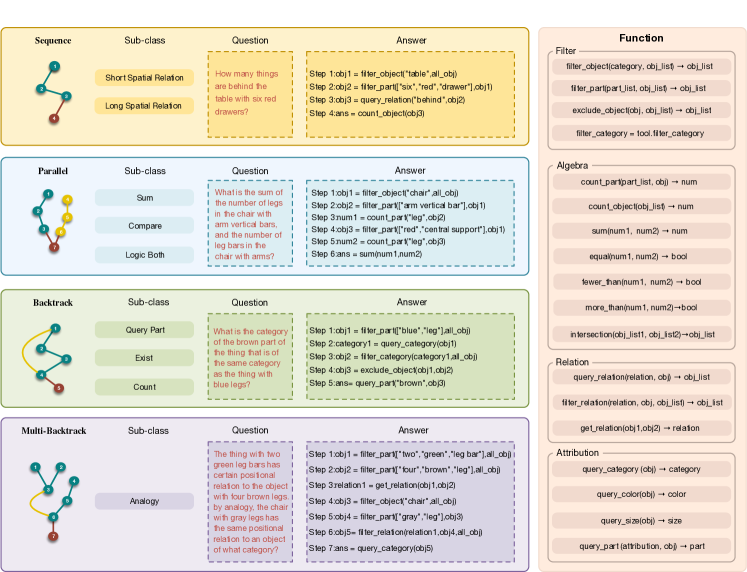
- Repurpose the PTR and CLEVR datasets into a new multi-hop reasoning benchmark with four reasoning structures and nine question types to evaluate planning complexity and depth.
Experimental results
Research questions
- RQ1Can combining fast one-stop generation with slow, iterative ToT reasoning improve both efficiency and accuracy in multi-hop visual reasoning?
- RQ2At what depth should fast thinking be applied to maximize performance while minimizing error propagation?
- RQ3How does block size in the ToT-Block strategy affect the trade-off between reasoning efficiency and plan accuracy?
- RQ4To what extent can scene graph-based tools enable accurate, independent evaluation of LLM planning without visual model bias?
- RQ5How do different reasoning structures (e.g., Long Rel, Logic) and hop counts influence the need for backtracking and the effectiveness of hybrid planning?
Key findings
- The ToT-OS strategy with a start depth of d=2 achieves the best balance, reducing inference steps while maintaining high plan accuracy.
- Increasing block size in ToT-Block reduces reasoning steps but degrades plan accuracy, confirming a clear trade-off between efficiency and precision.
- For hard question types like Long Rel and Logic, backtracking is essential—only 10–20% of plans are correct without backtracking, highlighting the need for iterative refinement.
- The correlation between hop count and number of correct plans without backtracking is significantly negative, confirming that longer reasoning chains require iterative search.
- The proposed evaluation framework enables reliable isolation of LLM planning performance, showing that visual expert model inaccuracies can otherwise mask LLM capability.
- ToMT outperforms pure ToT in both accuracy and inference efficiency across most question types, especially in high-hop and complex reasoning scenarios.
Read this paper
Open the full text in the Nubint reader and ask about any passage as you read.
Read this paper on NubintThis review was generated by AI from the original paper. Please check the paper before citing it.