
[Paper Review] TRIE: End-to-End Text Reading and Information Extraction for Document Understanding
This paper proposes TRIE, a unified end-to-end framework that jointly optimizes text reading and information extraction for visually rich documents (VRDs). By fusing multimodal visual and textual features and enabling mutual supervision between tasks, TRIE achieves state-of-the-art accuracy and speed across diverse document types, including structured, semi-structured, fixed-layout, and variable-layout documents.
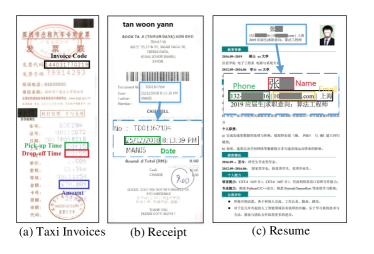
Since real-world ubiquitous documents (e.g., invoices, tickets, resumes and leaflets) contain rich information, automatic document image understanding has become a hot topic. Most existing works decouple the problem into two separate tasks, (1) text reading for detecting and recognizing texts in images and (2) information extraction for analyzing and extracting key elements from previously extracted plain text. However, they mainly focus on improving information extraction task, while neglecting the fact that text reading and information extraction are mutually correlated. In this paper, we propose a unified end-to-end text reading and information extraction network, where the two tasks can reinforce each other. Specifically, the multimodal visual and textual features of text reading are fused for information extraction and in turn, the semantics in information extraction contribute to the optimization of text reading. On three real-world datasets with diverse document images (from fixed layout to variable layout, from structured text to semi-structured text), our proposed method significantly outperforms the state-of-the-art methods in both efficiency and accuracy.
Motivation & Objective
- Address the limitations of decoupled text reading and information extraction pipelines in document understanding.
- Leverage mutual supervision between text reading and information extraction to improve both tasks.
- Integrate visual, textual, and positional features to enhance information extraction performance.
- Reduce computational redundancy by sharing features across text reading and information extraction modules.
- Achieve state-of-the-art performance across diverse document types, including invoices, resumes, and tickets.
Proposed method
- Propose an end-to-end deep learning framework, TRIE, that jointly trains text reading and information extraction modules.
- Fusion of visual features (from image patches) and textual features (from OCR) to enrich input for information extraction.
- Use textual context modeling via a Transformer-based Textural Context Block to capture dependencies between text spans.
- Introduce a visual context block that leverages spatial layout and visual cues (e.g., font size, boldness) to improve recognition and extraction.
- Apply joint loss optimization: information extraction loss supervises text reading, and text reading features enhance IE performance.
- Share features between text reading and information extraction to improve inference efficiency and reduce redundant computation.
Experimental results
Research questions
- RQ1Can joint training of text reading and information extraction improve performance compared to decoupled pipelines?
- RQ2How do multimodal features (visual, textual, positional) contribute to information extraction accuracy?
- RQ3To what extent does end-to-end training improve text reading accuracy through feedback from information extraction?
- RQ4How does the model generalize across document types with varying layouts and structures (e.g., fixed vs. variable, structured vs. semi-structured)?
- RQ5What is the optimal configuration of model depth (layers/heads) for different document types?
Key findings
- TRIE achieves 93.26% accuracy on information extraction across three datasets, outperforming state-of-the-art methods by up to 1.56 percentage points.
- End-to-end training improves text reading F1-score by 0.9 points compared to pipeline training, with correct recognition of ambiguous text like '23.3km' and '2017-12-21'.
- The inclusion of visual context boosts IE accuracy from 74.33% (text-only) to 93.26%, demonstrating the value of multimodal features.
- TRIE runs at 1.76 fps on resumes, outperforming pipeline baselines (1.13–1.69 fps) due to feature sharing and reduced redundancy.
- Ablation shows that deeper networks (3 layers, 16 heads) perform best on complex, variable-layout documents like resumes, while simpler models suffice for fixed-layout documents.
- Visual context is especially effective for distinguishing entities like 'Taxi Code' with bold or large fonts, while textual context helps resolve ambiguous or sequential dependencies.
Read this paper
Open the full text in the Nubint reader and ask about any passage as you read.
Read this paper on NubintThis review was generated by AI from the original paper. Please check the paper before citing it.