
[Paper Review] Trieste: Efficiently Exploring The Depths of Black-box Functions with TensorFlow
Trieste is an open-source TensorFlow-based Bayesian optimization and active-learning library with a modular design, enabling plug-and-play models and flexible acquisition strategies for real-world BO workflows.
We present Trieste, an open-source Python package for Bayesian optimization and active learning benefiting from the scalability and efficiency of TensorFlow. Our library enables the plug-and-play of popular TensorFlow-based models within sequential decision-making loops, e.g. Gaussian processes from GPflow or GPflux, or neural networks from Keras. This modular mindset is central to the package and extends to our acquisition functions and the internal dynamics of the decision-making loop, both of which can be tailored and extended by researchers or engineers when tackling custom use cases. Trieste is a research-friendly and production-ready toolkit backed by a comprehensive test suite, extensive documentation, and available at https://github.com/secondmind-labs/trieste.
Motivation & Objective
- Provide a TensorFlow-based Bayesian optimization library to leverage TF modeling ecosystems (GPflow, GPflux, Keras) within BO loops.
- Enable plug-and-play of diverse probabilistic models in BO (GPs, deep GPs, deep ensembles, etc.) and support multi-objective, multi-fidelity, and constrained settings.
- Offer flexible acquisition functions and rules with minimal retracing overhead to suit real-world, asynchronous, or batch evaluation scenarios.
- Present a user-friendly, production-ready toolkit with tests and documentation to foster research and deployment in real-world problems.
Proposed method
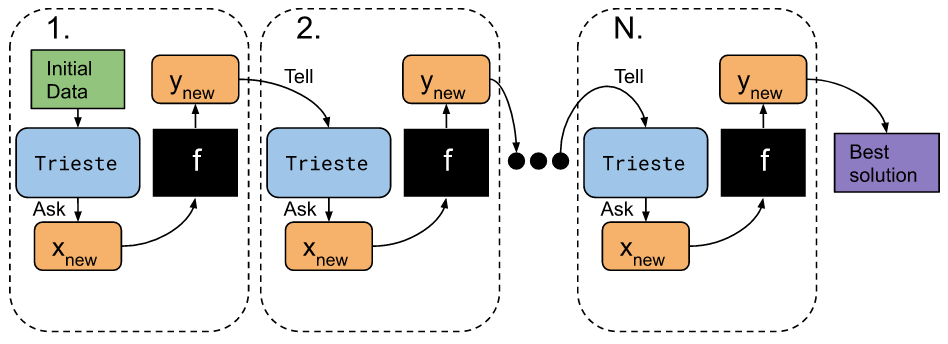
- Introduce a highly modular BO library designed to run in TensorFlow environments.
- Provide interfaces (AskTellOptimizer and BayesianOptimizer) for different levels of control, including asynchronous and batch evaluation workflows.
- Support a range of probabilistic models from TensorFlow-based libraries (GPflow, GPflux, Keras) and provide multi-output/multi-task capabilities.
- Define AcquisitionRule and AcquisitionFunction abstractions to handle complex query-point selection, with automatic differentiation for gradient-based optimization of acquisitions.
- Ensure efficient in-loop graph management to avoid expensive retracing, enabling scalable parallel optimization and monitoring (e.g., TensorBoard).
- Deliver a comprehensive test suite (97% coverage) and extensive documentation to support research extension and production use.
Experimental results
Research questions
- RQ1Can Trieste enable effective Bayesian optimization within TensorFlow ecosystems without requiring full model retracing between steps?
- RQ2How flexible is Trieste in supporting different model types, acquisition functions, and decision-loop interfaces for real-world BO tasks?
- RQ3Does the framework facilitate asynchronous, batched, multi-objective, multi-fidelity, and constrained optimization within a TensorFlow-based pipeline?
- RQ4To what extent can Trieste serve both research and production use cases with robust testing and documentation?
Key findings
- Trieste is an open-source, TensorFlow-based BO library designed for modularity and ease of extension.
- It supports plug-and-play integration of TF-based models (GPflow, GPflux, Keras) and multiple BO paradigms via AskTellOptimizer and BayesianOptimizer.
- The AcquisitionRule and AcquisitionFunction abstractions enable flexible, scalable query-point selection and batching with automatic differentiation for gradients.
- The project includes a comprehensive test suite with 97% coverage and extensive documentation, supporting both research and production use.
- Trieste is already influencing research and industry applications (e.g., heat exchangers, adhesive bonding) and will continue to add high-dimensional and non-Euclidean support in the future.

Read this paper
Open the full text in the Nubint reader and ask about any passage as you read.
Read this paper on NubintThis review was generated by AI from the original paper. Please check the paper before citing it.