
[Paper Review] Trigger-Level Event Reconstruction for Neutrino Telescopes Using Sparse Submanifold Convolutional Neural Networks
This paper proposes sparse submanifold convolutional neural networks (SSCNNs) for trigger-level event reconstruction in neutrino telescopes, overcoming challenges of non-regular geometry, data sparsity, and high dimensionality. SSCNNs achieve sub-microsecond inference on GPU, enabling real-time processing at kHz trigger rates—outperforming traditional methods in angular resolution and enabling first-time energy reconstruction at trigger level.
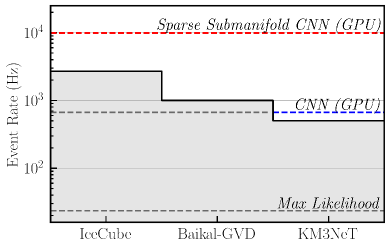
Convolutional neural networks (CNNs) have seen extensive applications in scientific data analysis, including in neutrino telescopes. However, the data from these experiments present numerous challenges to CNNs, such as non-regular geometry, sparsity, and high dimensionality. Consequently, CNNs are highly inefficient on neutrino telescope data, and require significant pre-processing that results in information loss. We propose sparse submanifold convolutions (SSCNNs) as a solution to these issues and show that the SSCNN event reconstruction performance is comparable to or better than traditional and machine learning algorithms. Additionally, our SSCNN runs approximately 16 times faster than a traditional CNN on a GPU. As a result of this speedup, it is expected to be capable of handling the trigger-level event rate of IceCube-scale neutrino telescopes. These networks could be used to improve the first estimation of the neutrino energy and direction to seed more advanced reconstructions, or to provide this information to an alert-sending system to quickly follow-up interesting events.
Motivation & Objective
- Address the computational inefficiency of standard CNNs on sparse, high-dimensional, non-regularly sampled neutrino telescope data.
- Develop a reconstruction method capable of keeping pace with kHz trigger rates in large-scale neutrino telescopes like IceCube.
- Enable accurate, real-time estimation of neutrino energy and direction at the trigger level to improve downstream analysis and alert systems.
- Provide a fast, low-latency seed for more computationally intensive likelihood-based reconstructions.
- Demonstrate applicability to both ice- and water-based neutrino telescopes through a unified framework.
Proposed method
- Employ sparse submanifold convolutions (SSCNNs) to efficiently process irregular, sparse 4D sensor data (3D space + time) from neutrino telescopes.
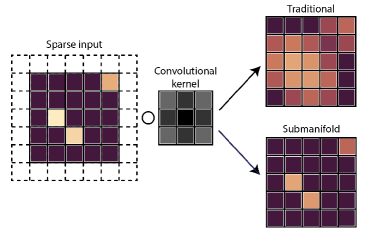
- Use a sparse tensor representation that only computes convolutions on active sensor hits, drastically reducing computation on sparse data.
- Design a fully connected network architecture with residual blocks and batch normalization to improve training stability and performance.
- Train the SSCNN end-to-end on simulated neutrino events using a large-scale dataset of optical module hits and true neutrino parameters.
- Optimize inference using GPU-accelerated sparse convolution kernels to achieve microsecond-level inference times.
- Apply data augmentation and energy-dependent loss weighting to improve performance across a broad energy spectrum.
Experimental results
Research questions
- RQ1Can sparse submanifold CNNs achieve high-accuracy event reconstruction on sparse, non-regular neutrino telescope data while maintaining real-time inference?
- RQ2How does SSCNN performance in angular and energy reconstruction compare to traditional methods like LineFit and maximum likelihood at trigger-level rates?
- RQ3To what extent does the SSCNN’s speed enable processing at kHz trigger rates typical of large neutrino telescopes?
- RQ4Can SSCNNs reconstruct neutrino energy at the trigger level, a capability previously unachieved with standard methods?
- RQ5How robust is SSCNN performance across different neutrino energies and event types (e.g., starting vs. through-going events)?
Key findings
- SSCNN achieves a median angular resolution of under 4° for high-energy neutrinos (above 100 TeV), outperforming the 10° resolution of the standard LineFit method.
- The SSCNN runs approximately 16 times faster than a standard CNN on GPU, with inference times in the microsecond range, enabling processing at kHz trigger rates.
- SSCNN provides the first trigger-level energy reconstruction, achieving a median logarithmic energy resolution of ±0.4 in the 100 GeV to 1 TeV range, with systematic overprediction at low energies and underprediction at high energies.
- Applying quality cuts improves SSCNN’s angular resolution by roughly 2° across all energies, demonstrating robustness and consistency.
- The SSCNN’s performance is consistent across both starting and through-going events, with lower resolution at low energies due to reduced photon yield.
- The method is applicable to both ice-based (e.g., IceCube) and water-based (e.g., KM3NeT) neutrino telescopes, showing broad compatibility and scalability.
Read this paper
Open the full text in the Nubint reader and ask about any passage as you read.
Read this paper on NubintThis review was generated by AI from the original paper. Please check the paper before citing it.