
[Paper Review] Trustworthy Distributed AI Systems: Robustness, Privacy, and Governance
This paper presents a comprehensive survey on trustworthy distributed AI systems, focusing on robustness, privacy, and fairness in federated and distributed learning. It proposes a unified taxonomy of countermeasures for adversarial attacks, data poisoning, model inversion, and bias amplification, offering a foundation for secure, private, and fair AI deployment in decentralized environments.
Emerging Distributed AI systems are revolutionizing big data computing and data processing capabilities with growing economic and societal impact. However, recent studies have identified new attack surfaces and risks caused by security, privacy, and fairness issues in AI systems. In this paper, we review representative techniques, algorithms, and theoretical foundations for trustworthy distributed AI through robustness guarantee, privacy protection, and fairness awareness in distributed learning. We first provide a brief overview of alternative architectures for distributed learning, discuss inherent vulnerabilities for security, privacy, and fairness of AI algorithms in distributed learning, and analyze why these problems are present in distributed learning regardless of specific architectures. Then we provide a unique taxonomy of countermeasures for trustworthy distributed AI, covering (1) robustness to evasion attacks and irregular queries at inference, and robustness to poisoning attacks, Byzantine attacks, and irregular data distribution during training; (2) privacy protection during distributed learning and model inference at deployment; and (3) AI fairness and governance with respect to both data and models. We conclude with a discussion on open challenges and future research directions toward trustworthy distributed AI, such as the need for trustworthy AI policy guidelines, the AI responsibility-utility co-design, and incentives and compliance.
Motivation & Objective
- Address the growing risks in distributed AI systems due to security, privacy, and fairness vulnerabilities in decentralized learning environments.
- Identify inherent vulnerabilities in distributed learning architectures related to data irregularity, model poisoning, and adversarial manipulation.
- Develop a unified taxonomy of countermeasures for robustness, privacy protection, and fairness in distributed AI systems.
- Highlight open challenges in governance, policy design, and compliance for trustworthy AI in the era of foundation models.
- Provide a research roadmap for trustworthy AI through responsibility-utility co-design and standardized governance frameworks.
Proposed method
- Survey and categorize representative techniques, algorithms, and theoretical foundations for robustness, privacy, and fairness in distributed learning.
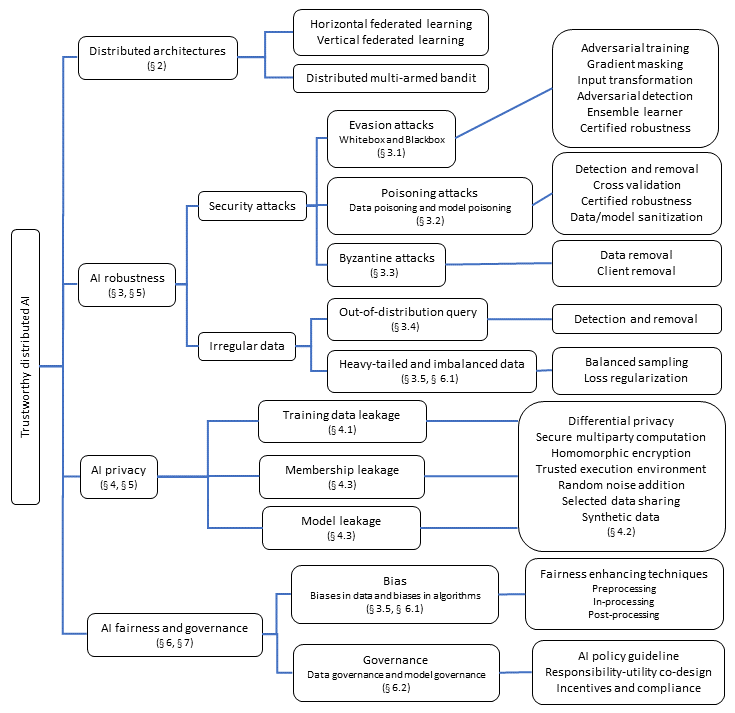
- Classify countermeasures into three pillars: (1) robustness against evasion, poisoning, and Byzantine attacks; (2) privacy-preserving mechanisms during training and inference; (3) fairness and governance for data and model integrity.
- Analyze vulnerabilities arising from non-IID data, gradient leakage, and model inversion attacks during inference.
- Examine risks from foundation models, including prompt injection, backdoor triggers, and data extraction via query probing.
- Propose a framework for trustworthy AI policy guidelines, emphasizing explainability, source verification, and access control.
- Integrate watermarking, toxicity detection, and bias evaluation tools to enhance model safety and compliance.
Experimental results
Research questions
- RQ1What are the key security, privacy, and fairness vulnerabilities inherent in distributed AI systems regardless of architecture?
- RQ2How can robustness be ensured against evasion attacks, data poisoning, and Byzantine behavior in distributed training and inference?
- RQ3What privacy-preserving techniques are effective during distributed model training and deployment, especially against gradient leakage and inference attacks?
- RQ4How can fairness and bias mitigation be systematically integrated into data and model lifecycle management in distributed learning?
- RQ5What governance and policy mechanisms are needed to ensure trustworthy foundation models and responsible AI deployment in decentralized systems?
Key findings
- Distributed learning inherently exposes systems to new attack surfaces due to decentralized, heterogeneous clients and open communication channels.
- Non-IID and imbalanced data distributions significantly degrade model performance and amplify bias, requiring robustness mechanisms beyond standard training.
- Gradient leakage and model inversion attacks can reconstruct sensitive training data from model updates or inference queries, necessitating strong privacy-preserving defenses.
- Evasion attacks using adversarial examples can cause high-impact failures in model inference, even with imperceptible input perturbations.
- Foundation models are vulnerable to prompt injection, backdoor triggers, and data extraction, requiring multi-layered safeguards including watermarking and input validation.
- A holistic approach combining technical defenses, governance frameworks, and responsibility-utility co-design is essential for trustworthy, scalable, and compliant distributed AI systems.
Read this paper
Open the full text in the Nubint reader and ask about any passage as you read.
Read this paper on NubintThis review was generated by AI from the original paper. Please check the paper before citing it.