
[Paper Review] Trustworthy Federated Learning: A Survey
This survey proposes a comprehensive taxonomy of Trustworthy Federated Learning (FL) centered on three pillars: Interpretability, Fairness, and Security & Privacy. It analyzes trustworthiness challenges across FL systems, introduces a structured architecture for trust assessment, and identifies key research gaps and future directions to enhance model robustness, privacy, and accountability in decentralized AI training.
Federated Learning (FL) has emerged as a significant advancement in the field of Artificial Intelligence (AI), enabling collaborative model training across distributed devices while maintaining data privacy. As the importance of FL increases, addressing trustworthiness issues in its various aspects becomes crucial. In this survey, we provide an extensive overview of the current state of Trustworthy FL, exploring existing solutions and well-defined pillars relevant to Trustworthy . Despite the growth in literature on trustworthy centralized Machine Learning (ML)/Deep Learning (DL), further efforts are necessary to identify trustworthiness pillars and evaluation metrics specific to FL models, as well as to develop solutions for computing trustworthiness levels. We propose a taxonomy that encompasses three main pillars: Interpretability, Fairness, and Security & Privacy. Each pillar represents a dimension of trust, further broken down into different notions. Our survey covers trustworthiness challenges at every level in FL settings. We present a comprehensive architecture of Trustworthy FL, addressing the fundamental principles underlying the concept, and offer an in-depth analysis of trust assessment mechanisms. In conclusion, we identify key research challenges related to every aspect of Trustworthy FL and suggest future research directions. This comprehensive survey serves as a valuable resource for researchers and practitioners working on the development and implementation of Trustworthy FL systems, contributing to a more secure and reliable AI landscape.
Motivation & Objective
- Address the growing need for trustworthiness in Federated Learning (FL) due to increasing deployment in privacy-sensitive domains like healthcare and finance.
- Identify and define core trustworthiness pillars—Interpretability, Fairness, and Security & Privacy—specific to FL, which are underdeveloped compared to centralized AI.
- Systematically analyze trust challenges at every level of FL, from client participation to server aggregation, including attacks and system vulnerabilities.
- Propose a unified architecture for Trustworthy FL that supports verifiable model updates, auditability, and resilience against malicious actors and untrusted clients.
- Highlight critical open research problems and suggest future directions to advance secure, fair, and interpretable FL systems.
Proposed method
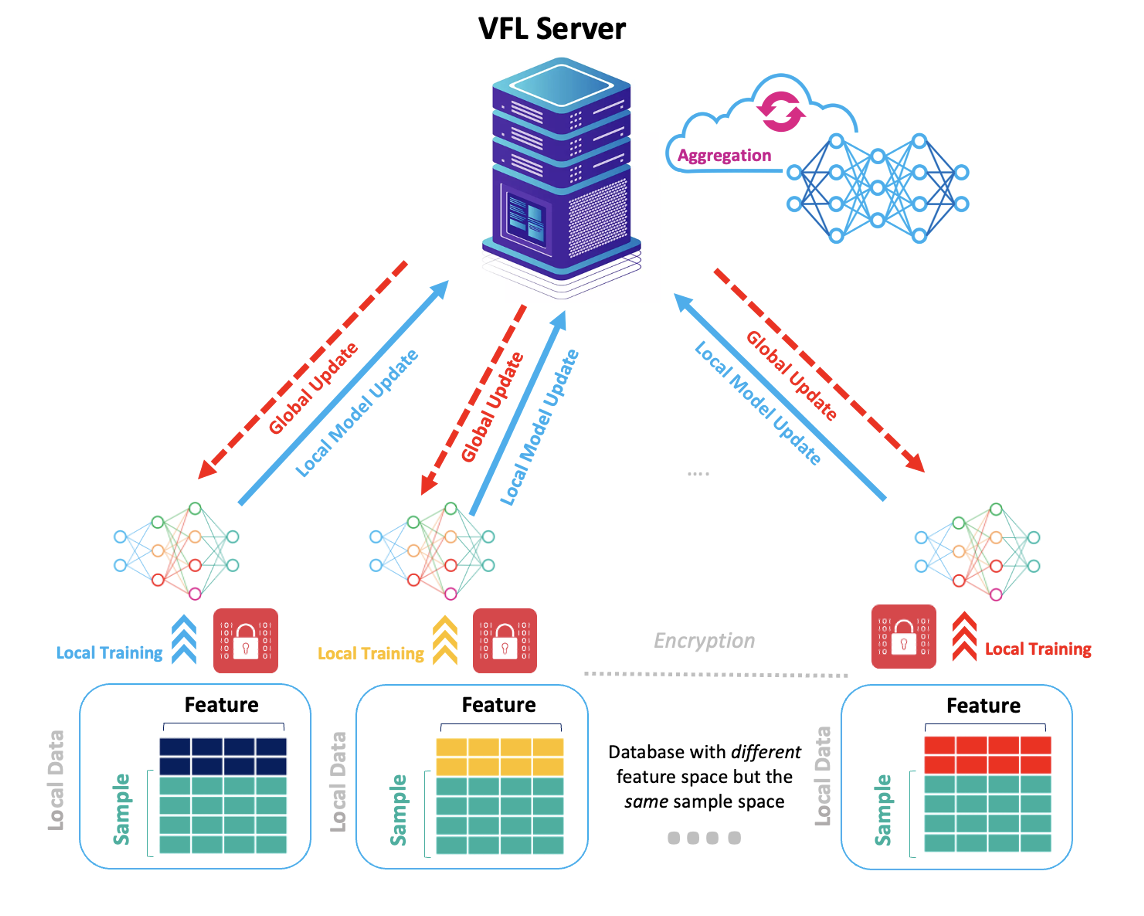
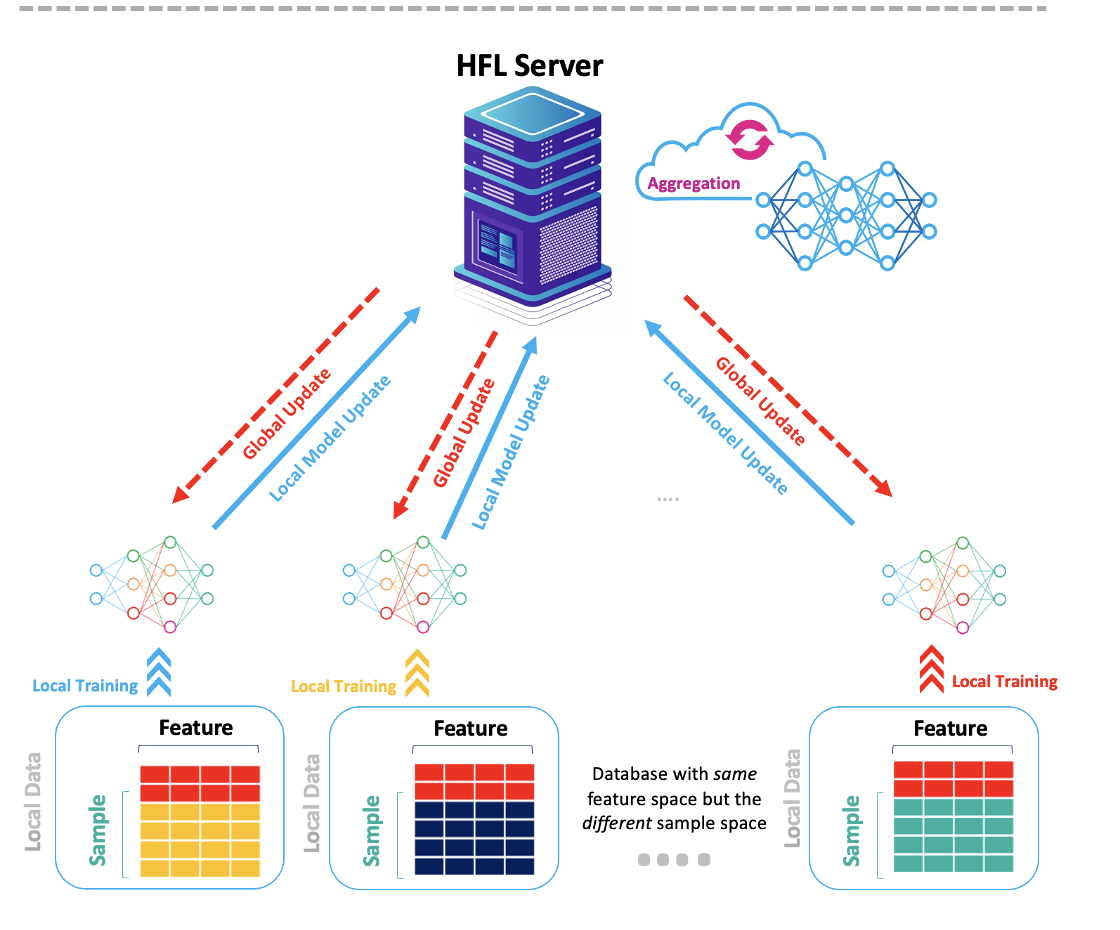
- Propose a three-pillar taxonomy: Interpretability (model explainability), Fairness (bias mitigation), and Security & Privacy (data protection, integrity, and confidentiality).
- Introduce a comprehensive architectural framework for Trustworthy FL that supports model verification, immutable update logging, and client authentication.
- Analyze trust assessment mechanisms, including verifiable aggregation protocols and dynamic key management for resilience against compromise.
- Examine challenges such as non-IID data, client dropouts, and communication overhead, proposing solutions that maintain privacy and integrity.
- Integrate principles of accountability, auditability, and robustness into the FL pipeline, emphasizing decentralized and verifiable training processes.
- Propose mechanisms for reliable contribution evaluation and incentive allocation to encourage honest client participation and prevent Sybil or lazy attacks.
Experimental results
Research questions
- RQ1What are the key pillars of trustworthiness in Federated Learning, and how do they differ from those in centralized machine learning?
- RQ2How can model integrity and authenticity be verified in a decentralized FL setting with untrusted clients and a potentially compromised server?
- RQ3What mechanisms ensure fair contribution evaluation and equitable incentive allocation in FL systems with heterogeneous and unreliable clients?
- RQ4How can FL systems achieve certifiable robustness against data poisoning and backdoor attacks while preserving privacy?
- RQ5What scalable and efficient protocols can support secure model aggregation without introducing communication bottlenecks in large-scale FL deployments?
Key findings
- The three core pillars of Trustworthy FL—Interpretability, Fairness, and Security & Privacy—are essential but underdeveloped in existing FL research compared to centralized AI.
- Trustworthy FL requires a secure, verifiable, and auditable architecture that supports immutable model update logs and client identity authentication to prevent tampering.
- Current FL systems are vulnerable to data poisoning, model poisoning, and backdoor attacks, necessitating robust detection and defense mechanisms.
- Resource-constrained environments like edge computing and IoT demand lightweight, privacy-preserving, and verifiable FL protocols to ensure scalability and resilience.
- Efficient and scalable secure aggregation protocols are critical to overcome communication overhead and enable large-scale deployment of trustworthy FL.
- Dynamic key management and timely monitoring are essential to maintain system integrity when some components are compromised, ensuring continued trust in the FL process.
Read this paper
Open the full text in the Nubint reader and ask about any passage as you read.
Read this paper on NubintThis review was generated by AI from the original paper. Please check the paper before citing it.