
[Paper Review] TSMixer: An All-MLP Architecture for Time Series Forecasting
TSMixer proposes an all-MLP architecture that alternates time-mixing and feature-mixing blocks to forecast multivariate time series, achieving competitive results on standard benchmarks and state-of-the-art performance on large-scale M5 data by leveraging cross-variate and auxiliary information.
Real-world time-series datasets are often multivariate with complex dynamics. To capture this complexity, high capacity architectures like recurrent- or attention-based sequential deep learning models have become popular. However, recent work demonstrates that simple univariate linear models can outperform such deep learning models on several commonly used academic benchmarks. Extending them, in this paper, we investigate the capabilities of linear models for time-series forecasting and present Time-Series Mixer (TSMixer), a novel architecture designed by stacking multi-layer perceptrons (MLPs). TSMixer is based on mixing operations along both the time and feature dimensions to extract information efficiently. On popular academic benchmarks, the simple-to-implement TSMixer is comparable to specialized state-of-the-art models that leverage the inductive biases of specific benchmarks. On the challenging and large scale M5 benchmark, a real-world retail dataset, TSMixer demonstrates superior performance compared to the state-of-the-art alternatives. Our results underline the importance of efficiently utilizing cross-variate and auxiliary information for improving the performance of time series forecasting. We present various analyses to shed light into the capabilities of TSMixer. The design paradigms utilized in TSMixer are expected to open new horizons for deep learning-based time series forecasting. The implementation is available at https://github.com/google-research/google-research/tree/master/tsmixer
Motivation & Objective
- Assess whether cross-variate information helps time-series forecasting on common benchmarks.
- Develop a lightweight, scalable all-MLP architecture that captures temporal patterns and cross-variate interactions.
- Explore extensions to incorporate auxiliary information (static features and future-time features).
- Compare against state-of-the-art multivariate and univariate models on long-term forecasting datasets.
Proposed method
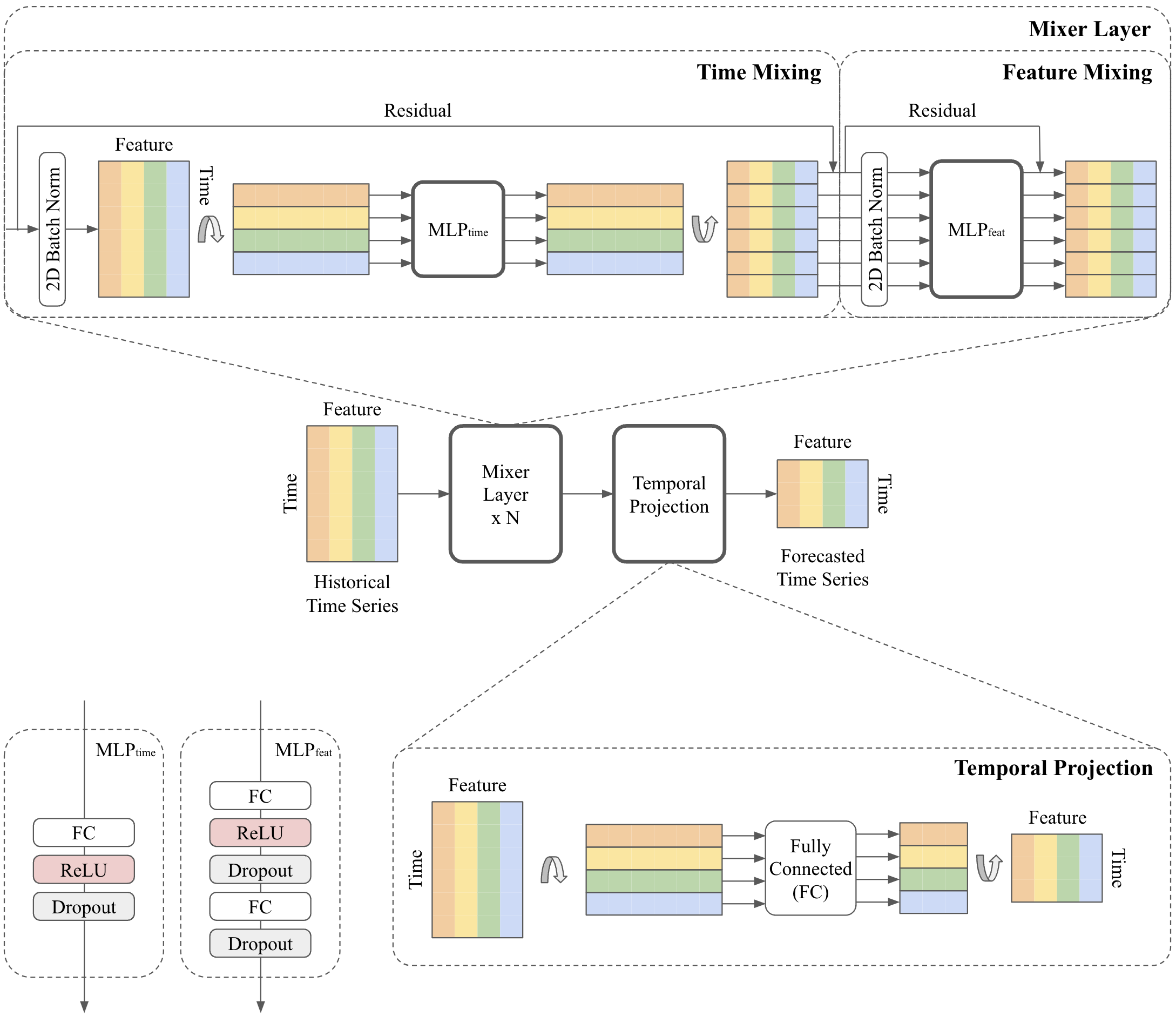
- Introduce Time-Series Mixer (TSMixer) with interleaving time-mixing and feature-mixing MLPs.
- Time-mixing MLPs are shared across features to model temporal patterns; feature-mixing MLPs are shared across time steps to leverage covariate information.
- Use temporal projection to map input length L to forecast length T and enable temporal learning.
- Incorporate residual connections and 2D normalization across time and feature dimensions for stable training.
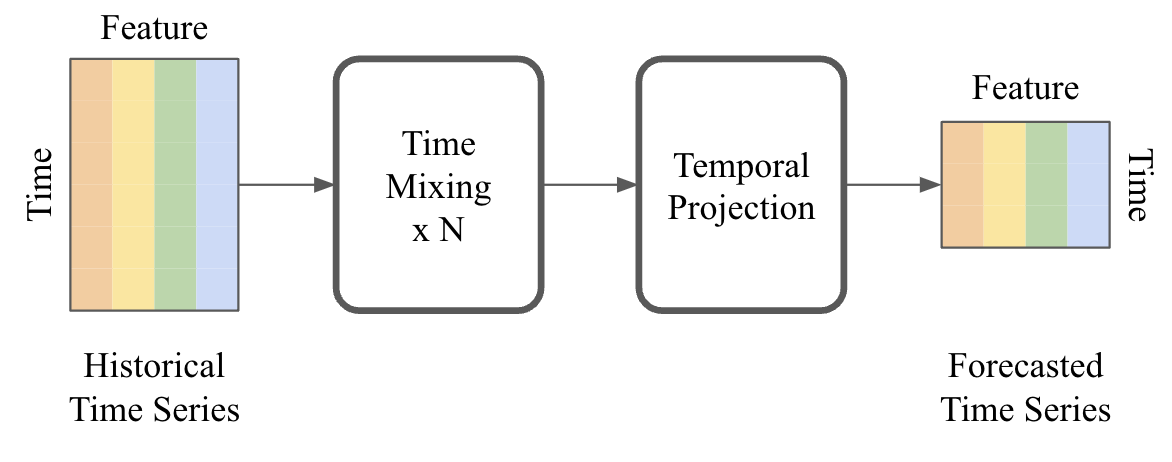
- Provide an variant TMix-Only with only time-mixing to isolate the impact of cross-variate mixing.
- Extend TSMixer to auxiliary information (static features and future time-varying features) by aligning inputs into a common shape and applying mixing on concatenated features.
Experimental results
Research questions
- RQ1Does cross-variate information provide a reliable benefit for time-series forecasting on standard benchmarks?
- RQ2Can an all-MLP mixer architecture match univariate models and outperform multivariate Transformer-based models on long-term forecasting?
- RQ3How does TSMixer scale with longer lookback windows and large-scale datasets?
- RQ4Can TSMixer effectively utilize auxiliary information such as static features and future-time features?
Key findings
- TSMixer is competitive with state-of-the-art univariate models and significantly outperforms other multivariate models on common long-term forecasting benchmarks.
- On large-scale M5 retail data, cross-variate information provides significant improvements and TSMixer effectively leverages auxiliary information.
- TMix-Only (time-mixing only) performs comparably to PatchTST, suggesting cross-variate mixing is not always necessary for these benchmarks.
- TSMixer can exploit longer lookback windows better than multivariate Transformer-based models, showing improved generalization and reduced overfitting on long sequences.
- Extending to auxiliary information (static and future features) yields strong performance, often surpassing industrial baselines like DeepAR and TFT in the M5 setting.
Read this paper
Open the full text in the Nubint reader and ask about any passage as you read.
Read this paper on NubintThis review was generated by AI from the original paper. Please check the paper before citing it.