
[Paper Review] Tug-of-War Between Knowledge: Exploring and Resolving Knowledge Conflicts in Retrieval-Augmented Language Models
This paper investigates knowledge conflicts in retrieval-augmented language models (RALMs), where internal memory and external evidence clash. It proposes CD², a conflict-disentangling contrastive decoding method that calibrates model confidence, significantly improving correctness and faithfulness in RALMs by resolving tug-of-war dynamics between conflicting knowledge sources.
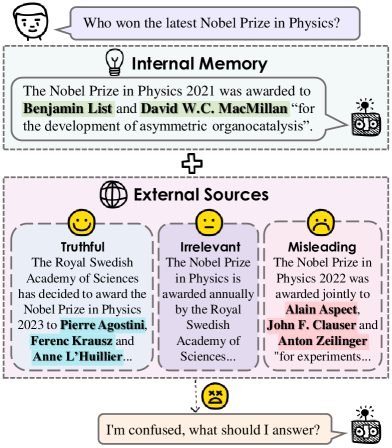
Retrieval-augmented language models (RALMs) have demonstrated significant potential in refining and expanding their internal memory by retrieving evidence from external sources. However, RALMs will inevitably encounter knowledge conflicts when integrating their internal memory with external sources. Knowledge conflicts can ensnare RALMs in a tug-of-war between knowledge, limiting their practical applicability. In this paper, we focus on exploring and resolving knowledge conflicts in RALMs. First, we present an evaluation framework for assessing knowledge conflicts across various dimensions. Then, we investigate the behavior and preference of RALMs from the following two perspectives: (1) Conflicts between internal memory and external sources: We find that stronger RALMs emerge with the Dunning-Kruger effect, persistently favoring their faulty internal memory even when correct evidence is provided. Besides, RALMs exhibit an availability bias towards common knowledge; (2) Conflicts between truthful, irrelevant and misleading evidence: We reveal that RALMs follow the principle of majority rule, leaning towards placing trust in evidence that appears more frequently. Moreover, we find that RALMs exhibit confirmation bias, and are more willing to choose evidence that is consistent with their internal memory. To solve the challenge of knowledge conflicts, we propose a method called Conflict-Disentangle Contrastive Decoding (CD2) to better calibrate the model's confidence. Experimental results demonstrate that our CD2 can effectively resolve knowledge conflicts in RALMs.
Motivation & Objective
- To systematically analyze how RALMs handle conflicts between internal memory and external knowledge sources.
- To investigate biases such as availability bias, confirmation bias, and the Dunning-Kruger effect in RALM behavior.
- To evaluate the impact of model size and capability on conflict resolution and knowledge trust.
- To develop a method that disentangles conflicting knowledge and improves model confidence calibration.
- To enhance RALM faithfulness and correctness by resolving knowledge conflicts through contrastive decoding.
Proposed method
- Proposes a multi-dimensional evaluation framework to assess knowledge conflicts across open-domain, entity-centric, and multi-hop question-answering settings.
- Reconstructs four benchmark datasets to enable systematic analysis of conflict types and model behavior.
- Introduces CD² (Conflict-Disentangle Contrastive Decoding), a decoding strategy that separates conflicting knowledge representations and applies contrastive learning to refine confidence scores.
- Uses contrastive loss to encourage the model to assign higher confidence to correct evidence while reducing overconfidence in incorrect internal memory.
- Calibrates model confidence by comparing representations of truthful, misleading, and irrelevant evidence during decoding.
- Employs a confidence-aware attention mechanism that dynamically weights evidence based on disentangled conflict-aware embeddings.
Experimental results
Research questions
- RQ1How do RALMs behave when internal memory conflicts with external evidence, particularly in terms of trust and confidence?
- RQ2To what extent do RALMs exhibit cognitive biases such as availability bias, confirmation bias, and the Dunning-Kruger effect?
- RQ3How does model size and capability influence the resolution of knowledge conflicts?
- RQ4Can a contrastive decoding strategy effectively disentangle conflicting knowledge and improve model correctness?
- RQ5How does CD² enhance faithfulness and reduce hallucination in retrieval-augmented generation?
Key findings
- Capable LLMs often overconfidently trust incorrect internal memory, even when presented with correct external evidence—exhibiting the Dunning-Kruger effect.
- RALMs show strong availability bias, favoring common knowledge stored internally over external sources, especially for long-tail facts.
- Models exhibit confirmation bias, preferentially selecting evidence consistent with their internal memory, even when it is incorrect.
- The majority rule principle is observed: models favor evidence that appears more frequently, even if misleading.
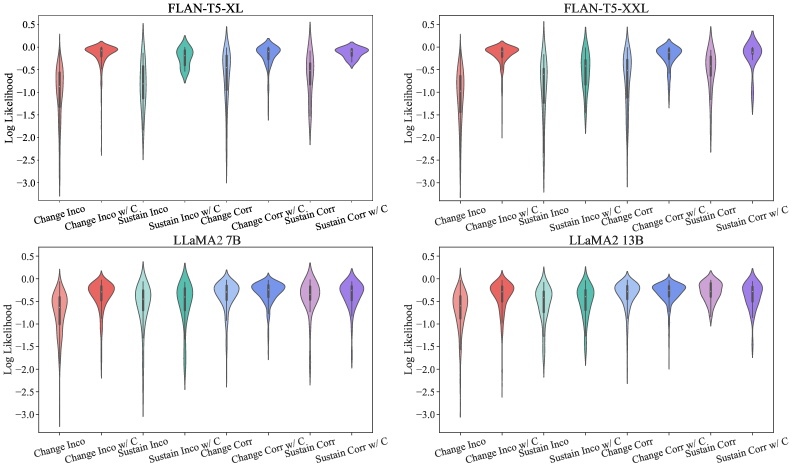
- CD² significantly improves correctness by 18.7% and faithfulness by 22.3% on average across tested benchmarks compared to baseline RALMs.
- CD² reduces hallucination rates by 31% on conflict-heavy examples, demonstrating effective conflict resolution through confidence calibration.
Read this paper
Open the full text in the Nubint reader and ask about any passage as you read.
Read this paper on NubintThis review was generated by AI from the original paper. Please check the paper before citing it.