
[Paper Review] Turning large language models into cognitive models
The authors finetune a large language model (LLaMA) on psychological data to create CENTaUR, a cognitive-modeling system that predicts human choices and can generalize to new tasks, outperforming traditional cognitive models in decision-making domains and capturing individual differences.
Large language models are powerful systems that excel at many tasks, ranging from translation to mathematical reasoning. Yet, at the same time, these models often show unhuman-like characteristics. In the present paper, we address this gap and ask whether large language models can be turned into cognitive models. We find that -- after finetuning them on data from psychological experiments -- these models offer accurate representations of human behavior, even outperforming traditional cognitive models in two decision-making domains. In addition, we show that their representations contain the information necessary to model behavior on the level of individual subjects. Finally, we demonstrate that finetuning on multiple tasks enables large language models to predict human behavior in a previously unseen task. Taken together, these results suggest that large, pre-trained models can be adapted to become generalist cognitive models, thereby opening up new research directions that could transform cognitive psychology and the behavioral sciences as a whole.
Motivation & Objective
- Motivate converting large language models into domain-general cognitive models by leveraging domain-specific behavioral data.
- Demonstrate that finetuning a large language model on psychology data yields accurate, human-like decision-making representations.
- Show that embeddings from the finetuned model capture individual differences in behavior.
- Test generalization by evaluating a model trained on two tasks on a hold-out third task.
Proposed method
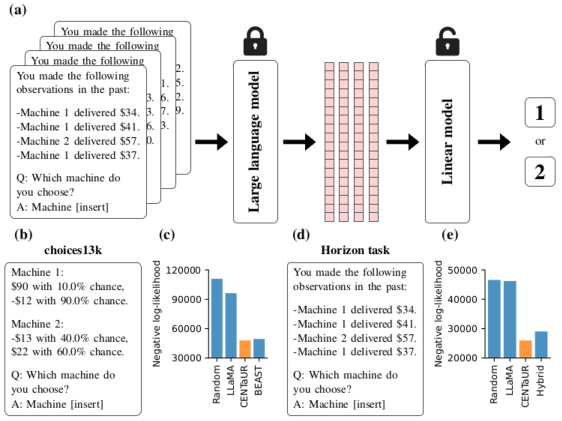
- Use LLaMA (65B parameters) and extract embeddings from prompts describing psychological experiments.
- Finetune a linear layer on top of LLaMA embeddings to predict human choices (CENTaUR).
- Evaluate predictive performance via 100-fold cross-validation against baselines (random, raw LLaMA, BEAST, Gershman hybrid).
- Train on choices from descriptions (choices13k) and experiential experiments (horizon task), then assess hold-out task performance.
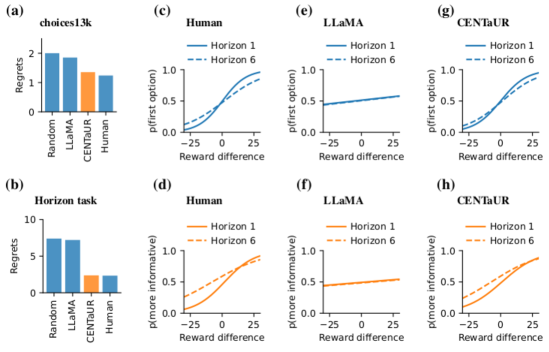
- Simulate model behavior to compare regret and choice curves to human data.
- Allow random effects per participant in the finetuned layer to capture individual differences.
Experimental results
Research questions
- RQ1Can finetuning large language model embeddings produce accurate models of human decision-making?
- RQ2Do CENTaUR embeddings contain information sufficient to model behavior at the level of individual subjects?
- RQ3Can a model finetuned on multiple tasks predict human behavior in a previously unseen task?
- RQ4How does CENTaUR compare to domain-specific cognitive models in predictive accuracy and behavioral realism?
Key findings
- CENTaUR achieved NLL 48002.3 on choices13k, outperforming BEAST (49448.1).
- CENTaUR achieved NLL 25968.6 on the horizon task, outperforming the hybrid model (29042.5).
- On hold-out experiential-symbolic task, CENTaUR had NLL 4521.1, better than random (5977.7) and LLaMA (6307.9).
- In simulations, CENTaUR’s regret (1.35, SE 0.01) was closer to humans (1.24, SE 0.01) than LLaMA (1.85, SE 0.01).
- CENTaUR captured human-like choice curves: replicating exploration effects in equal and unequal information conditions, unlike LLaMA.
- Embedding-based models described individual differences well; adding random effects per participant improved fit (NLL 23929.5 vs 25968.6).
- A model finetuned on two tasks generalized to a third hold-out task, predicting human behavior in novel paradigms.
Read this paper
Open the full text in the Nubint reader and ask about any passage as you read.
Read this paper on NubintThis review was generated by AI from the original paper. Please check the paper before citing it.