
[Paper Review] Two-photon amplitude interferometry for precision astrometry
This paper proposes two-photon amplitude interferometry, a quantum-enhanced astrometric technique that enables micro-arcsecond-level precision in measuring the relative angular separation of two stellar sources using only classical communication between two decoupled stations. By interfering entangled photon pairs from separate astronomical sources at independent detectors, the method achieves high-contrast interference fringes sensitive to phase differences, allowing sub-microarcsecond astrometry in a single night's observation of bright stars.
Improved quantum sensing of photons from astronomical objects could provide high resolution observations in the optical benefiting numerous fields, including general relativity, dark matter studies, and cosmology. It has been recently proposed that stations in optical interferometers would not require a phase-stable optical link if instead sources of quantum-mechanically entangled pairs could be provided to them, potentially enabling hitherto prohibitively long baselines. A new refinement of this idea is developed, in which two photons from different sources are interfered at two separate and decoupled stations, requiring only a slow classical information link between them. We rigorously calculate the observables and contrast this new interferometric technique with the Hanbury Brown & Twiss intensity interferometry. We argue this technique could allow robust high-precision measurements of the relative astrometry of the two sources. A basic calculation suggests that angular precision on the order of $10$~microarcsecond in the relative opening angle could be achieved in a single night's observation of two bright stars.
Motivation & Objective
- To develop a quantum-enhanced interferometric technique that overcomes classical limitations in long-baseline optical astrometry.
- To enable high-precision relative astrometry of two distant stellar sources without requiring a phase-stable optical link between stations.
- To demonstrate that quantum interference of entangled photon pairs from separate sources can yield measurable fringes sensitive to angular source separation.
- To evaluate the statistical sensitivity of the method using Fisher information matrix analysis for realistic observational conditions.
- To establish a practical framework for Earth-rotation scan observations to extract relative motion parameters such as parallax and proper motion.
Proposed method
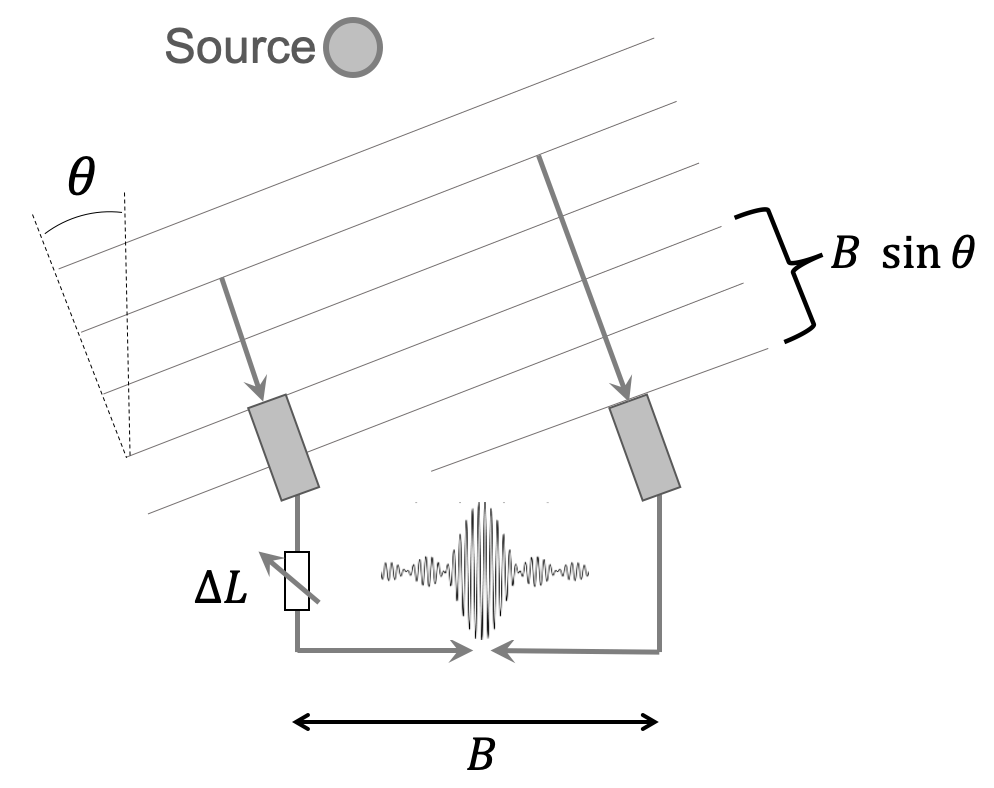
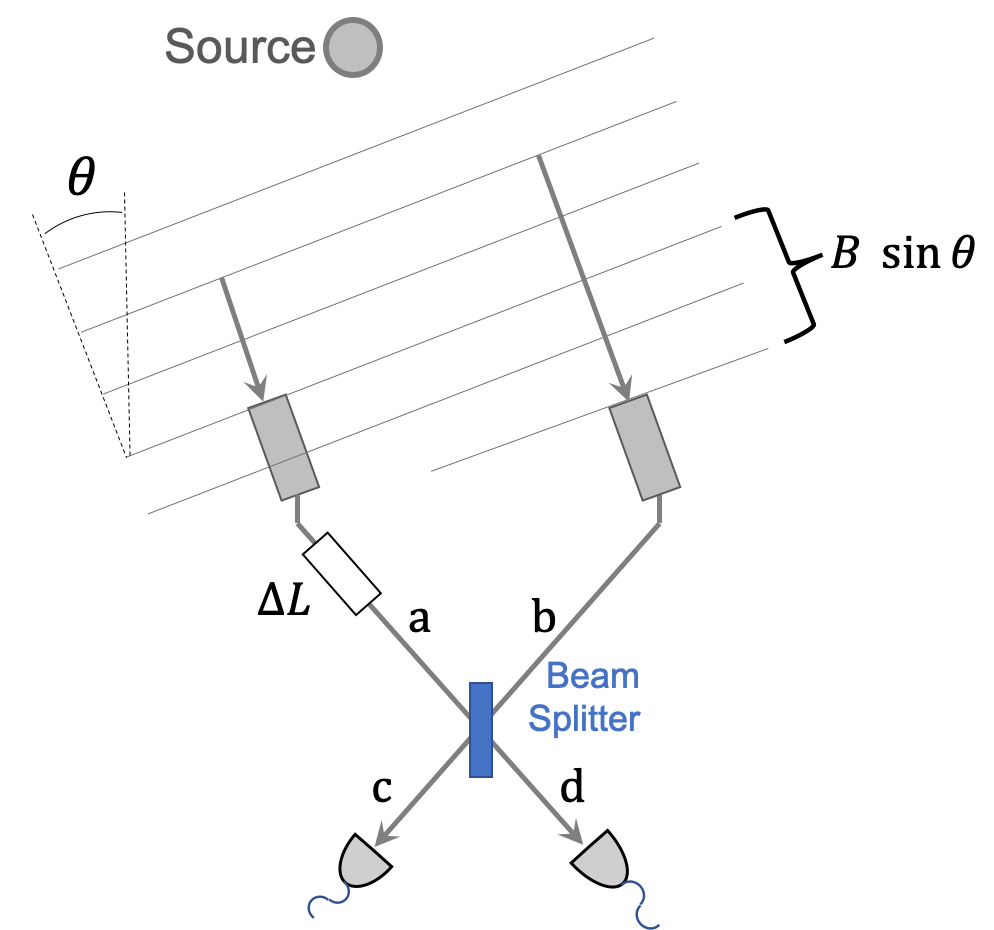
- The method uses entangled photon pairs generated from two independent astronomical sources, with one photon from each source sent to separate, decoupled stations.
- At each station, the incoming photon from space interferes with the entangled partner via a beam splitter, producing correlated detection outcomes.
- The coincidence rate between the two stations is calculated using quantum optics formalism, revealing interference fringes dependent on the relative phase difference due to source separation.
- The fringe pattern is modulated by the relative opening angle between the two sources, encoded in the frequency and phase of the coincidence rate oscillations.
- A Fisher information matrix is applied to the time-dependent coincidence rate to estimate the statistical precision of measuring the angular frequency parameter ω_f, which encodes the source separation.
- The analysis assumes Poissonian statistics for photon detection and derives the marginalized error on ω_f, showing scaling with integration time T, average pair rate n̄, and visibility V.
Experimental results
Research questions
- RQ1Can two-photon amplitude interferometry achieve micro-arcsecond-level precision in relative astrometry without a phase-stable optical link?
- RQ2How does the visibility of the interference fringes depend on the angular separation and spectral characteristics of the two sources?
- RQ3What is the fundamental statistical limit on measuring the relative opening angle using this quantum interferometric technique?
- RQ4How does the method compare in sensitivity to classical Hanbury Brown & Twiss intensity interferometry?
- RQ5Can Earth-rotation scan observations be used to extract parallax, proper motion, and other astrometric parameters from the fringe rate?
Key findings
- The method achieves a theoretical angular precision of approximately 10 microarcseconds on the relative opening angle between two bright stars in a single night’s observation.
- The Fisher information matrix analysis shows that the error on the angular frequency parameter ω_f scales as σ[ω_f] ≈ 24 / (n̄ T³ V² κ(V))¹ᐟ², where n̄ is the average pair rate, T is integration time, V is fringe visibility, and κ(V) is a visibility-dependent function.
- The method is robust to variations in average pair rate n̄ and visibility V, with the error decreasing as T⁻³/², indicating strong time integration gain.
- The technique generalizes Hanbury Brown & Twiss intensity interferometry by introducing alternating correlations and anti-correlations (fringes) between two independent sources, enabling phase-sensitive astrometry.
- Measurements of ω_f are uncorrelated with estimates of the average rate n̄ and visibility V, allowing independent calibration of these parameters.
- The method enables baseline-independent astrometry, as no optical path is required between stations, only classical communication of coincidence timestamps.
Read this paper
Open the full text in the Nubint reader and ask about any passage as you read.
Read this paper on NubintThis review was generated by AI from the original paper. Please check the paper before citing it.