
[Paper Review] Two-stage Temporal Modelling Framework for Video-based Depression Recognition using Graph Representation
This paper proposes a two-stage temporal modeling framework for video-based depression recognition using graph representations to capture multi-scale facial behaviors. It first enhances short-term depression-related features via a Depression Feature Enhancement (DFE) module, then encodes these into video-level graph representations using Sequential (SEG) and Spectral (SPG) graph encoding, achieving state-of-the-art performance on AVEC 2013 and 2014 datasets with PCC up to 0.770 and RMSE of 8.18.
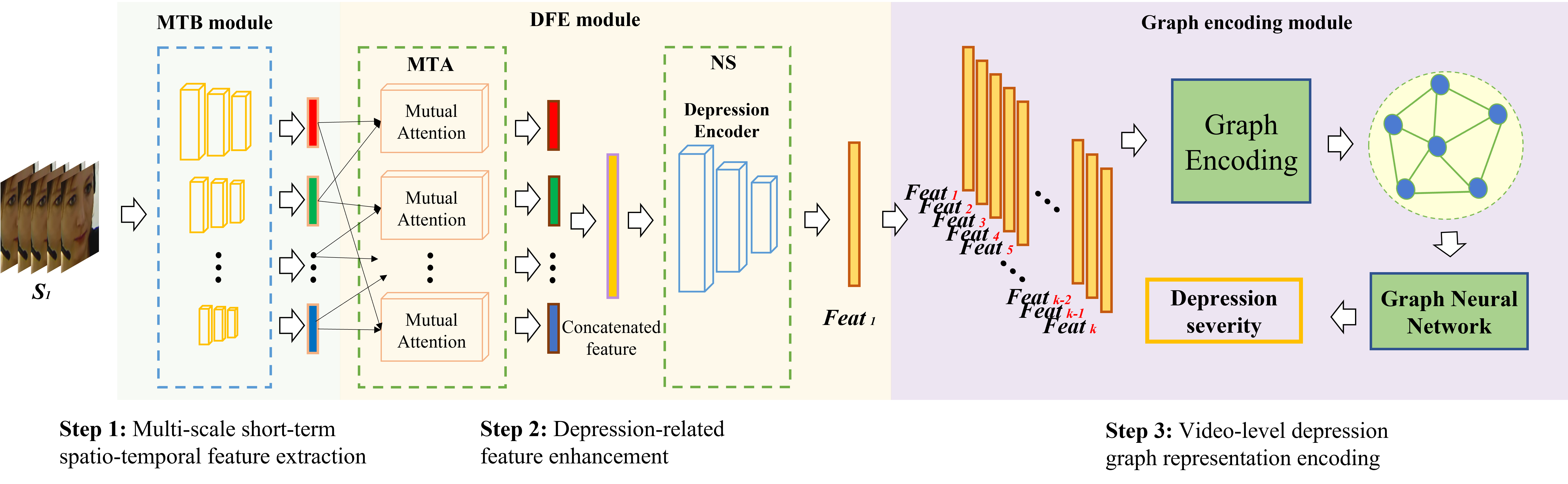
Video-based automatic depression analysis provides a fast, objective and repeatable self-assessment solution, which has been widely developed in recent years. While depression clues may be reflected by human facial behaviours of various temporal scales, most existing approaches either focused on modelling depression from short-term or video-level facial behaviours. In this sense, we propose a two-stage framework that models depression severity from multi-scale short-term and video-level facial behaviours. The short-term depressive behaviour modelling stage first deep learns depression-related facial behavioural features from multiple short temporal scales, where a Depression Feature Enhancement (DFE) module is proposed to enhance the depression-related clues for all temporal scales and remove non-depression noises. Then, the video-level depressive behaviour modelling stage proposes two novel graph encoding strategies, i.e., Sequential Graph Representation (SEG) and Spectral Graph Representation (SPG), to re-encode all short-term features of the target video into a video-level graph representation, summarizing depression-related multi-scale video-level temporal information. As a result, the produced graph representations predict depression severity using both short-term and long-term facial beahviour patterns. The experimental results on AVEC 2013 and AVEC 2014 datasets show that the proposed DFE module constantly enhanced the depression severity estimation performance for various CNN models while the SPG is superior than other video-level modelling methods. More importantly, the result achieved for the proposed two-stage framework shows its promising and solid performance compared to widely-used one-stage modelling approaches.
Motivation & Objective
- Address the limitation of existing one-stage methods that fail to model both short-term and long-term depression-related facial behaviors effectively.
- Overcome the issue of non-depression-related facial attributes (e.g., identity) dominating in frame-level modeling by disentangling noise from depression cues.
- Develop a novel video-level representation that summarizes multi-scale short-term features into a graph structure for improved temporal modeling.
- Enable end-to-end learning of depression severity by integrating short-term feature enhancement with long-term graph-based video representation.
- Demonstrate the superiority of the proposed two-stage framework over one-stage baselines in both intra- and cross-dataset evaluations.
Proposed method
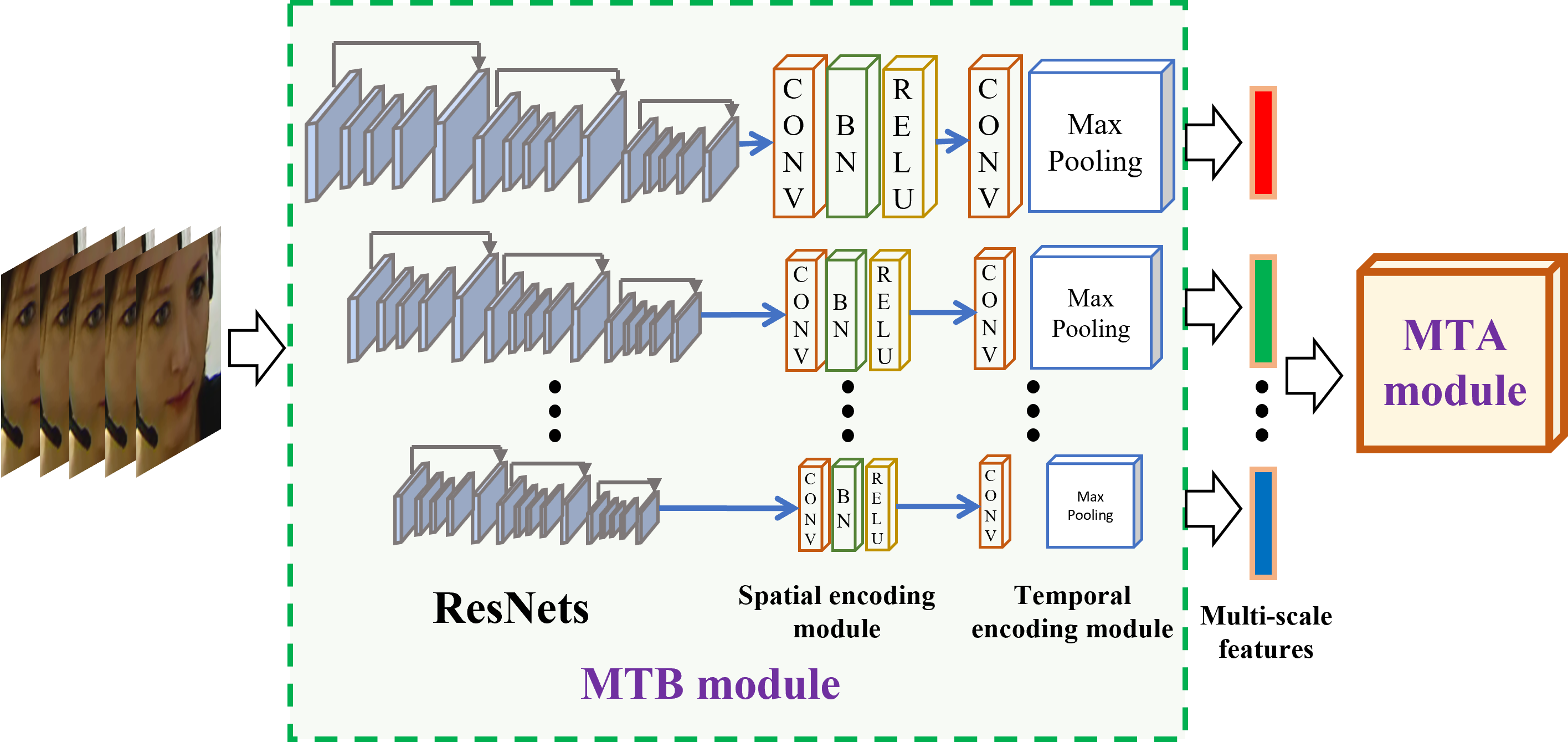
- Extract multi-scale temporal features from short video slices using a Multi-Task Bottleneck (MTB) module, capturing facial dynamics at varying temporal scales.
- Apply a Depression Feature Enhancement (DFE) module to each scale to amplify depression-related cues and suppress non-depression noise in the feature representation.
- Concatenate enhanced features across scales and apply a non-sparse (NS) sub-module to further disentangle irrelevant attributes.
- Construct two novel graph encoding strategies: Sequential Graph Representation (SEG) and Spectral Graph Representation (SPG), to model the entire video as a graph.
- Feed the resulting graph representations into Graph Neural Networks (GNNs) for regression of depression severity scores.
- Use attention mechanisms within the DFE and GNN modules to prioritize relevant temporal and spatial facial patterns.
Experimental results
Research questions
- RQ1Can a two-stage framework that models both short-term and video-level facial behaviors improve depression recognition performance compared to one-stage methods?
- RQ2To what extent does the proposed DFE module enhance depression-related features and reduce interference from non-depression facial attributes?
- RQ3How do different graph encoding strategies (SEG vs. SPG) compare in summarizing multi-scale short-term features into a coherent video-level representation?
- RQ4Does the integration of graph-based video-level modeling lead to better generalization across different datasets and evaluation settings?
- RQ5Can the proposed framework be extended to other video-level recognition tasks beyond depression detection?
Key findings
- The proposed two-stage framework outperformed most existing one-stage methods, achieving a PCC of 0.770 and RMSE of 8.18 on the AVEC 2013 test set using the MTB-DFE+SPG configuration.
- The DFE module consistently improved performance across all tested CNN models, demonstrating its effectiveness in enhancing depression-related cues and suppressing non-depression noise.
- Spectral Graph Representation (SPG) achieved superior performance compared to SEG and other baselines, indicating its effectiveness in encoding arbitrary-length sequences of short-term features.
- The MTB-DFE+SPG model showed strong performance on in-domain evaluations (e.g., 0.770 PCC on AVEC 2013), though generalization to cross-dataset settings was limited, with negative PCC values on NorthWind and Freeform sets.
- The two-stage approach consistently outperformed corresponding one-stage models, confirming that joint modeling of short-term and long-term behaviors enhances prediction robustness.
- The framework’s modular design allows integration with various short-term and long-term modeling components, suggesting strong extensibility for future applications.
Read this paper
Open the full text in the Nubint reader and ask about any passage as you read.
Read this paper on NubintThis review was generated by AI from the original paper. Please check the paper before citing it.