
[Paper Review] U-MixFormer: UNet-like Transformer with Mix-Attention for Efficient Semantic Segmentation
Introduces a UNet-inspired transformer decoder with a mix-attention mechanism that fuses multi-scale encoder/decoder features to improve semantic segmentation efficiency and accuracy across diverse encoders and datasets.
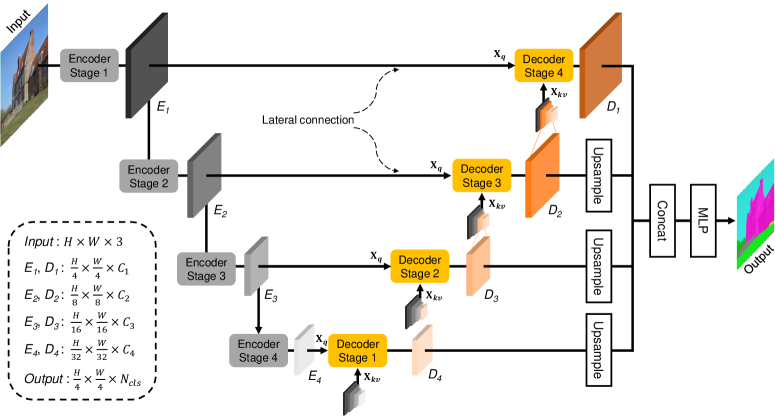
Semantic segmentation has witnessed remarkable advancements with the adaptation of the Transformer architecture. Parallel to the strides made by the Transformer, CNN-based U-Net has seen significant progress, especially in high-resolution medical imaging and remote sensing. This dual success inspired us to merge the strengths of both, leading to the inception of a U-Net-based vision transformer decoder tailored for efficient contextual encoding. Here, we propose a novel transformer decoder, U-MixFormer, built upon the U-Net structure, designed for efficient semantic segmentation. Our approach distinguishes itself from the previous transformer methods by leveraging lateral connections between the encoder and decoder stages as feature queries for the attention modules, apart from the traditional reliance on skip connections. Moreover, we innovatively mix hierarchical feature maps from various encoder and decoder stages to form a unified representation for keys and values, giving rise to our unique mix-attention module. Our approach demonstrates state-of-the-art performance across various configurations. Extensive experiments show that U-MixFormer outperforms SegFormer, FeedFormer, and SegNeXt by a large margin. For example, U-MixFormer-B0 surpasses SegFormer-B0 and FeedFormer-B0 with 3.8% and 2.0% higher mIoU and 27.3% and 21.8% less computation and outperforms SegNext with 3.3% higher mIoU with MSCAN-T encoder on ADE20K. Code available at https://github.com/julian-klitzing/u-mixformer.
Motivation & Objective
- Merge the strengths of U-Net and vision transformers for efficient semantic segmentation.
- Design a decoder that uses encoder-side lateral features as queries and multi-stage mixed features as keys/values.
- Ensure compatibility with both CNN- and transformer-based encoders while improving context and boundaries.
- Demonstrate state-of-the-art efficiency-accuracy trade-offs on ADE20K and Cityscapes.
Proposed method
- Propose a UNet-like transformer decoder where each stage uses lateral encoder features as queries.
- Introduce mix-attention that builds keys/values from a mix of multi-scale encoder and decoder features.
- Align feature maps across stages via spatial reduction (AvgPool and Linear projections) before concatenation into X_kv.
- Propagate decoder features through stages without explicit upsampling between stages, mirroring U-Net progression.
- Predict segmentation by concatenating decoder outputs and applying an MLP.
- Evaluate across multiple encoders (MiT, LVT, MSCAN) and show robustness to corruptions (Cityscapes-C).

Experimental results
Research questions
- RQ1Can a UNet-inspired transformer decoder with mix-attention improve segmentation quality and efficiency over prior cross/self-attention decoders?
- RQ2How does mixing multi-scale features for keys/values affect context modeling and boundary delineation in semantic segmentation?
- RQ3Is the proposed decoder compatible with both CNN- and transformer-based encoders while delivering consistent gains?
- RQ4What is the impact of mix-attention and U-Net-like decoding on robustness to image corruptions?
- RQ5How do larger encoder backbones (MiT-B3/4/5) with U-MixFormer impact mIoU and compute?
Key findings
- U-MixFormer-B0 achieves 41.2 mIoU on ADE20K with 6.1M params and 6.1 GFLOPs, outperforming SegFormer-B0 and FeedFormer-B0 by 3.8% and 2.0% mIoU respectively while reducing computation.
- With LVT encoder, mIoU improves to 43.7, and with MSCAN-T to 44.4, while keeping competitive FLOPs.
- On ADE20K heavy encoders, MiT-B3/4/5 variants reach 49.8, 50.4, and 51.9 mIoU respectively, with substantial FLOPs reductions compared to comparable methods.
- U-MixFormer+ with MiT-B4/5 yields incremental gains (51.2–52.0 mIoU) at modest cost increases, showing scalability with encoder depth.
- Cityscapes results show strong gains: U-MixFormer achieves up to 79.9 mIoU with LVT and 81.0 mIoU with MSCAN-S, while maintaining lower FLOPs than many baselines.
- Ablation studies confirm mix-attention and UNet-like decoding jointly provide the best performance (41.2 mIoU) beyond self- or cross-attention alone.
- Cityscapes-C corruption robustness favors U-MixFormer over SegFormer and FeedFormer across diverse corruptions, illustrating enhanced reliability in challenging conditions.
Read this paper
Open the full text in the Nubint reader and ask about any passage as you read.
Read this paper on NubintThis review was generated by AI from the original paper. Please check the paper before citing it.