
[Paper Review] UAV-Enabled Mobile Edge Computing: Offloading Optimization and Trajectory Design
This paper proposes a joint optimization framework for UAV-enabled mobile edge computing that minimizes UAV energy consumption by jointly designing computation offloading, CPU frequency allocation, and UAV trajectory. Using sequential convex optimization, the scheme achieves significant energy savings and fast convergence, outperforming benchmark methods in simulation under dynamic user offloading demands and energy harvesting constraints.
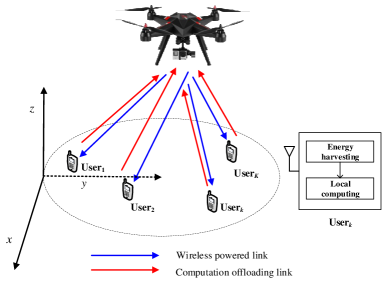
With the emergence of diverse mobile applications (such as augmented reality), the quality of experience of mobile users is greatly limited by their computation capacity and finite battery lifetime. Mobile edge computing (MEC) and wireless power transfer are promising to address this issue. However, these two techniques are susceptible to propagation delay and loss. Motivated by the chance of short-distance line-of-sight achieved by leveraging unmanned aerial vehicle (UAV) communications, an UAV-enabled wireless powered MEC system is studied. A power minimization problem is formulated subject to the constraints on the number of the computation bits and energy harvesting causality. The problem is non-convex and challenging to tackle. An alternative optimization algorithm is proposed based on sequential convex optimization. Simulation results show that our proposed design is superior to other benchmark schemes and the proposed algorithm is efficient in terms of the convergence.
Motivation & Objective
- To address the limited computation capacity and battery life of mobile users in latency-sensitive applications like augmented reality.
- To overcome the energy efficiency limitations of fixed-location MEC and WPT systems due to path loss and non-line-of-sight propagation.
- To design a UAV-enabled wireless powered MEC system that enables sustainable computation offloading via dynamic energy transfer and trajectory control.
- To jointly optimize offloading bits, user and UAV CPU frequencies, and UAV trajectory to minimize UAV transmit energy while satisfying causality and computation constraints.
Proposed method
- Formulates a non-convex power minimization problem integrating computation offloading, energy harvesting causality, and UAV mobility.
- Applies sequential convex approximation (SCA) to decompose the joint optimization into tractable subproblems for iterative solution.
- Uses alternating optimization to iteratively refine offloading decisions, CPU frequencies, and UAV trajectory under time-division constraints.
- Employs Lagrangian duality and Karush-Kuhn-Tucker (KKT) conditions to derive closed-form solutions for subproblems.
- Implements an alternative algorithm based on SCA that alternates between optimizing UAV trajectory and user offloading/frequency allocation.
- Validates the approach through simulations with realistic parameters, including UAV speed, transmit power, and user computation demands.
Experimental results
Research questions
- RQ1How can UAV trajectory design improve energy efficiency in wireless-powered mobile edge computing systems?
- RQ2What is the optimal trade-off between computation offloading, local processing, and energy harvesting under dynamic UAV mobility?
- RQ3How does joint optimization of offloading bits, CPU frequencies, and UAV trajectory reduce UAV energy consumption compared to benchmark schemes?
- RQ4To what extent does the proposed sequential convex optimization algorithm converge quickly and achieve near-optimal performance?
Key findings
- The proposed scheme reduces UAV energy consumption more effectively than benchmark schemes, with the lowest total energy usage observed in simulations.
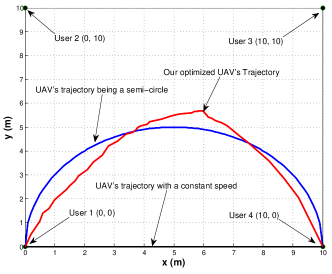
- The UAV trajectory under the proposed scheme shows adaptive flight behavior—slower near users with higher offloading demands and faster toward the end to balance energy usage.
- The proposed algorithm converges in only a few iterations, demonstrating high computational efficiency and practical feasibility.
- Simulation results confirm that the joint optimization of offloading, CPU frequency, and UAV trajectory significantly outperforms schemes with fixed trajectories or static resource allocation.
- The total energy consumption at the UAV decreases as the flight time increases, due to reduced speed and CPU frequency requirements.
- The system achieves higher computation rates and better energy utilization by leveraging UAV mobility for line-of-sight energy transfer and dynamic task offloading.
Read this paper
Open the full text in the Nubint reader and ask about any passage as you read.
Read this paper on NubintThis review was generated by AI from the original paper. Please check the paper before citing it.