
[Paper Review] UMD: Unsupervised Model Detection for X2X Backdoor Attacks
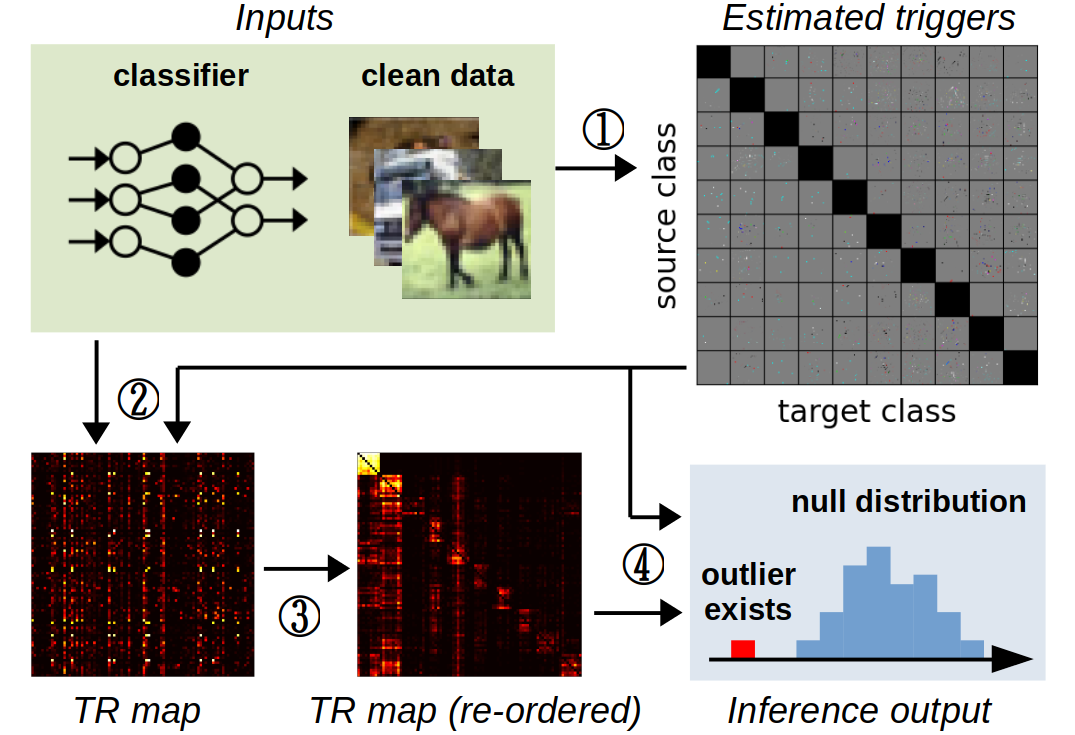
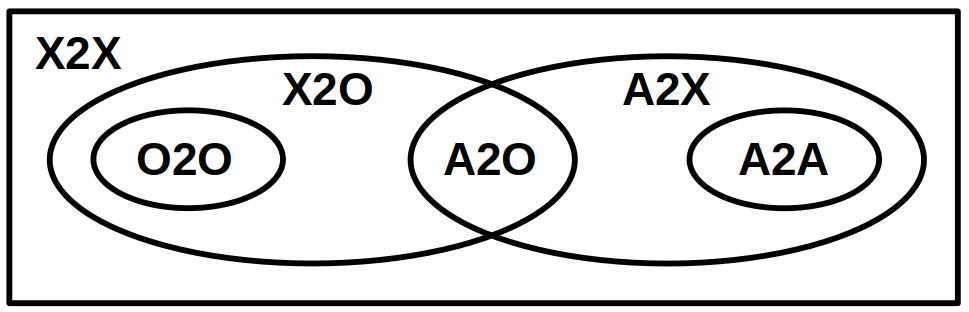
UMD is the first unsupervised model detection method for X2X backdoor attacks—where any number of source classes can be misclassified to arbitrary target classes—by jointly inferring adversarial (source, target) class pairs. It uses a novel transferability statistic (TR) to cluster and select putative backdoor pairs, then applies an unsupervised anomaly detector on aggregated trigger statistics, achieving 17–18% higher detection accuracy than SOTA methods on CIFAR-10, GTSRB, and Imagenette.
Backdoor (Trojan) attack is a common threat to deep neural networks, where samples from one or more source classes embedded with a backdoor trigger will be misclassified to adversarial target classes. Existing methods for detecting whether a classifier is backdoor attacked are mostly designed for attacks with a single adversarial target (e.g., all-to-one attack). To the best of our knowledge, without supervision, no existing methods can effectively address the more general X2X attack with an arbitrary number of source classes, each paired with an arbitrary target class. In this paper, we propose UMD, the first Unsupervised Model Detection method that effectively detects X2X backdoor attacks via a joint inference of the adversarial (source, target) class pairs. In particular, we first define a novel transferability statistic to measure and select a subset of putative backdoor class pairs based on a proposed clustering approach. Then, these selected class pairs are jointly assessed based on an aggregation of their reverse-engineered trigger size for detection inference, using a robust and unsupervised anomaly detector we proposed. We conduct comprehensive evaluations on CIFAR-10, GTSRB, and Imagenette dataset, and show that our unsupervised UMD outperforms SOTA detectors (even with supervision) by 17%, 4%, and 8%, respectively, in terms of the detection accuracy against diverse X2X attacks. We also show the strong detection performance of UMD against several strong adaptive attacks.
Motivation & Objective
- Address the gap in unsupervised detection of X2X backdoor attacks, which involve arbitrary numbers of source and target class pairs.
- Overcome limitations of existing detectors that are restricted to specific attack types like all-to-one or one-to-one.
- Enable detection without access to training data, benign models, or attack-specific shadow classifiers.
- Develop a method robust to adaptive and strong backdoor attacks that evade prior detection mechanisms.
Proposed method
- Reverse-engineer a putative trigger for each ordered class pair (i, j) to estimate their adversarial behavior.
- Introduce a transferability statistic (TR) to measure the likelihood of one class pair being backdoored based on trigger transferability to other pairs.
- Formulate a novel clustering problem using TR statistics to identify a core group of putative backdoor class pairs.
- Apply an unsupervised, bias-reduced anomaly detector to aggregate trigger statistics over the selected class pairs for final detection inference.
- Adapt the detection confidence threshold dynamically based on the number of classes in the dataset to improve robustness.
- Use a two-stage inference pipeline: (1) TR-based clustering for candidate selection; (2) anomaly detection on aggregated trigger features.
Experimental results
Research questions
- RQ1Can an unsupervised method detect X2X backdoor attacks with arbitrary source and target class assignments without access to training data or shadow models?
- RQ2How effective is the proposed transferability statistic (TR) in distinguishing true backdoor class pairs from non-backdoored ones?
- RQ3Can the clustering of TR statistics reliably identify the set of adversarial (source, target) class pairs involved in an X2X attack?
- RQ4How does UMD perform against strong adaptive backdoor attacks that evade existing detection methods?
- RQ5Does the unsupervised anomaly detection component maintain high detection accuracy across diverse datasets and attack types?
Key findings
- UMD achieves 100% model inference accuracy (MIA) on CIFAR-10, GTSRB, and Imagenette, outperforming SOTA detectors by 17%, 4%, and 8% respectively in detection accuracy.
- On CIFAR-10 with A2Ar (all-to-all) attacks, UMD achieves 1.0 MIA and 0.90 PDR, significantly outperforming supervised baselines.
- UMD maintains strong performance even with only 1,500 poisoning images (PDR = 0.70), though detection drops slightly due to low ASR in some pairs.
- UMD detects O2O (one-to-one) attacks effectively due to collateral damage, where non-targeted class pairs also exhibit high ASR from the same trigger.
- The method is robust against adaptive attacks, with no significant drop in performance across diverse X2X attack settings.
- Computational cost is acceptable for off-line detection, requiring ~0.3h per model on CIFAR-10, with potential for acceleration via optimization techniques.
Read this paper
Open the full text in the Nubint reader and ask about any passage as you read.
Read this paper on NubintThis review was generated by AI from the original paper. Please check the paper before citing it.