
[Paper Review] unarXive 2022: All arXiv Publications Pre-Processed for NLP, Including Structured Full-Text and Citation Network
This paper introduces unarXive 2022, a large-scale, FAIR-compliant scholarly data set of 1.9 million arXiv publications pre-processed from LaTeX sources, preserving structured full-text, mathematical notation, figure/table captions, and a citation network with 44.4% completeness—surpassing prior versions and most comparable data sets. It includes ready-to-use training and test data for citation recommendation and IMRaD classification, all publicly shared under permissive licenses.
Large-scale data sets on scholarly publications are the basis for a variety of bibliometric analyses and natural language processing (NLP) applications. Especially data sets derived from publication's full-text have recently gained attention. While several such data sets already exist, we see key shortcomings in terms of their domain and time coverage, citation network completeness, and representation of full-text content. To address these points, we propose a new version of the data set unarXive. We base our data processing pipeline and output format on two existing data sets, and improve on each of them. Our resulting data set comprises 1.9 M publications spanning multiple disciplines and 32 years. It furthermore has a more complete citation network than its predecessors and retains a richer representation of document structure as well as non-textual publication content such as mathematical notation. In addition to the data set, we provide ready-to-use training/test data for citation recommendation and IMRaD classification. All data and source code is publicly available at https://github.com/IllDepence/unarXive.
Motivation & Objective
- To address key limitations in existing full-text scholarly data sets, including incomplete citation networks, poor handling of mathematical notation, and limited structural representation.
- To create a larger, more comprehensive, and more structured scholarly data set by processing 1.9 million arXiv publications from original LaTeX sources.
- To improve upon prior versions of unarXive by enhancing citation network completeness and preserving non-textual content such as equations, tables, and figures.
- To provide ready-to-use, benchmark-ready training and test data for two NLP tasks: citation recommendation and IMRaD classification.
- To ensure long-term accessibility, reusability, and extensibility by distributing data and source code under FAIR principles and permissive licenses.
Proposed method
- Processing 1.9 million arXiv publications using a custom pipeline that extracts and structures full-text content from original LaTeX sources.
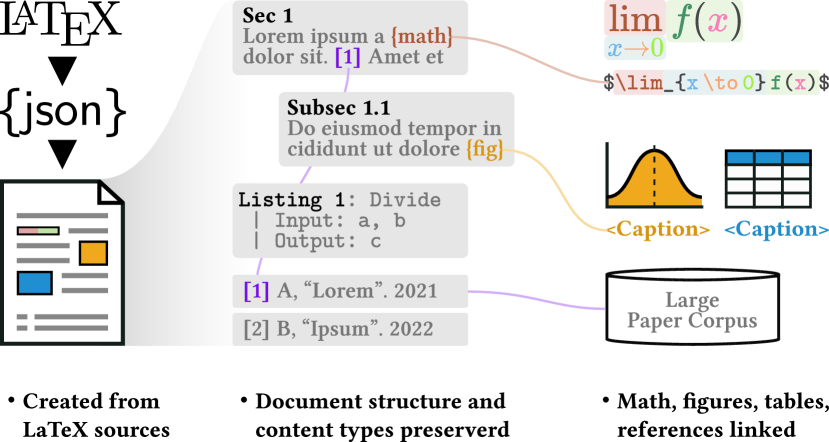
- Preserving document structure (sections, subsections), content types (paragraphs, listings), and in-text positions of mathematical notation, figures, tables, and citations.
- Linking citation markers to bibliographic references and mapping them to OpenAlex IDs for enhanced citation network completeness.
- Generating structured, machine-readable representations of mathematical notation, figure captions, and table content to retain semantic and structural fidelity.
- Creating two task-specific datasets: 2.5 million citation recommendation samples and 530,000 IMRaD classification samples from computer science papers.
- Distributing the data set via Zenodo (with open and restricted access versions), NLP task data via Hugging Face Hub, and source code via GitHub under the MIT License.
Experimental results
Research questions
- RQ1How can a large-scale scholarly data set be constructed to preserve full-text structure, mathematical notation, and citation networks more completely than existing alternatives?
- RQ2To what extent does a data set derived from LaTeX sources outperform PDF-based or less structured data sets in terms of citation network completeness and content fidelity?
- RQ3Can a unified, FAIR-compliant data set support diverse NLP applications, including citation recommendation and section classification, with ready-to-use, high-quality training data?
- RQ4How can the integration of structured mathematical notation and citation networks enable novel scholarly data analysis and NLP applications?
- RQ5What are the practical and licensing challenges in scaling a scholarly data set from permissively-licensed and non-exclusively-licensed source materials?
Key findings
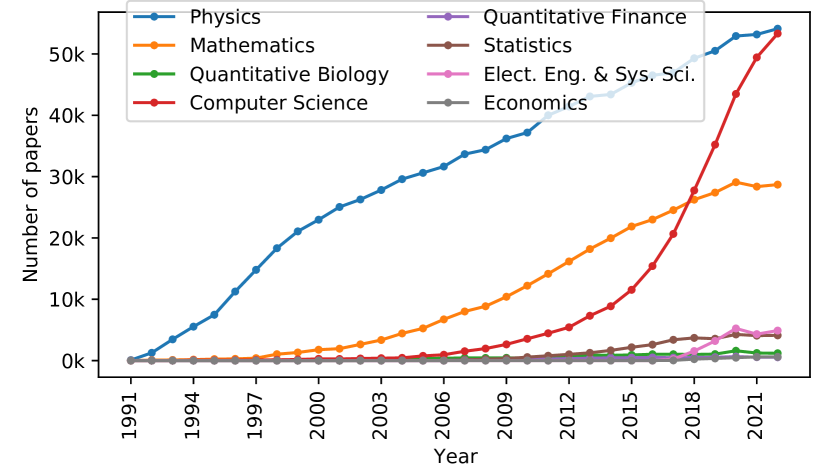
- The unarXive 2022 data set comprises 1.9 million publications across physics, mathematics, and computer science, with 44.4% citation network completeness—higher than any prior comparable full-text data set.
- The data set preserves structured full-text content, including in-line mathematical notation, figure and table captions, and section-level structure, with precise positional linking to source LaTeX elements.
- The citation network is linked to OpenAlex, enabling cross-referencing and improved bibliometric analysis capabilities.
- The authors provide 2.5 million citation recommendation samples and 530,000 IMRaD classification samples, all derived from permissively-licensed computer science papers, for immediate NLP use.
- The data set is distributed via Zenodo (with open and restricted access versions), task data via Hugging Face Hub, and source code via GitHub under the MIT License, ensuring broad accessibility and reusability.
- The data set is designed for incremental updates, with future versions planned to incorporate new arXiv submissions, ensuring ongoing relevance and scalability.
Read this paper
Open the full text in the Nubint reader and ask about any passage as you read.
Read this paper on NubintThis review was generated by AI from the original paper. Please check the paper before citing it.