
[Paper Review] Unbiased Asymmetric Reinforcement Learning under Partial Observability
This paper proposes an unbiased asymmetric actor-critic method for partially observable reinforcement learning that uses a history-state value function $\hat{V}(h,s)$ instead of a state-only critic, resolving theoretical flaws in prior biased approaches. The method ensures policy gradient validity, reduces training bias, and achieves faster convergence and better performance than symmetric and biased asymmetric baselines in memory-intensive, partially observable environments like Heaven-Hell-4 and Memory-Four-Rooms-9x9.
In partially observable reinforcement learning, offline training gives access to latent information which is not available during online training and/or execution, such as the system state. Asymmetric actor-critic methods exploit such information by training a history-based policy via a state-based critic. However, many asymmetric methods lack theoretical foundation, and are only evaluated on limited domains. We examine the theory of asymmetric actor-critic methods which use state-based critics, and expose fundamental issues which undermine the validity of a common variant, and limit its ability to address partial observability. We propose an unbiased asymmetric actor-critic variant which is able to exploit state information while remaining theoretically sound, maintaining the validity of the policy gradient theorem, and introducing no bias and relatively low variance into the training process. An empirical evaluation performed on domains which exhibit significant partial observability confirms our analysis, demonstrating that unbiased asymmetric actor-critic converges to better policies and/or faster than symmetric and biased asymmetric baselines.
Motivation & Objective
- To identify theoretical flaws in existing asymmetric actor-critic methods that use state-based critics $V^\pi(s)$ in partially observable environments.
- To establish a rigorous policy gradient theorem for asymmetric actor-critic methods under partial observability, explicitly incorporating latent state information.
- To design a novel, unbiased asymmetric actor-critic variant that leverages history-state pairs $(h,s)$ as input to the critic, ensuring no learning bias is introduced.
- To empirically validate the theoretical claims on environments with high partial observability, demonstrating superior convergence and performance over symmetric and biased asymmetric baselines.
- To lay the foundation for principled use of privileged information in offline training for both single-agent and multi-agent reinforcement learning.
Proposed method
- Proposes a new critic architecture $\hat{V}^\pi(h,s)$ that jointly conditions on the agent's history $h$ and the true system state $s$, enabling more accurate value estimation in POMDPs.
- Derives a new asymmetric policy gradient theorem that formally justifies the use of $\hat{V}^\pi(h,s)$ in policy optimization, ensuring unbiased gradient updates.
- Introduces the A2C-asym-hs algorithm, an extension of Advantage Actor-Critic that uses the history-state critic while maintaining the same policy network as standard A2C.
- Employs a training objective that ensures the critic's value estimates are grounded in both the observable history and the privileged state, avoiding the ambiguity of state-only critics.
- Uses a double-branch network structure where the critic receives both history and state inputs, while the policy remains history-based, preserving online execution constraints.
- Employs off-policy experience replay and standard A2C update rules, but modifies the value function target to use the history-state critic, ensuring consistent and unbiased learning.
Experimental results
Research questions
- RQ1Why do state-based critics $V^\pi(s)$ in asymmetric actor-critic methods lead to biased learning in partially observable environments?
- RQ2Can a theoretically sound policy gradient theorem be derived for asymmetric actor-critic methods that incorporate privileged state information?
- RQ3Does using a history-state critic $\hat{V}^\pi(h,s)$ instead of a state-only critic $\hat{V}^\pi(s)$ eliminate learning bias and improve policy performance in POMDPs?
- RQ4How does the proposed unbiased asymmetric method compare to symmetric A2C and biased asymmetric baselines in terms of convergence speed and final policy quality?
- RQ5Can the proposed method be generalized to other critic-based deep reinforcement learning algorithms beyond A2C?
Key findings
- The state-based critic $\hat{V}^\pi(s)$ is fundamentally ill-defined in POMDPs because multiple distinct histories can map to the same state, leading to ambiguous value estimates and learning bias.
- The A2C-asym-hs critic, which conditions on both history $h$ and state $s$, produces distinct value outputs for different histories even when the state is identical, enabling proper credit assignment.
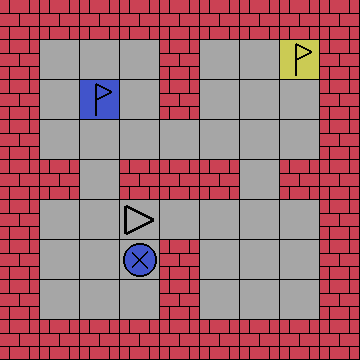
- In the Heaven-Hell-4 environment, the A2C-asym-hs critic correctly assigns higher values to states where the agent has previously visited the priest, signaling the importance of information-gathering actions.
- Empirical results show that the unbiased A2C-asym-hs method converges faster and achieves higher final returns than both symmetric A2C and biased asymmetric baselines on Memory-Four-Rooms-9x9 and Heaven-Hell-4.
- The A2C-asym-hs method maintains consistent value estimates across runs, while the biased A2C-asym-s critic produces identical values for different histories with the same state, undermining learning.
- The proposed method is the first to provide a theoretically grounded, unbiased asymmetric actor-critic framework that maintains the validity of the policy gradient theorem under partial observability.

Read this paper
Open the full text in the Nubint reader and ask about any passage as you read.
Read this paper on NubintThis review was generated by AI from the original paper. Please check the paper before citing it.