
[Paper Review] Uncertain Quality-Diversity: Evaluation methodology and new methods for Quality-Diversity in Uncertain Domains
This paper introduces Uncertain Quality-Diversity (Uncertain QD), a formal framework for QD in uncertain environments where fitness and descriptors are distributions rather than fixed values. It proposes a new evaluation methodology using per-generation sampling budgets and introduces three new algorithms—Archive-sampling, Parallel-Adaptive-sampling, and Deep-Grid-sampling—that outperform standard MAP-Elites by improving solution reproducibility and robustness in uncertain domains.
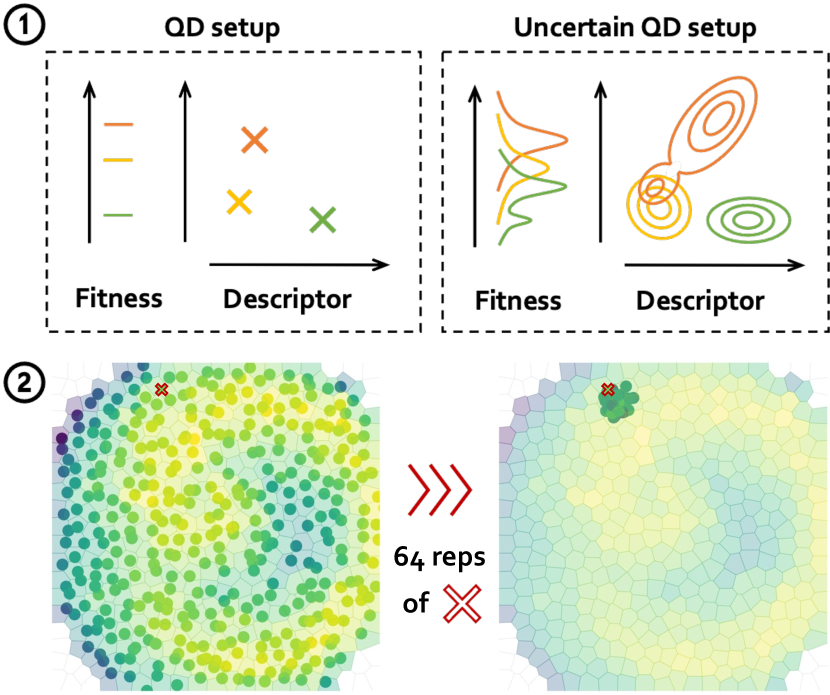
Quality-Diversity optimisation (QD) has proven to yield promising results across a broad set of applications. However, QD approaches struggle in the presence of uncertainty in the environment, as it impacts their ability to quantify the true performance and novelty of solutions. This problem has been highlighted multiple times independently in previous literature. In this work, we propose to uniformise the view on this problem through four main contributions. First, we formalise a common framework for uncertain domains: the Uncertain QD setting, a special case of QD in which fitness and descriptors for each solution are no longer fixed values but distribution over possible values. Second, we propose a new methodology to evaluate Uncertain QD approaches, relying on a new per-generation sampling budget and a set of existing and new metrics specifically designed for Uncertain QD. Third, we propose three new Uncertain QD algorithms: Archive-sampling, Parallel-Adaptive-sampling and Deep-Grid-sampling. We propose these approaches taking into account recent advances in the QD community toward the use of hardware acceleration that enable large numbers of parallel evaluations and make sampling an affordable approach to uncertainty. Our final and fourth contribution is to use this new framework and the associated comparison methods to benchmark existing and novel approaches. We demonstrate once again the limitation of MAP-Elites in uncertain domains and highlight the performance of the existing Deep-Grid approach, and of our new algorithms. The goal of this framework and methods is to become an instrumental benchmark for future works considering Uncertain QD.
Motivation & Objective
- To formalize a unified framework for Quality-Diversity optimization in uncertain domains, where fitness and descriptors are distributions rather than fixed values.
- To address the limitation of standard QD algorithms like MAP-Elites, which are biased toward lucky evaluations due to elitism in uncertain environments.
- To propose a new evaluation methodology that accounts for sampling budgets rather than batch sizes, enabling fair comparison of uncertainty-handling strategies.
- To design and evaluate new Uncertain QD algorithms that leverage high-parallelization and sampling to improve solution reliability and diversity.
- To establish a benchmark for future research in Uncertain QD through open-sourced tools and standardized evaluation protocols.
Proposed method
- Formalizes the Uncertain QD setting as a special case of QD where fitness and descriptors are probability distributions over possible values.
- Introduces 'sampling-size' as a replacement for batch-size in algorithm comparison, representing the total number of evaluations per generation for each solution.
- Proposes a new evaluation pipeline that includes per-generation sampling, repeated evaluation of solutions, and computation of distribution-based metrics.
- Develops three new algorithms: Archive-sampling (samples solutions from the archive for evaluation), Parallel-Adaptive-sampling (adapts sampling per cell based on variance), and Deep-Grid-sampling (uses a neural network to model distributions and sample strategically).
- Employs metrics such as QD-Score, Reproducibility-Score, and fitness/descriptor variance to evaluate performance and robustness across tasks.
- Uses high-parallelization via libraries like QDax and EvoJax to enable efficient sampling-based evaluation, making sampling a viable alternative to model-based uncertainty handling.
Experimental results
Research questions
- RQ1How can Quality-Diversity optimization be formally extended to handle uncertainty in fitness and descriptor values?
- RQ2What is the most effective way to fairly compare Uncertain QD algorithms when evaluation cost varies due to sampling?
- RQ3How do sampling-based approaches compare to model-based or adaptive strategies in terms of solution quality, diversity, and reproducibility?
- RQ4Which algorithmic design—uniform sampling, adaptive sampling, or distribution modeling—yields the most robust and diverse solutions in uncertain environments?
- RQ5Can simple sampling strategies outperform more complex model-based methods when high parallelization enables affordable sampling?
Key findings
- MAP-Elites fails in uncertain domains due to elitism favoring lucky evaluations, leading to selection of non-reproducible solutions.
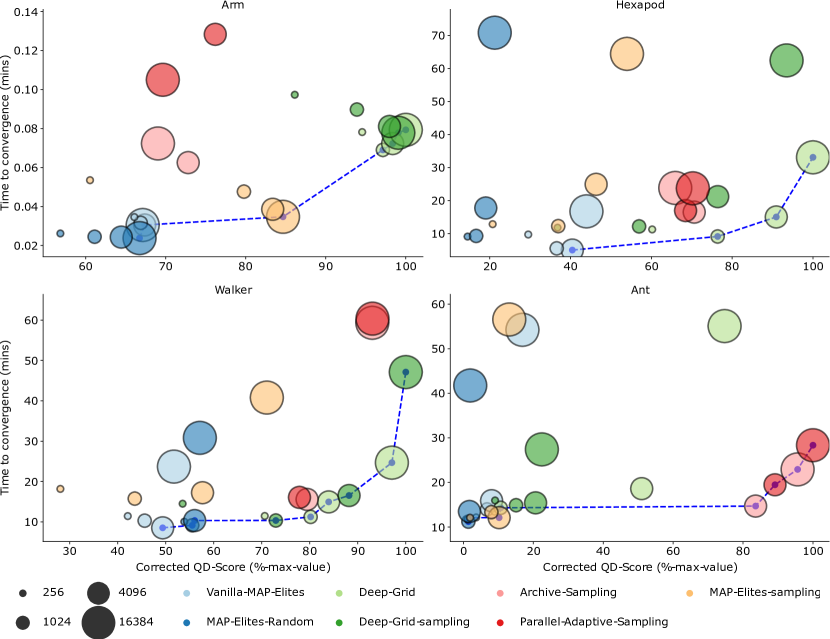
- Archive-sampling and Parallel-Adaptive-sampling significantly improve reproducibility over MAP-Elites and MAP-Elites-Random (p < 1.10⁻³) by reducing variance in solution performance.
- Deep-Grid-sampling outperforms other methods in terms of QD-Score on the Walker task (p < 5.10⁻² for sampling size 256) and shows strong performance on simpler tasks.
- Deep-Grid performs well in domains with simple noise structures but struggles with complex noise, indicating limitations in distribution approximation.
- MAP-Elites-sampling, despite using sampling, performs no better than standard MAP-Elites in reproducibility, due to lack of exploration and poor sampling strategy.
- Archive-sampling and Parallel-Adaptive-sampling achieve competitive QD-Score on complex tasks (Ant and Walker), outperforming Deep-Grid-sampling in these settings, and demonstrate strong reproducibility.
Read this paper
Open the full text in the Nubint reader and ask about any passage as you read.
Read this paper on NubintThis review was generated by AI from the original paper. Please check the paper before citing it.