
[Paper Review] Uncovering Local Integrability in Quantum Many-Body Dynamics
This study demonstrates experimental reconstruction of local integrals of motion (LIOMs) in disordered, periodically-driven quantum spin systems using up to 124 superconducting qubits. By analyzing spectral anomalies in the one-particle density matrix and leveraging quantum circuit tomography, the authors identify hidden local conservation laws in the many-body localized regime, providing direct evidence of local integrability in a regime previously inaccessible to exact theoretical analysis.
Interacting many-body quantum systems and their dynamics, while fundamental to modern science and technology, are formidable to simulate and understand. However, by discovering their symmetries, conservation laws, and integrability one can unravel their intricacies. Here, using up to 124 qubits of a fully programmable quantum computer, we uncover local conservation laws and integrability in one- and two-dimensional periodically-driven spin lattices in a regime previously inaccessible to such detailed analysis. We focus on the paradigmatic example of disorder-induced ergodicity breaking, where we first benchmark the system crossover into a localized regime through anomalies in the one-particle-density-matrix spectrum and other hallmark signatures. We then demonstrate that this regime stems from hidden local integrals of motion by faithfully reconstructing their quantum operators, thus providing a detailed portrait of the system's integrable dynamics. Our results demonstrate a versatile strategy for extracting the hidden dynamical structure from noisy experiments on large-scale quantum computers.
Motivation & Objective
- To detect and characterize local integrals of motion (LIOMs) in disordered, periodically-driven quantum spin systems where exact analytical solutions are intractable.
- To overcome the limitations of finite-size effects and noise in large-scale quantum experiments by developing robust protocols for identifying approximate LIOMs.
- To provide experimental validation of the many-body localization (MBL) scenario through signatures such as suppressed level spacing and spectral gaps in the one-particle density matrix.
- To demonstrate that approximate LIOMs can serve as effective quantum numbers for describing non-ergodic dynamics in noisy, large-scale quantum systems.
- To establish a scalable experimental framework for uncovering hidden dynamical structures in quantum many-body systems using programmable quantum hardware.
Proposed method
- Employing a digital quantum circuit implementation of the kicked Ising model with random on-site disorder via single-qubit phase gates and controlled-Z interactions.
- Using time-evolved density matrices and one-particle density matrix (OPDM) spectra to detect ergodicity-breaking signatures, including spectral gaps and level repulsion suppression.
- Applying a noise mitigation protocol by normalizing experimental data against a reference circuit with zero coupling (θ=0), using the average decay curve to compensate for decoherence.
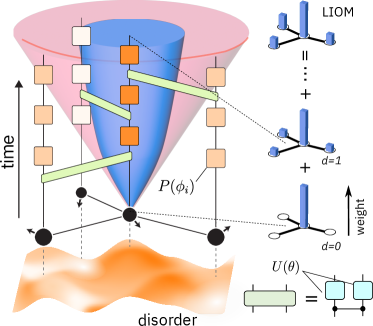
- Reconstructing approximate LIOMs via averaging over time-evolved local operators, with spatial localization confirmed through weight distribution across qubit sites.
- Utilizing non-commuting basis measurements and quantum circuit tomography to extract operator dynamics and verify conservation properties in the MBL regime.
- Performing a decomposition of reconstructed LIOMs into Pauli operator contributions (1-local to 4-local) to analyze the role of quantum scrambling and interaction range.
Experimental results
Research questions
- RQ1Can local integrals of motion (LIOMs) be experimentally reconstructed in a large-scale, noisy quantum many-body system with up to 124 qubits?
- RQ2What experimental signatures in the one-particle density matrix spectrum indicate the onset of many-body localization and ergodicity breaking?
- RQ3To what extent do approximate LIOMs serve as effective conserved quantities in the finite-time dynamics of disordered quantum spin systems?
- RQ4How does the spatial structure and locality of reconstructed LIOMs reflect the underlying interactions and disorder realizations in 1D and 2D lattices?
- RQ5Can noise-compensated quantum circuit measurements reliably reveal the presence of hidden conservation laws in systems where exact integrability is unprovable?
Key findings
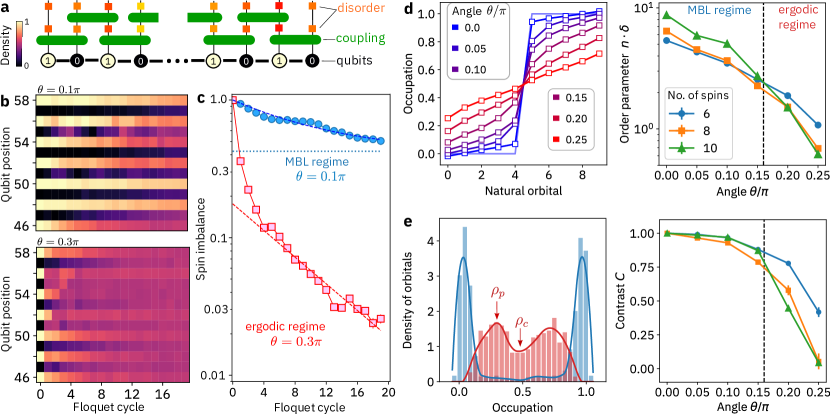
- The one-particle density matrix (OPDM) spectrum exhibits a clear spectral gap in the MBL regime (θ=0.1π), with a gap ratio of approximately 0.425, indicating suppressed level repulsion and ergodicity breaking.
- A fit to the spin imbalance dynamics in the MBL regime yields a decay constant γ = 0.0966, consistent with slow, non-ergodic evolution and supporting the existence of conserved quantities.
- The reconstructed LIOMs in the 104-qubit 1D system are spatially localized around individual qubits, with dominant contributions from single-site Z operators and non-negligible two- and three-local terms, indicating quantum scrambling.
- The average LIOM profile shows strong spatial localization and robustness to noise, with individual LIOMs exhibiting varying degrees of imprecision, where higher-imprecision operators show stronger temporal oscillations.
- In 2D systems, the spectral gap becomes 'soft' due to noise, leading to a plateau in the discontinuity parameter independent of system size, yet the gap ratio still reflects thermalization dynamics.
- The decomposition of LIOMs reveals that one-local Pauli operators dominate, but three-local contributions are nearly equal to two-local ones, suggesting non-trivial many-body entanglement and scrambling in the system.
Read this paper
Open the full text in the Nubint reader and ask about any passage as you read.
Read this paper on NubintThis review was generated by AI from the original paper. Please check the paper before citing it.