
[Paper Review] Understand Data Preprocessing for Effective End-to-End Training of Deep Neural Networks
This paper investigates data preprocessing bottlenecks in end-to-end deep learning training, demonstrating that CPU-GPU co-processing via NVIDIA DALI significantly improves training throughput—achieving 7.86% faster training for AlexNet and 3.03% for ResNet50—while showing that storage choice (e.g., DRAM vs. SSD) and model-specific CPU-GPU resource allocation critically impact performance and cost-efficiency.
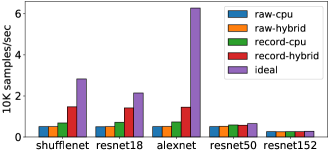
In this paper, we primarily focus on understanding the data preprocessing pipeline for DNN Training in the public cloud. First, we run experiments to test the performance implications of the two major data preprocessing methods using either raw data or record files. The preliminary results show that data preprocessing is a clear bottleneck, even with the most efficient software and hardware configuration enabled by NVIDIA DALI, a high-optimized data preprocessing library. Second, we identify the potential causes, exercise a variety of optimization methods, and present their pros and cons. We hope this work will shed light on the new co-design of ``data storage, loading pipeline'' and ``training framework'' and flexible resource configurations between them so that the resources can be fully exploited and performance can be maximized.
Motivation & Objective
- To identify and analyze performance bottlenecks in data preprocessing pipelines for deep neural network (DNN) training in public cloud environments.
- To evaluate the impact of different data preprocessing methods—raw data vs. record files—on end-to-end training efficiency.
- To investigate the role of CPU and GPU resource allocation in data preprocessing and training workloads, especially under varying model complexity.
- To explore how storage media (e.g., EBS, NVMe SSD, DRAM) influence training performance and cost-effectiveness.
- To advocate for co-design of data storage, loading pipelines, and training frameworks with flexible, model-aware resource configurations.
Proposed method
- Benchmarked three major deep learning frameworks—TensorFlow, MXNet, and PyTorch—on standard vision models (AlexNet, ResNet50, ResNet18) to analyze data preprocessing pipelines.
- Used NVIDIA DALI to enable CPU-GPU co-processing for data preprocessing, comparing its performance against traditional CPU-only and GPU-only modes.
- Measured end-to-end training throughput across varying vCPU and GPU configurations, identifying saturation points and performance scaling behavior.
- Evaluated storage impact by deploying models on EC2 p3dn.24xlarge instances with EBS, NVMe SSD, and DRAM-backed storage for data loading.
- Conducted ablation studies to isolate the effects of data decoding, augmentation, and I/O bandwidth on pipeline efficiency.
- Proposed model-specific, fine-grained resource allocation strategies based on whether the pipeline is I/O-bound or compute-bound.

Experimental results
Research questions
- RQ1How do different data preprocessing methods (raw data vs. record files) affect end-to-end training performance in public cloud environments?
- RQ2What is the performance impact of CPU-GPU co-processing in data preprocessing, and how does it compare to CPU-only or GPU-only approaches?
- RQ3How does the choice of storage medium (EBS, NVMe SSD, DRAM) influence training throughput for different DNN models?
- RQ4To what extent can flexible, model-aware CPU-GPU resource allocation improve training efficiency and cost-effectiveness?
- RQ5What are the key performance bottlenecks in current data preprocessing pipelines, and how can they be mitigated through system co-design?
Key findings
- Data preprocessing remains a significant bottleneck even with optimized software (e.g., NVIDIA DALI) and high-end hardware, often underutilizing expensive GPU resources.
- Using CPU-GPU co-processing via DALI’s hybrid mode increased training speed by 7.86% for AlexNet and 3.03% for ResNet50 compared to CPU-only preprocessing.
- Loading data from DRAM improved AlexNet training speed by 1.84× compared to EBS or NVMe SSD, due to its high I/O bandwidth requirements.
- ResNet18 training performance was only slightly improved (8.8%) when loading from DRAM, indicating it is less I/O-bound than AlexNet.
- The optimal vCPU allocation varies by model: ResNet50 required only 16 vCPUs (2 per GPU) in hybrid mode, while AlexNet needed 44 vCPUs (11 per GPU) to saturate the pipeline.
- Reducing vCPU allocation for ResNet50 by 75% while maintaining comparable performance demonstrates significant cost savings without performance degradation.
Read this paper
Open the full text in the Nubint reader and ask about any passage as you read.
Read this paper on NubintThis review was generated by AI from the original paper. Please check the paper before citing it.