
[Paper Review] Understand Legal Documents with Contextualized Large Language Models
The paper presents Legal-BERT-HSLN for sequential rhetorical role classification and Legal-LUKE for legal named entity recognition, outperforming baselines and achieving top-5 on rhetoric roles leaderboard.
The growth of pending legal cases in populous countries, such as India, has become a major issue. Developing effective techniques to process and understand legal documents is extremely useful in resolving this problem. In this paper, we present our systems for SemEval-2023 Task 6: understanding legal texts (Modi et al., 2023). Specifically, we first develop the Legal-BERT-HSLN model that considers the comprehensive context information in both intra- and inter-sentence levels to predict rhetorical roles (subtask A) and then train a Legal-LUKE model, which is legal-contextualized and entity-aware, to recognize legal entities (subtask B). Our evaluations demonstrate that our designed models are more accurate than baselines, e.g., with an up to 15.0% better F1 score in subtask B. We achieved notable performance in the task leaderboard, e.g., 0.834 micro F1 score, and ranked No.5 out of 27 teams in subtask A.
Motivation & Objective
- Formalize rhetorical role prediction as sequential sentence classification to better handle intra- and inter-sentence context in legal texts.
- Develop a context-aware, hierarchical model (Legal-BERT-HSLN) for sentence-level rhetorical role labeling.
- Design an entity-aware, context-sensitive model (Legal-LUKE) for legal named entity recognition.
- Evaluate against strong baselines to demonstrate improvements in F1 scores and leaderboard placement.
Proposed method
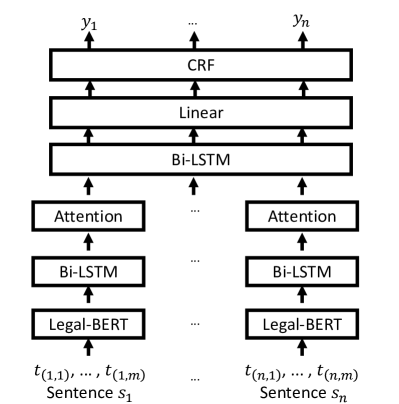
- Adopt Legal-BERT-HSLN with a hierarchical structure: token embeddings from Legal-BERT, Bi-LSTM contextualization, attention pooling, and CRF decoding for sequence labeling.
- Enhance sentence representations with inter-sentence context to capture long-range dependencies.
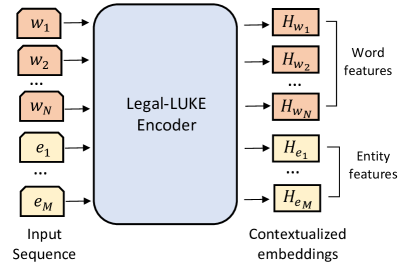
- Propose Legal-LUKE based on LUKE architecture to learn legal-contextualized word and entity representations with token, type, and position embeddings.
- In Legal-LUKE, integrate an entity sequence alongside word sequence to produce joint word and entity embeddings for NER.
- Compare against baselines including BERT-CRF, BERT-Span, XLM-RoBERTa-CRF, and mLUKE under constrained resource settings.
Experimental results
Research questions
- RQ1How effectively can contextualized language models capture intra- and inter-sentence context for rhetorical role classification in legal documents?
- RQ2Can an entity-aware, contextually rich model improve legal NER performance over standard encoders?
- RQ3How do the proposed models compare to strong baselines on SemEval-2023 Task 6 benchmarks?
- RQ4What are the practical limitations and hyperparameter sensitivities in applying contextualized legal models to long, noisy documents?
Key findings
- Legal-BERT-HSLN achieves micro F1 of 0.828 on validation and 0.8343 on test, ranking No.5 out of 27 teams for rhetorical role classification.
- Legal-LUKE outperforms baselines in legal NER with micro F1 up to 0.796 on validation (best among listed baselines).
- Legal-LUKE shows up to 14.3% improvement in micro F1 over the BERT-CRF baseline for NER.
- XLM-RoBERTa-CRF baseline and mLUKE also perform strong in NER, with XLM-RoBERTa-CRF reaching 0.773 and mLUKE 0.787.
- Regularization preprocessing for rhetorical role classification reduced performance, indicating sensitivity to stop words and sentence markers.
- Test set results for Legal-LUKE were lower (0.667) than validation, suggesting distribution shifts between sets.
Read this paper
Open the full text in the Nubint reader and ask about any passage as you read.
Read this paper on NubintThis review was generated by AI from the original paper. Please check the paper before citing it.