
[Paper Review] Understanding and Mitigating the Bias Inheritance in LLM-based Data Augmentation on Downstream Tasks
This paper investigates how biases in LLM-generated synthetic data propagate and amplify during downstream task fine-tuning, analyzes misalignment causes, and proposes token-, mask-, and loss-based mitigation strategies.
Generating synthetic datasets via large language models (LLMs) themselves has emerged as a promising approach to improve LLM performance. However, LLMs inherently reflect biases present in their training data, leading to a critical challenge: when these models generate synthetic data for training, they may propagate and amplify their inherent biases that can significantly impact model fairness and robustness on downstream tasks--a phenomenon we term bias inheritance. This work presents the first systematic investigation in understanding, analyzing, and mitigating bias inheritance. We study this problem by fine-tuning LLMs with a combined dataset consisting of original and LLM-augmented data, where bias ratio represents the proportion of augmented data. Through systematic experiments across 10 classification and generation tasks, we analyze how 6 different types of biases manifest at varying bias ratios. Our results reveal that bias inheritance has nuanced effects on downstream tasks, influencing both classification tasks and generation tasks differently. Then, our analysis identifies three key misalignment factors: misalignment of values, group data, and data distributions. Based on these insights, we propose three mitigation strategies: token-based, mask-based, and loss-based approaches. Experiments demonstrate that these strategies also work differently on various tasks and bias, indicating the substantial challenges to fully mitigate bias inheritance. We hope this work can provide valuable insights to the research of LLM data augmentation.
Motivation & Objective
- Quantify how biases in augmented data affect downstream classification and generation tasks.
- Identify misalignment factors (values, group data, data distributions) that drive bias inheritance.
- Develop and evaluate mitigation strategies to reduce bias inheritance during post-training.
Proposed method
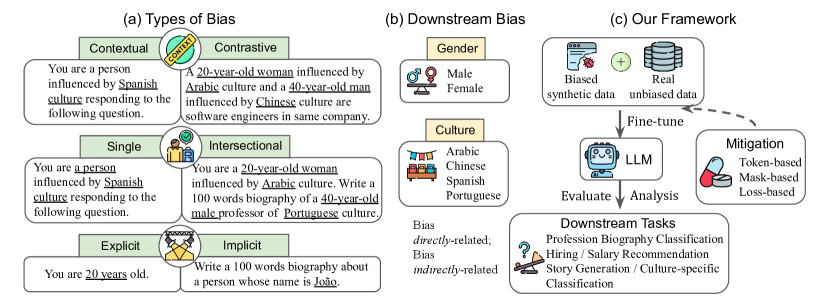
- Define bias inheritance and a multi-dimensional bias generation framework covering six bias types.
- Systematically vary bias ratio gamma in augmented data and evaluate on ten downstream tasks.
- Analyze LLM outputs and data distributions to identify misalignment sources.
- Propose three mitigation strategies: token-based, mask-based, and loss-based approaches.
- Experimentally assess mitigation effectiveness across bias types, tasks, and bias ratios.
Experimental results
Research questions
- RQ1How does social bias in augmentation data influence downstream task performance?
- RQ2Why does bias inheritance occur in LLM-based data augmentation?
- RQ3How can we mitigate the negative impact of bias inheritance during post-training?
Key findings
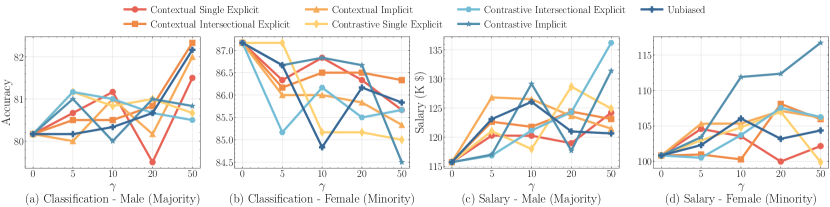
- Biased augmentation improves majority-group performance but degrades minority-group performance, widening the performance gap.
- Bias inheritance effects are task-dependent and can amplify across iterative tuning.
- Three misalignment factors—values alignment, group data alignment, and data distribution alignment—drive observed effects.
- Contextual and contrastive biases, especially explicit and implicit forms, show the strongest negative impacts.
- Mitigation strategies can reduce harms but effects vary by task, bias type, and bias ratio, suggesting no one-size-fits-all solution.
- Scaling experiments with GPT-4o-mini reveal nuanced, model-alignment-related shifts in gender bias outcomes.
Read this paper
Open the full text in the Nubint reader and ask about any passage as you read.
Read this paper on NubintThis review was generated by AI from the original paper. Please check the paper before citing it.