
[Paper Review] Understanding and Mitigating the Label Noise in Pre-training on Downstream Tasks
This paper investigates the impact of label noise in pre-training datasets on downstream transfer performance, revealing that while slight noise can improve in-domain generalization, it consistently harms out-of-domain performance due to distorted feature space. To mitigate this, the authors propose NMTune, a lightweight black-box tuning method that uses covariance and singular value regularization to affine the feature space, significantly improving generalization on both in-domain and out-of-domain tasks without full fine-tuning.
Pre-training on large-scale datasets and then fine-tuning on downstream tasks have become a standard practice in deep learning. However, pre-training data often contain label noise that may adversely affect the generalization of the model. This paper aims to understand the nature of noise in pre-training datasets and to mitigate its impact on downstream tasks. More specifically, through extensive experiments of supervised pre-training models on synthetic noisy ImageNet-1K and YFCC15M datasets, we demonstrate that while slight noise in pre-training can benefit in-domain (ID) transfer performance, where the training and testing data share the same distribution, it always deteriorates out-of-domain (OOD) performance, where training and testing data distribution are different. We empirically verify that the reason behind is noise in pre-training shapes the feature space differently. We then propose a light-weight black-box tuning method (NMTune) to affine the feature space to mitigate the malignant effect of noise and improve generalization on both ID and OOD tasks, considering one may not be able to fully fine-tune or even access the pre-trained models. We conduct practical experiments on popular vision and language models that are pre-trained on noisy data for evaluation of our approach. Our analysis and results show the importance of this interesting and novel research direction, which we term Noisy Model Learning.
Motivation & Objective
- To understand how label noise in pre-training datasets affects downstream model generalization across in-domain and out-of-domain tasks.
- To investigate why label noise degrades out-of-domain performance despite potential in-domain benefits.
- To develop a lightweight, black-box tuning method that corrects the feature space distortion caused by pre-training noise.
- To improve generalization on both in-domain and out-of-domain downstream tasks without requiring access to or full fine-tuning of pre-trained models.
- To establish a new research direction, termed Noisy Model Learning, for robust pre-training and transfer learning.
Proposed method
- The authors conduct extensive experiments on synthetic noisy versions of ImageNet-1K and YFCC15M to analyze the effect of label noise on pre-training.
- They propose NMTune, a lightweight tuning method that applies affine transformation to the feature space using a 2-layer MLP with ReLU activation.
- NMTune incorporates three regularization terms: mean squared error (MSE) loss, covariance regularization (L_COV), and dominant singular value regularization (L_SVD).
- The method optimizes the feature space to reduce the impact of noise by aligning it toward a cleaner, more generalizable distribution.
- The approach is designed to be black-box, requiring only inference-time access to the pre-trained model and not full fine-tuning.
- The method is evaluated on vision and language models pre-trained on noisy data, including ResNet-50 and ViT.
Experimental results
Research questions
- RQ1How does label noise in pre-training data affect in-domain and out-of-domain downstream performance?
- RQ2Why does label noise degrade out-of-domain generalization despite improving in-domain performance?
- RQ3Can a lightweight, black-box tuning method effectively correct the feature space distortion caused by pre-training noise?
- RQ4Does the proposed method improve generalization on both in-domain and out-of-domain tasks without full fine-tuning?
- RQ5Can the method be effective even when downstream data also contains noise?
Key findings
- Slight label noise in pre-training improves in-domain transfer performance but consistently degrades out-of-domain performance due to feature space distortion.
- The feature space becomes misaligned under noisy pre-training, which harms generalization under distribution shift.
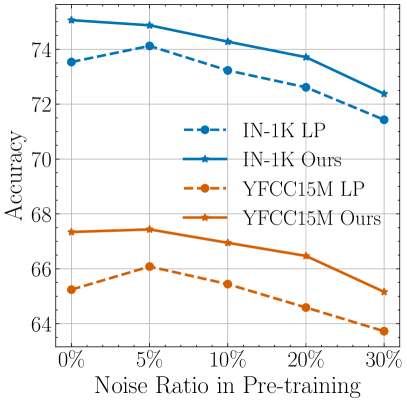
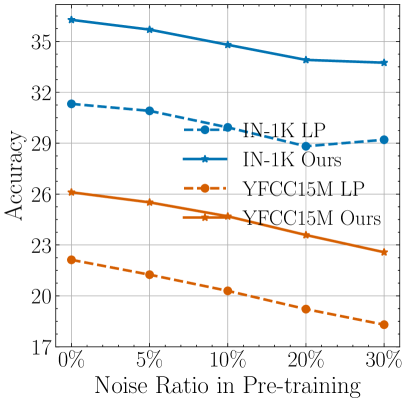
- NMTune improves generalization on both in-domain and out-of-domain tasks, outperforming standard fine-tuning (LP) in many cases, especially with clean pre-trained models.
- On CIFAR-10 and CIFAR-100 with 5% and 10% label noise, NMTune achieves 75.06% and 67.34% accuracy on ImageNet-1K pre-trained ResNet-50, respectively, surpassing LP in some settings.
- The ablation study confirms that ReLU non-linearity and the 2-layer MLP architecture are optimal, while removing regularization terms reduces performance.
- Runtime analysis shows NMTune adds minimal computation, with only 1.45 GPU hours on average across language out-of-domain tasks, compared to 1.34 for MLP tuning.
Better researchstarts right now
From reading papers to final review, dramatically reduce your research time.
No credit card · Free plan available
This review was created by AI and reviewed by human editors.