
[Paper Review] Understanding Blockchain Governance: Analyzing Decentralized Voting to Amend DeFi Smart Contracts
The paper analyzes on-chain governance in Compound and Uniswap, revealing concentrated voting power, high costs for small holders, and potential coalitions that risk decentralization.
Smart contracts are contractual agreements between participants of a blockchain, who cannot implicitly trust one another. They are software programs that run on top of a blockchain, and we may need to change them from time to time (e.g., to fix bugs or address new use cases). Governance protocols define the means for amending or changing these smart contracts without any centralized authority. They distribute the decision-making power to every user of the smart contract: Users vote on accepting or rejecting every change. In this work, we review and characterize decentralized governance in practice, using Compound and Uniswap -- two widely used governance protocols -- as a case study. We reveal a high concentration of voting power in both Compound and Uniswap: 10 voters hold together 57.86% and 44.72% of the voting power, respectively. Although proposals to change or amend the protocol receive, on average, a substantial number of votes (i.e., 89.39%) in favor within the Compound protocol, they require fewer than three voters to obtain 50% or more votes. We show that voting on Compound proposals can be unfairly expensive for small token holders, and we discover voting coalitions that can further marginalize these users.
Motivation & Objective
- Assess how governance protocols allocate voting power among token holders in DeFi protocols.
- Quantify participation, costs, and delegation patterns in on-chain governance.
- Identify how token distribution and coalitions affect decentralization and governance fairness.
Proposed method
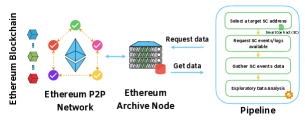
- Collect and analyze on-chain governance data from Compound and Uniswap (votes, proposals, delegations, token distributions).
- Map wallet ownership via Etherscan and Sybil-List to group addresses by entity.
- Measure voting participation, quorum attainment, and execution timelines for proposals.
- Compute voting costs in USD using block-era ETH-USD rates and analyze cost per vote unit.
- Characterize token delegation dynamics and concentration among top holders and delegates.
- Compare on-chain and off-chain voting modalities and their implications for governance execution.
Experimental results
Research questions
- RQ1What is the extent of decentralization in Compound and Uniswap governance in terms of token distribution and delegated voting power?
- RQ2How do voting costs, participation, and proposal dynamics influence governance outcomes and fairness?
- RQ3 Do top voters form coalitions that marginalize smaller token holders, and how might this affect protocol security and decentralization?
Key findings
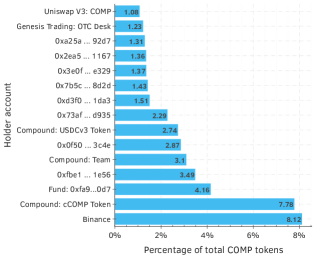
- A small group of 10 voters holds 57.86% of all Compound voting power and 44.72% of Uniswap voting power.
- Proposals in Compound receive an average of 89.39% in favor, yet fewer than three voters are often sufficient to reach 50% of votes.
- Voting costs vary widely from 0.03 to 294.02 USD per proposal, with an average of 7.88 USD per proposal and 358.54 USD per vote unit on a per-voter basis.
- Only about half of circulating tokens are delegated; top delegated-token holders account for the majority of delegated power (e.g., top 50 hold 99.23% of delegated COMP).
- Top voters and delegates are highly concentrated; the top 50 delegates hold the vast majority of delegated tokens (e.g., 94.73% in Uniswap).
- There is evidence of potential voting coalitions among top voters which can exacerbate centralization and marginalize smaller holders.
Read this paper
Open the full text in the Nubint reader and ask about any passage as you read.
Read this paper on NubintThis review was generated by AI from the original paper. Please check the paper before citing it.