
[Paper Review] Understanding Self-Attention of Self-Supervised Audio Transformers
This paper analyzes self-attention mechanisms in self-supervised audio Transformers (SATs) by categorizing attention heads into global, vertical, and diagonal types, revealing that diagonal attention is most important for phoneme classification. Through visualization, importance ranking via globalness (entropy-based), and pruning strategies, the authors show that removing global or long-range attention heads improves performance and inference speed without loss in accuracy, especially in utterance-level speaker recognition.
Self-supervised Audio Transformers (SAT) enable great success in many downstream speech applications like ASR, but how they work has not been widely explored yet. In this work, we present multiple strategies for the analysis of attention mechanisms in SAT. We categorize attentions into explainable categories, where we discover each category possesses its own unique functionality. We provide a visualization tool for understanding multi-head self-attention, importance ranking strategies for identifying critical attention, and attention refinement techniques to improve model performance.
Motivation & Objective
- To understand the functional roles of self-attention heads in self-supervised audio Transformers (SATs), which remain underexplored despite their success in ASR and other tasks.
- To develop interpretability tools for multi-head self-attention in SATs, including visualization, categorization, and importance ranking.
- To investigate whether global and long-range attention heads are beneficial or harmful for phonetic and speaker representation learning.
- To refine SAT representations by removing or constraining less important attention heads, improving inference speed and model efficiency.
- To establish a principled method for attention head pruning that outperforms standard weight-based ranking.
Proposed method
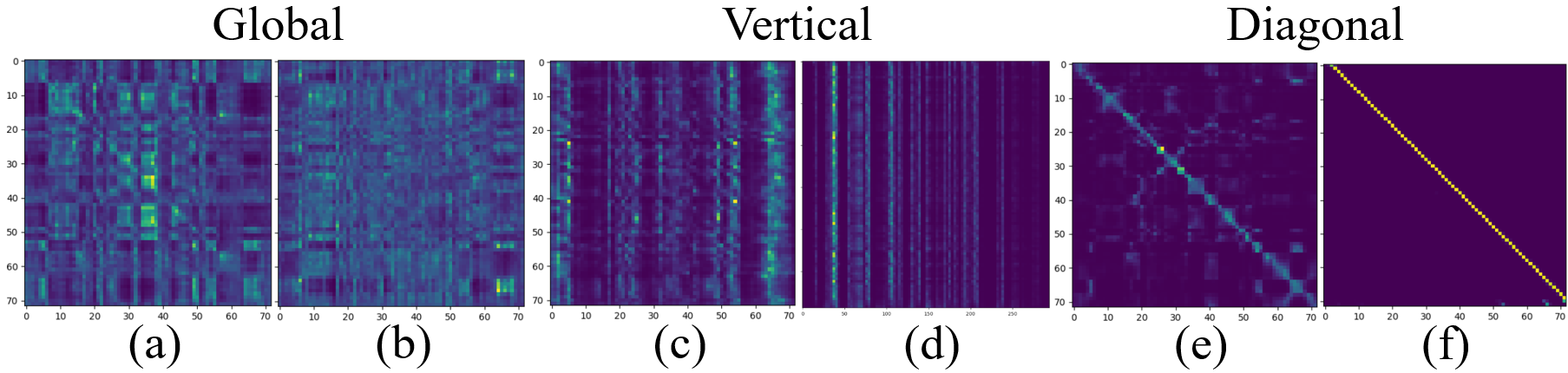
- Categorize self-attention heads into three functional types: global (flat distributions), vertical (concentrated on specific phonemes), and diagonal (focused on ±t neighbors or phoneme boundaries).
- Develop a visualization tool to analyze attention maps and identify implicit operations, such as neglect or correlation with phoneme boundaries.
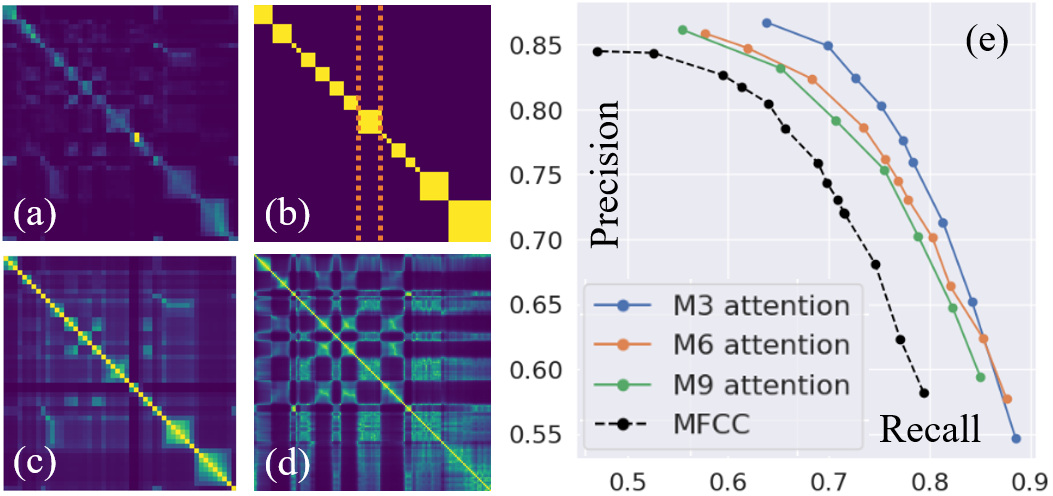
- Propose a globalness metric based on entropy of attention distributions to rank head importance, outperforming simple attention weight ranking.
- Apply two pruning strategies: head pruning based on globalness and span-based pruning by limiting attention to a fixed range r.
- Train and evaluate three SAT models (M3, M6, M9) on LibriSpeech with varying consecutive masking lengths (C_num = 3, 6, 9) to assess robustness across settings.
- Use phoneme relation maps (PRMs) to analyze head behavior and validate that heads with 'neglect' operations are more critical than those with high attention weights alone.
Experimental results
Research questions
- RQ1What functional roles do different types of self-attention heads play in self-supervised audio Transformers?
- RQ2How can we interpret and visualize the implicit operations of attention mechanisms in SATs?
- RQ3Which attention heads are most important for downstream tasks like phoneme classification and speaker recognition?
- RQ4Does removing global or long-range attention heads improve model performance and inference speed?
- RQ5Can attention refinement through pruning enhance representation quality while reducing computational cost?
Key findings
- Diagonal attention heads are the most important for phoneme classification, with pruning the first 24 diagonal heads causing the largest performance drop.
- Vertical and global attention heads are harmful to phonetic structure, as pruning them improves phoneme classification accuracy.
- Globalness-based importance ranking outperforms attention weight-based ranking, as it better identifies heads with meaningful operations like neglect.
- Pruning global heads leads to performance gains in phoneme classification and faster inference, especially when using utterance-level speaker recognition.
- Span-based pruning shows that long-range attention is not essential for phonetic representation, and constraining attention span improves efficiency without significant accuracy loss.
- The authors achieve over 50% head pruning with no performance degradation across all tasks, demonstrating significant efficiency gains.
Read this paper
Open the full text in the Nubint reader and ask about any passage as you read.
Read this paper on NubintThis review was generated by AI from the original paper. Please check the paper before citing it.