
[Paper Review] Understanding the Effectiveness of Very Large Language Models on Dialog Evaluation
This paper investigates the effectiveness of very large language models (LLMs) in few-shot and zero-shot dialog evaluation, demonstrating that instruction-tuned and dialog-specific fine-tuned LLMs outperform general-purpose models. Key findings show that example selection strategy and model pre-training data diversity significantly impact performance, with InstructGPT achieving the best results across multiple dialog evaluation metrics.
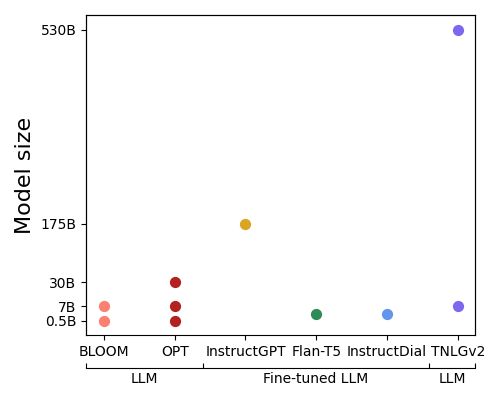
Language models have steadily increased in size over the past few years. They achieve a high level of performance on various natural language processing (NLP) tasks such as question answering and summarization. Large language models (LLMs) have been used for generation and can now output human-like text. Due to this, there are other downstream tasks in the realm of dialog that can now harness the LLMs' language understanding capabilities. Dialog evaluation is one task that this paper will explore. It concentrates on prompting with LLMs: BLOOM, OPT, GPT-3, Flan-T5, InstructDial and TNLGv2. The paper shows that the choice of datasets used for training a model contributes to how well it performs on a task as well as on how the prompt should be structured. Specifically, the more diverse and relevant the group of datasets that a model is trained on, the better dialog evaluation performs. This paper also investigates how the number of examples in the prompt and the type of example selection used affect the model's performance.
Motivation & Objective
- To evaluate the performance of very large language models (LLMs) in few-shot and zero-shot settings for fine-grained dialog evaluation.
- To investigate how model architecture, size, and pre-training data influence LLM performance on dialog evaluation tasks.
- To analyze the impact of in-context example selection strategies (e.g., random, BM25, similarity-based) on evaluation accuracy.
- To assess the generalization capability of LLMs across diverse dialog datasets and metrics such as fluency, coherence, consistency, and relevance.
- To identify optimal prompting strategies and model characteristics for robust automatic dialog evaluation.
Proposed method
- Evaluated six LLMs: BLOOM, OPT, GPT-3, Flan-T5, InstructDial, and TNLGv2 across multiple dialog evaluation benchmarks.
- Applied zero-shot and few-shot prompting with 4 in-context examples, using context-only or context-and-response examples.
- Employed example selection strategies including random sampling, BM25 retrieval, and similarity-based selection based on context or response.
- Used human-annotated datasets for turn-level (relevance, fluency) and dialog-level (consistency, coherence) evaluation metrics.
- Compared model performance across datasets using correlation with human judgments (e.g., Pearson correlation, F1 scores).
- Analyzed the effect of model size and pre-training data diversity on zero-shot and few-shot generalization across domains.
Experimental results
Research questions
- RQ1How do different LLM architectures and sizes perform in zero-shot and few-shot dialog evaluation across diverse datasets?
- RQ2What is the impact of in-context example selection strategy (random, BM25, similarity-based) on LLM performance in dialog evaluation?
- RQ3How does the diversity and relevance of pre-training data affect LLM generalization in dialog evaluation tasks?
- RQ4Which prompting strategy (e.g., context-only vs. context-and-response examples) yields the highest correlation with human judgments?
- RQ5To what extent do instruction-tuned or dialog-specific fine-tuned models outperform general-purpose LLMs in dialog evaluation?
Key findings
- InstructGPT (text-davinci-002) achieved the highest performance across all datasets and metrics, outperforming both general-purpose and smaller models.
- Flan-T5 and InstructDial showed strong zero-shot performance, outperforming baselines on 6 and 5 of 8 datasets respectively, indicating efficacy of instruction tuning.
- Example selection based on context and response improved performance on the EG dataset, while random selection outperformed algorithmic selection on DGR and EG for the 530B TNLGv2 model.
- Models trained on diverse, dialog-relevant corpora (e.g., TNLGv2, InstructDial) showed better generalization across domains than those trained on broad internet data alone.
- The 530B TNLGv2 model achieved strong performance, especially in few-shot settings, demonstrating that larger model size contributes to improved evaluation capability.
- Smaller, instruction-tuned models like Flan-T5 and InstructDial often outperformed larger, non-fine-tuned models (e.g., BLOOM, OPT), highlighting the importance of task-specific adaptation.
Read this paper
Open the full text in the Nubint reader and ask about any passage as you read.
Read this paper on NubintThis review was generated by AI from the original paper. Please check the paper before citing it.