
[Paper Review] Understanding the Uncertainty Loop of Human-Robot Interaction
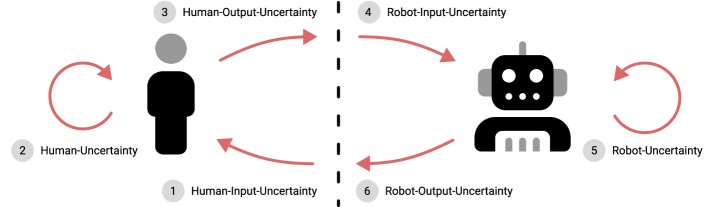
This paper introduces the Human-Robot Uncertainty Loop, a six-phase framework analyzing uncertainty in human-robot interaction (HRI), emphasizing how robots and humans express and interpret uncertainty through verbal and non-verbal cues. It proposes that robots should transparently communicate their own uncertainty and interpret human uncertainty using human-like or artificial cues, improving interaction transparency and trust.
Recently the field of Human-Robot Interaction gained popularity, due to the wide range of possibilities of how robots can support humans during daily tasks. One form of supportive robots are socially assistive robots which are specifically built for communicating with humans, e.g., as service robots or personal companions. As they understand humans through artificial intelligence, these robots will at some point make wrong assumptions about the humans' current state and give an unexpected response. In human-human conversations, unexpected responses happen frequently. However, it is currently unclear how such robots should act if they understand that the human did not expect their response, or even showing the uncertainty of their response in the first place. For this, we explore the different forms of potential uncertainties during human-robot conversations and how humanoids can, through verbal and non-verbal cues, communicate these uncertainties.
Motivation & Objective
- To understand how uncertainty arises and propagates in human-robot interactions, especially in socially assistive robots (SARs).
- To identify the different forms of uncertainty—human-intrinsic, human-expressed, robot-inferred, and robot-expressed—during HRI.
- To investigate how robots can communicate their own uncertainty and interpret human uncertainty using verbal and non-verbal cues.
- To evaluate whether human-like or artificial cues are more effective and less uncanny in conveying uncertainty.
- To improve interaction transparency and user trust by modeling uncertainty as a dynamic, bidirectional loop between humans and robots.
Proposed method
- Proposes a six-stage Human-Robot Uncertainty Loop: Human-Input-Uncertainty, Human-Uncertainty, Human-Output-Uncertainty, Robot-Input-Uncertainty, Robot-Output-Uncertainty, and Robot-Decision-Uncertainty.
- Analyzes how humans express uncertainty using prosodic cues (e.g., filler words), facial expressions (frowning, hesitation), and gestures (shrugging, palm-up).
- Examines robot perception of human uncertainty using AI techniques such as facial action unit detection and EEG analysis during decision-making.
- Explores robot expression of uncertainty through voice modulation (tone, pitch), movement speed (e.g., Hough and Schlangen, 2017), and artificial gestures or light cues.
- Compares human-like cues (e.g., facial expressions, natural speech) with artificial cues (e.g., light patterns, stylized gestures) for clarity and uncanniness.
- Uses existing literature and case studies (e.g., Google Duplex, AR-based action indication) to ground the framework in real-world applications.
Experimental results
Research questions
- RQ1How do humans perceive and interpret uncertainty cues expressed by robots in HRI?
- RQ2What types of verbal and non-verbal cues are most effective for robots to communicate their own uncertainty?
- RQ3To what extent do human-like cues improve understanding versus triggering the uncanny valley effect?
- RQ4How can robots detect and respond to human uncertainty in real time during interaction?
- RQ5What are the trade-offs between using human-like versus artificial cues for uncertainty communication in non-humanoid robots?
Key findings
- Robots that transparently communicate their uncertainty through verbal and non-verbal cues improve user trust and interaction fluency.
- Non-verbal cues such as hesitation, frowning, or slow movement are more effective than verbal cues in conveying uncertainty, especially in real-time interaction.
- Humanoid robots using human-like expressions and prosody are more readily understood, but risk triggering the uncanny valley if overdone.
- Artificial cues—such as light patterns or stylized gestures—can effectively communicate uncertainty even in non-humanoid robots, especially when paired with clear affordances.
- Users can reliably infer robot confidence levels from movement speed and voice pitch, as demonstrated by Hough and Schlangen (2017).
- There is a trade-off between naturalness and acceptability: cues that mimic human behavior are more intuitive but may be perceived as uncanny if too realistic.
Read this paper
Open the full text in the Nubint reader and ask about any passage as you read.
Read this paper on NubintThis review was generated by AI from the original paper. Please check the paper before citing it.