
[Paper Review] Uni-Perceiver: Pre-training Unified Architecture for Generic Perception for Zero-shot and Few-shot Tasks
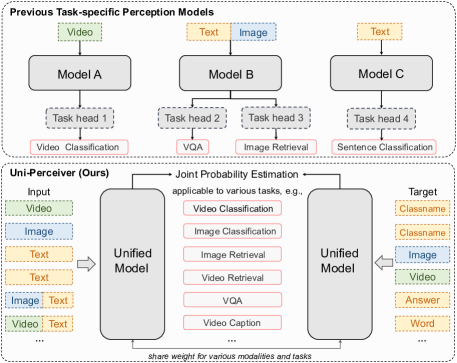
Uni-Perceiver proposes a unified, parameter-shared architecture that processes diverse modalities and perception tasks through a single siamese Transformer encoder, modeling all tasks as similarity-based retrieval in a shared representation space. Pre-trained on multi-modal and uni-modal tasks, it achieves zero-shot performance on unseen tasks and reaches SOTA-level results with only 1% fine-tuning data via prompt tuning.
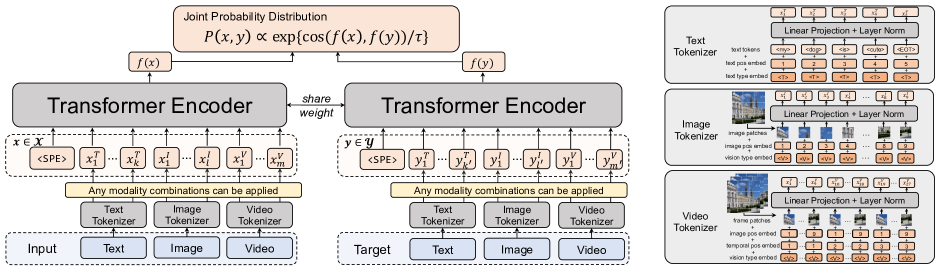
Biological intelligence systems of animals perceive the world by integrating information in different modalities and processing simultaneously for various tasks. In contrast, current machine learning research follows a task-specific paradigm, leading to inefficient collaboration between tasks and high marginal costs of developing perception models for new tasks. In this paper, we present a generic perception architecture named Uni-Perceiver, which processes a variety of modalities and tasks with unified modeling and shared parameters. Specifically, Uni-Perceiver encodes different task inputs and targets from arbitrary modalities into a unified representation space with a modality-agnostic Transformer encoder and lightweight modality-specific tokenizers. Different perception tasks are modeled as the same formulation, that is, finding the maximum likelihood target for each input through the similarity of their representations. The model is pre-trained on several uni-modal and multi-modal tasks, and evaluated on a variety of downstream tasks, including novel tasks that did not appear in the pre-training stage. Results show that our pre-trained model without any tuning can achieve reasonable performance even on novel tasks. The performance can be improved to a level close to state-of-the-art methods by conducting prompt tuning on 1% of downstream task data. Full-data fine-tuning further delivers results on par with or better than state-of-the-art results. Code shall be released.
Motivation & Objective
- Address the inefficiency and high marginal cost of task-specific perception models in machine learning.
- Enable generic perception by unifying diverse modalities and tasks under a single architecture with shared parameters.
- Facilitate zero-shot inference on novel tasks not seen during pre-training.
- Reduce downstream fine-tuning cost by enabling effective prompt tuning with minimal labeled data.
- Improve knowledge transfer by aligning pre-training and inference formulations across tasks.
Proposed method
- Encode inputs and targets from arbitrary modalities (e.g., image, text, video) into unified token sequences using lightweight, modality-specific tokenizers.
- Process all token sequences through a modality-agnostic Transformer encoder to produce shared representations in a unified space.
- Model all perception tasks as a similarity-based retrieval: find the target with maximum similarity to the input representation.
- Pre-train the model on a combination of uni-modal (e.g., image classification, language modeling) and multi-modal (e.g., image-text retrieval) tasks.
- Enable zero-shot inference by directly computing similarity between input and candidate targets without any fine-tuning.
- Apply prompt tuning with only 1% of downstream data to achieve performance close to SOTA, and full fine-tuning for state-of-the-art results.
Experimental results
Research questions
- RQ1Can a unified architecture with shared parameters achieve zero-shot generalization across diverse perception tasks and modalities?
- RQ2How effective is similarity-based representation matching as a unified formulation for diverse perception tasks?
- RQ3To what extent can prompt tuning with minimal data improve zero-shot performance on unseen tasks?
- RQ4Can a single pre-trained model outperform task-specific models with minimal adaptation on downstream tasks?
- RQ5How does the performance of the unified model compare to SOTA methods across multiple benchmarks and modalities?
Key findings
- The pre-trained Uni-Perceiver achieves reasonable zero-shot performance on novel tasks such as video captioning, video-text retrieval, and visual question answering, even though these tasks were not included in pre-training.
- Prompt tuning with only 1% of downstream data improves performance to within close range of SOTA results on tasks like VQA and GLUE.
- Full fine-tuning with 100% downstream data achieves results on par with or better than SOTA methods on benchmarks such as GLUE and VQA.
- On the GLUE benchmark, the model achieves 81.7% accuracy in zero-shot evaluation, comparable to the 84.6% of BERT BASE with fine-tuning.
- The model demonstrates strong few-shot generalization, with prompt tuning on 1% of data yielding 60.1% accuracy on MNLI and 70.2% F1 on QNLI, approaching SOTA.
- Despite having the same number of parameters as BERT BASE, the model performs slightly worse on full fine-tuning, likely due to its broader multi-task and multi-modal pre-training capacity constraints.
Read this paper
Open the full text in the Nubint reader and ask about any passage as you read.
Read this paper on NubintThis review was generated by AI from the original paper. Please check the paper before citing it.